Why Domenico Gargiulo matters
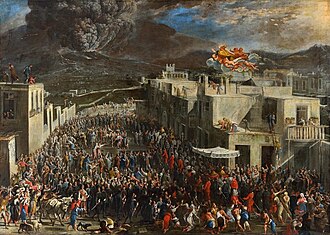
Domenico Gargiulo, known by the nickname Micco Spadaro, is one of the principal visual chroniclers of seventeenth century Naples. His paintings of the 1647 Masaniello revolt, the 1656 plague, and the 1631 eruption of Vesuvius are cited by historians as much for their documentary value as for their artistry, and his fresco cycle at the Certosa di San Martino remains in situ in one of the city's most visited monuments. For collectors, he represents a category common among Old Masters: strong museum and scholarly standing paired with a thin, infrequent auction market.
- Nationality
- Italian
- Media
- Painting, Fresco, Drawing
- Movement
- Italian Baroque, Neapolitan School
- Education
- Trained in the workshop of Aniello Falcone, Naples, from about 1628; also studied figure drawing with Antonio Vaccaro. No formal academy enrollment or degree is documented.
- Signature motifs
- "Panoramic views of Naples", "Contemporary Neapolitan history painting (the 1631 Vesuvius eruption, the 1647 Masaniello revolt, the 1656 plague)"
By the numbers
- Not reliably confirmableAuction recordPublic sources show scattered results without a verified realized-price ranking; see Market section.
- Naples, c. 1628 to 1675ActiveNeapolitan Baroque school
- Workshop of Aniello FalconeTrainingFrom about 1628, alongside Salvator Rosa and Andrea di Leone
- 9 institutionsMuseum collectionsIncluding the Prado, the Met, the Louvre, and the Hermitage
Biography
Domenico Gargiulo was born in Naples around 1609 to 1610, the son of a sword maker, or spadaio, which gave rise to his lifelong nickname Micco Spadaro. From about 1628 he trained in the workshop of the Neapolitan painter Aniello Falcone, alongside fellow students Salvator Rosa and Andrea di Leone, and he is also recorded as having studied figure drawing with Antonio Vaccaro.
Gargiulo built his career painting landscapes, genre scenes, and history paintings for Neapolitan patrons and religious institutions. Between about 1640 and 1642 he executed a fresco cycle at the Certosa di San Martino in Naples, including the View of the Lay Brothers' Choir and Moses and Aaron Collecting Alms for the Building of the Temple, work that remains part of the site today. He is best remembered for a series of paintings that recorded contemporary Neapolitan events as they happened or shortly after: the 1631 eruption of Vesuvius, the 1647 popular revolt led by Masaniello, and the plague that devastated the city in 1656. These works stand among the only surviving visual records of the events they depict.
He died in Naples, according to the converging estimate of art historical and museum sources, around 1675. No archival record with an exact day or month of death has surfaced in modern scholarship, and museums including the Metropolitan Museum of Art note his death year with a qualifying question mark.
Critical reception
Scholarship on Gargiulo tends to treat him less as a stylistic innovator than as an indispensable eyewitness painter of Baroque Naples, an artist whose value lies at the intersection of documentary content and painterly skill. His 2002 monographic exhibition at the Museo Nazionale di San Martino, Micco Spadaro, Napoli ai tempi di Masaniello, framed him explicitly around his depictions of the Masaniello uprising. No verbatim critical assessment from a named critic in a major outlet could be confirmed for this profile, so none is quoted here.
Market
Gargiulo's works appear infrequently at auction and are handled through Old Master specialists rather than any gallery representing a living artist or a formal estate. Sotheby's, Christie's, Dorotheum, and the Naples house Blindarte have all sold or offered paintings attributed to him, including a 2026 Sotheby's London day sale of The Triumph of Love with an estimate of GBP 20,000 to 30,000. A verified, all-time highest realized auction price could not be confirmed from public sources as of this writing, and any single cited record figure should be checked against a primary auction house archive before being treated as definitive.
Selected exhibitions
| Years | Exhibition | Venues |
|---|---|---|
| 2002 | Micco Spadaro. Napoli ai tempi di Masaniello | Museo Nazionale di San Martino, Naples |
Museum collections
- Museo del Prado, Madrid
- Art Institute of Chicago
- Kunsthistorisches Museum, Vienna
- Musee du Louvre, Departement des Arts Graphiques, Paris
- Metropolitan Museum of Art, New York
- Statens Museum for Kunst, Copenhagen
- The Walters Art Museum, Baltimore
- State Hermitage Museum, St. Petersburg
- Museo Nazionale di San Martino, Naples
Authentication and provenance
No catalogue raisonne.
No catalogue raisonne of Gargiulo's work has been published. Attribution relies on archival documents, comparison to signed and dated paintings such as the 1636 tondo The Fortune Teller, and the fresco cycle he executed at the Certosa di San Martino in Naples, assessed case by case by Old Master specialists and museum curators.
Primary reference: https://en.wikipedia.org/wiki/Domenico_Gargiulo
What collectors should know
There is no catalogue raisonne for Gargiulo, and attribution rests on archival documentation and comparison to signed, dated, or documented works such as the 1636 tondo The Fortune Teller and the San Martino frescoes. The auction market is thin and no single verified all-time record price could be confirmed from public sources, so any given work's price should be read on its own terms rather than as part of a broader trend line. Museum presence, by contrast, is deep and geographically wide, spanning the Prado, the Met, the Louvre, and the Hermitage among many others, which is the strongest available signal of his standing.
Further reading and resources
Data current as of 2026-07-13.

