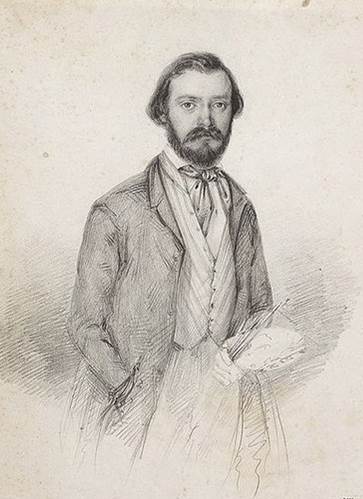
Why Domenico Induno matters
Domenico Induno was one of the leading Milanese painters of the Risorgimento generation, admired in his own time for genre scenes and historical subjects that gave Italy's unification-era social life a sympathetic, closely observed pictorial language. He earned an imperial commission in his twenties, a gold medal at the 1873 Vienna Universal Exhibition, and the Legion of Honour at the 1878 Paris Exposition Universelle, and his paintings now sit in the permanent collections of major Italian museums, from the Pinacoteca di Brera to the Galleria Nazionale d'Arte Moderna in Rome. For collectors of nineteenth-century European painting, he represents a historically significant, museum-validated name whose market runs almost entirely through the secondary market rather than through any living estate or gallery structure.
- Born
- 1815-05-14, Milan, Kingdom of Lombardy-Venetia (present-day Italy)
- Nationality
- Italian
- Media
- Painting
- Movement
- Italian Romanticism, Risorgimento genre painting
- Education
- Apprenticed to goldsmith and medalist Luigi Cossa, Milan, before 1831; Accademia di Belle Arti di Brera, Milan, from 1831, studying under Pompeo Marchesi, Luigi Sabatelli, and Francesco Hayez
- Signature motifs
- Domestic genre interiors, Risorgimento-era historical subjects
By the numbers
- 1831 to 1878Active periodBrera Academy training to his death
- 1845Grand Painting Prize, Brera AcademyFor a historical Deluge subject; preceded by an 1840 imperial commission from Emperor Ferdinand I of Austria
- Vienna Universal Exhibition, 1873Gold medalFor Un dramma domestico (A Domestic Drama)
- 1878Legion of HonourExposition Universelle, Paris
Selected works
Click any work to view it full screen.
Biography
Domenico Induno was born in Milan on 14 May 1815. As a young man he was apprenticed to the goldsmith and medalist Luigi Cossa, who recognized his talent for drawing and, in 1831, persuaded him to enroll at the Accademia di Belle Arti di Brera. There he studied first with the sculptor Pompeo Marchesi, then with the painter and professor Luigi Sabatelli, and finally with Francesco Hayez, whose influence on his mature style was the most lasting of the three.
An early history painting, Il profeta Samuele unge re Saul, was purchased for Emperor Ferdinand I of Austria and entered the Imperial Picture Gallery in Vienna in 1840. A later canvas on the subject of the Deluge won him the Academy's grand painting prize in 1845. After further study and travel, Induno returned to Milan by the end of 1849 and resumed exhibiting at Brera. In 1854 he was named a Socio d'Arte of the Academy, and in 1860 he became an Accademico. Over the following decades he moved increasingly toward genre painting, using scenes of domestic and working-class life, such as Pane e lagrime (Bread and Tears), shown at the 1855 Paris Exposition Universelle, to address themes of poverty, family, and labor alongside his historical and Risorgimento subjects. A version of Bollettino di Villafranca, commissioned by King Victor Emmanuel II, earned him the title of Knight of the Orders of Saints Maurice and Lazarus.
Induno's later career brought international recognition: his painting Un dramma domestico (A Domestic Drama) won a gold medal at the 1873 Vienna Universal Exhibition, and a further version of the same composition was shown at the 1878 Paris Exposition Universelle, where he was awarded the Legion of Honour. He died in Milan on 5 November 1878 and was buried in the Monumental Cemetery of Milan. He is sometimes confused in market listings with the painter Gerolamo Induno, a different artist of the same surname whose auction results are occasionally attributed to him in error.
Critical reception
Italian biographical and encyclopedic sources, including the Dizionario Biografico degli Italiani, treat Induno as a significant figure in the transition from academic history painting toward a more intimate, socially observant genre painting in Risorgimento-era Lombardy. His progression from prize-winning student to imperial commission recipient to internationally decorated painter, culminating in the Vienna gold medal and the French Legion of Honour, is consistently presented as evidence of sustained institutional and state recognition across his career. No verbatim critical assessment from a named critic in a major contemporary outlet could be confirmed for reproduction here.
Market
Domenico Induno's market runs through auction houses and dealers specializing in nineteenth-century Italian painting rather than through any contemporary gallery or estate, since no such representation exists for an artist who died in 1878. Auction-market databases show ongoing sale activity for his work over time, though a precise, verifiable count of appearances could not be confirmed from available sources, indicating a modest but active secondary-market presence. Available sources do not support a verified, sourced figure for his single highest auction price to date; a price sometimes associated with the surname belongs instead to the separate artist Gerolamo Induno, and that figure should not be attributed to Domenico Induno.
Selected exhibitions
| Years | Exhibition | Venues |
|---|---|---|
| 1831 to 1836 | Student prize exhibitions | Accademia di Belle Arti di Brera, Milan |
| 1840 | Profeta Samuele unge re Saul (imperial commission, entered the Imperial Picture Gallery) | Kaiserliche Gemaldegalerie, Vienna |
| 1845 | Historical Deluge subject, Grand Painting Prize of the Academy | Accademia di Belle Arti di Brera, Milan |
| 1855 | Exposition Universelle (Pane e lagrime and four other paintings representing Italy) | Paris |
| 1872 | Esposizione Nazionale di Milano | Milan |
| 1873 | Esposizione Universale di Vienna (Matrimonio di convenienza / Un dramma domestico, gold medal) | Vienna |
| 1878 | Exposition Universelle (further version of Un dramma domestico, Legion of Honour awarded) | Paris |
Museum collections
- Pinacoteca di Brera, Milan
- Galleria d'Arte Moderna, Milan
- Museo del Risorgimento, Milan
- Gallerie d'Italia, Piazza Scala, Milan
- Palazzo Pitti, Florence
- Galleria Nazionale d'Arte Moderna, Rome
- Galleria d'Arte Moderna Achille Forti, Verona
- Museo Nacional de Bellas Artes, Buenos Aires
Awards and honors
- Painting purchased by Emperor Ferdinand I of Austria for the Imperial Picture Gallery, Vienna (Il profeta Samuele unge re Saul) (1840)
- Grand Painting Prize, Accademia di Belle Arti di Brera (1845)
- Socio d'Arte, Accademia di Belle Arti di Brera (1854)
- Accademico, Accademia di Belle Arti di Brera (1860)
- Gold medal, Esposizione Universale di Vienna (1873)
- Legion of Honour (Legion d'Honneur), France (1878)
Authentication and provenance
No catalogue raisonne.
No catalogue raisonne of Domenico Induno's work has been identified, and no certificate-of-authenticity program exists. Works attributed to him are generally assessed through provenance research, comparison with documented exhibition and academy records (Brera Academy prize lists, national and international exhibition catalogues), and connoisseurship in nineteenth-century Italian painting, supplemented by Italian state cultural-heritage catalogues that record known works.
Primary reference: https://www.treccani.it/enciclopedia/domenico-induno_(Dizionario-Biografico)/
What collectors should know
There is no catalogue raisonne for Domenico Induno and no current gallery or estate representation, so authentication rests on provenance, exhibition history, and expert connoisseurship in nineteenth-century Italian painting rather than any centralized program. Collectors should also take care with attribution and market research, since auction records for the similarly named painter Gerolamo Induno are sometimes conflated with Domenico Induno's own sales history. Given the limited, unverified public data on his highest recorded auction price, prospective buyers should treat any specific price claim with caution until it can be confirmed against a primary auction-house record.
Further reading and resources
Data current as of 2026-07-18.

