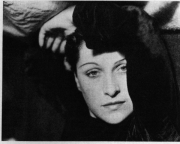
Why Dora Maar matters
Dora Maar was a Surrealist photographer and painter whose own body of work, for decades, was overshadowed by her decade-long relationship with Pablo Picasso and by his many portraits of her. She was the only photographer to document Picasso's creation of Guernica in 1937, and her own photomontages and street photography were central to Surrealist circles in 1930s Paris and London. Since a pair of landmark 2019 retrospectives at the Centre Pompidou and Tate Modern, museums and specialist galleries have worked to re-establish her as an artist in her own right rather than solely as a muse, a reassessment collectors should understand before approaching her market.
- Born
- 1907-11-22
- Nationality
- French
- Media
- Photography, Painting
- Movement
- Surrealism
- Education
- Union Centrale des Arts Decoratifs, Ecole de Photographie, Academie Julian, and the atelier of Andre Lhote, Paris, from 1926. No degree is documented.
- Signature motifs
- Surrealist photomontage, Portrait and street photography, Photograms
- Representation
- Amar Gallery, London (estate-linked exhibitions), Paul Stolper Gallery, London (estate-linked exhibitions)
By the numbers
- Centre Pompidou and Tate ModernPosthumous retrospective2019 to 2020, the first major museum retrospectives of her work as an artist
- Sole photographer on siteGuernica documentationThe only photographer known to have documented Picasso's creation of Guernica, 1937
- Amar Gallery; Paul Stolper Gallery (London)Represented byEstate-linked exhibitions; no single exclusive worldwide representative is confirmed in current sources
Biography
Dora Maar was born Henriette Theodora Markovitch on 22 November 1907. After a childhood partly spent in Buenos Aires, she returned to Paris in 1926 and studied art and photography at the Union Centrale des Arts Decoratifs, the Ecole de Photographie, the Academie Julian, and in the private atelier of the Cubist painter Andre Lhote. No formal degree from this period is documented; her training was professional and studio-based rather than academic.
By the early 1930s she had established a commercial and fine-art photography practice, working across fashion, advertising, and street photography, and adopting the name Dora Maar. She became associated with the Surrealist movement and exhibited in its major group shows, including the 1936 International Surrealist Exhibition in London. She began a relationship with Pablo Picasso around 1935 to 1936, and in 1937 she was the sole photographer permitted to document the creation of his mural Guernica, a sequence of images that remains one of the most important visual records of the painting's making. The relationship with Picasso ended in 1943, after which Maar increasingly turned toward painting and, later in life, a more private and reclusive existence in Paris.
Dora Maar died on 16 July 1997 in Paris, at the age of 89, and was buried in the Bois-Tardieu cemetery in Clamart. The Musee national d'Art moderne at the Centre Pompidou holds archival and studio material linked to her photographic work, though the exact acquisition date and holdings figures are not confirmed in current sourcing. That material, together with major retrospectives at the Centre Pompidou (5 June to 29 July 2019) and Tate Modern (2019 to 2020), drove a broad critical reassessment of her as a photographer, Surrealist, and painter in her own right.
Critical reception
Critical assessment of Dora Maar has long grappled with a basic imbalance identified by AWARE (Archives of Women Artists, Research and Exhibitions), which notes that she is "mostly remembered as Picasso's muse and lover," a framing that AWARE argues detracts from her "singular work as a prominent photographer of the surrealist movement." Smithsonian magazine, citing the Encyclopaedia Britannica, makes a related point, observing that most mentions of the artist reference her mainly in relation to Picasso and that her own career was overshadowed during her lifetime by the details of the affair. The 2019 retrospectives at the Centre Pompidou and Tate Modern were widely read as a corrective to that framing, prompting critics to weigh her photomontage, street photography, and painting on their own terms rather than as a footnote to Picasso's biography.
Market
There is no widely reported, fully documented all-time auction record for a work by Dora Maar herself in currently available sources. Public auction listings point to a comparatively modest market: Phillips has sold an untitled Maar work for GBP 10,795 against a GBP 3,000 to 5,000 estimate, suggesting her own prices generally sit in the low to mid five-figure range rather than higher. Collectors should be careful to distinguish this from the far larger prices paid for Picasso's portraits of Dora Maar, which are works by Picasso, not by her. The clearest recent example is "Buste de femme au chapeau a fleurs (Dora Maar)," a rediscovered 1943 Picasso painting that sold for EUR 32,012,397 (about USD 37 million) via the auction house Lucien, at Hotel Drouot in Paris, on 24 October 2025. That sale reflects demand for Picasso, using Maar as subject, and says nothing about the market for her own photographs or paintings.
Selected exhibitions
| Years | Exhibition | Venues |
|---|---|---|
| 1936 | International Surrealist Exhibition | New Burlington Galleries, London |
| 2019 | Dora Maar | Musee national d'Art moderne, Centre Pompidou, Paris (5 June to 29 July 2019) |
| 2019 to 2020 | Dora Maar | Tate Modern, London (2019 to 2020) |
| 2023 | Dora Maar | Paul Stolper Gallery, London |
| 2024 | Dora Maar: Behind the Lens | Amar Gallery, London |
| 2025 to 2026 | Dora Maar: Photography and Drawings | Museo Lazaro Galdiano, Madrid (Loewe Foundation, for PHotoESPANA) |
Museum collections
- Centre Pompidou (Musee national d'Art moderne), Paris
- Tate, London
- Museum of Modern Art, New York
- J. Paul Getty Museum, Los Angeles
Authentication and provenance
No catalogue raisonne.
No published catalogue raisonne is confirmed for Dora Maar. Museums and galleries, including the Centre Pompidou, hold archival and studio material linked to her photographic and painting practice, but exact acquisition dates and holdings figures are not confirmed in current sourcing. Verification instead relies on museum holdings and estate-linked gallery material rather than a single certifying body.
Primary reference: https://www.tate.org.uk/art/artists/dora-maar-15766/seven-things-know-dora-maar
What collectors should know
Dora Maar's public auction history is thin and, in currently available sources, does not support a confirmed all-time record price for a work by her own hand. Anyone assessing her market should first confirm whether a given lot is a work by Maar or a Picasso depiction of her, since the two trade in entirely different price tiers and are sometimes conflated in press coverage. There is no catalogue raisonne, so provenance research benefits from cross-checking the Centre Pompidou's studio archive holdings and the exhibition history built by estate-linked galleries such as Amar Gallery and Paul Stolper Gallery in London. Institutional momentum since the 2019 retrospectives at the Centre Pompidou and Tate Modern is the strongest evidence of her rising art-historical standing, even though that momentum has not yet translated into a large or well-documented auction record.
Further reading and resources
Data current as of 2026-07-10.

