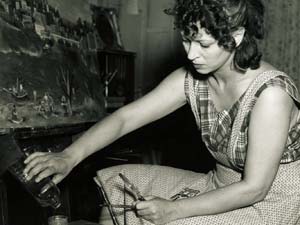
Why Doris Emrick Lee matters
Doris Emrick Lee was one of the most publicly visible American painters of the Depression era, an artist whose folk-inflected genre scenes of rural and small-town life won the Art Institute of Chicago's Logan Prize in 1935 and reached a wide audience through magazine illustration and popular prints. For collectors, she is a case study in a once-major reputation that has receded into a thin, low-volume auction market even as her work remains anchored in the permanent collections of leading American museums.
- Born
- 1905-02-01, Aledo, Illinois, USA
- Nationality
- American
- Media
- Painting, Printmaking, Illustration
- Movement
- American Scene painting, Genre painting
- Education
- Rockford College, BA 1927 (art and philosophy); study in Paris with Andre Lhote, c. 1927 to 1929; Kansas City Art Institute, 1929, under Ernest Lawson; California School of Fine Arts, 1930, under Arnold Blanch.
- Signature motifs
- Rural and small-town genre scenes, Folk-inflected humor
By the numbers
- USD 289,800Auction highButterfly Catchers, Christie's New York, April 17, 2025
- 1935Logan PrizeArt Institute of Chicago, for Thanksgiving
- 1932Whitney BiennialWhitney Museum of American Art
Biography
Doris Emrick Lee was born on February 1, 1905, in Aledo, Illinois. She attended the Ferry Hall School, a preparatory school for girls in Lake Forest, Illinois, from 1920 to 1922, and earned a BA from Rockford College in 1927, majoring in art and philosophy. She then studied painting in Europe, including a period in Paris with the Cubist painter Andre Lhote, before studying with the American Impressionist Ernest Lawson at the Kansas City Art Institute around 1929, and, in 1930, at the California School of Fine Arts in San Francisco under Arnold Blanch, who later became her second husband.
Lee's work was included in the Whitney Museum of American Art's Biennial in 1932. Her reputation was made in 1935, when her painting Thanksgiving, a genre scene set in a farm kitchen, won the Logan Medal at the Art Institute of Chicago. The same period brought a U.S. Treasury Department mural commission: she painted murals for the General Post Office building in Washington, D.C.
Lee worked as a magazine illustrator, reportedly including work for Life, and in 1947 co-authored the book It's Fun to Paint with her husband Arnold Blanch. She also taught at Michigan State University and at the Colorado Springs Fine Arts Center, and settled in Woodstock, New York, where she became a prominent figure in the town's artist colony. Some dealer and gallery sources credit her with a Carnegie Prize from the Carnegie Institute in 1944, though this claim does not appear in major museum or encyclopedic accounts of her career and should be treated with caution. She died on June 16, 1983, in Clearwater, Florida, at the age of 78.
Critical reception
Assessments of Lee's work consistently point to the same qualities: plain-spoken, folk-inflected subject matter and a sense of humor that some viewers have read as charming and others as slight. Her best-known painting, Thanksgiving, won the Art Institute of Chicago's Logan Prize in 1935 and made her one of the more visible American painters of her generation, even as the picture's homely, genre-scene style sat apart from the era's more modernist currents. Lee continued to move between fine art and commercial illustration for the rest of her career, a dual track that has shaped how later critics and museums have positioned her, as a significant figure in American Scene and genre painting rather than a modernist innovator.
Market
Lee's all-time auction high is Butterfly Catchers, which sold for USD 289,800 at Christie's New York on April 17, 2025, according to auction-market tracking; this is reported as her record price since 2000. That figure sits far above the results typical for her work on paper: lithographs such as Siesta have historically sold at auction for a few hundred dollars. The gap between her single strongest painting result and the routine range for her prints and smaller works is a defining feature of her market, and it means her auction record should be read as an outlier rather than a baseline.
Top auction results
| Work | Price | Sale |
|---|---|---|
| Butterfly Catchers (2025) | USD 289,800 | Christie's, New York, 2025-04-17 |
Selected exhibitions
| Years | Exhibition | Venues |
|---|---|---|
| 1932 | Whitney Biennial | Whitney Museum of American Art, New York |
| 1935 | Annual exhibition (Logan Prize for Thanksgiving) | Art Institute of Chicago |
Museum collections
- Art Institute of Chicago
- Metropolitan Museum of Art, New York
- Whitney Museum of American Art, New York
- The Phillips Collection, Washington, D.C.
- National Museum of Women in the Arts, Washington, D.C.
- RISD Museum, Providence
- Cleveland Museum of Art
Awards and honors
- Logan Medal (Mr. and Mrs. Frank G. Logan Purchase Prize), Art Institute of Chicago, for Thanksgiving (1935)
- U.S. Treasury Department mural commission, General Post Office, Washington, D.C. (two murals) (1935)
- Carnegie Prize, Carnegie Institute, reported in dealer and gallery sources; not confirmed in major museum or encyclopedic references (1944)
Authentication and provenance
No catalogue raisonne.
No published catalogue raisonne has been identified for the artist, and no exclusive gallery or estate representation is confirmed. Individual works are typically documented through museum accession records, exhibition history, and archival holdings such as the Doris Lee papers at the University of Minnesota and the artist finding aid at the National Museum of Women in the Arts.
Primary reference: https://nmwa.org/art/artists/doris-lee/
What collectors should know
There is no published catalogue raisonne for Lee, and no exclusive gallery or estate representation has been identified; her work appears on the secondary market through multiple dealers and auction houses rather than a single program. Verification of individual works depends on museum accession records, exhibition history, and archival holdings such as the Doris Lee papers at the University of Minnesota and the artist finding aid at the National Museum of Women in the Arts. Her market is thin and bifurcated: a handful of major paintings, headlined by the 2025 sale of Butterfly Catchers, sell for substantial sums, while the far more common lithographs and works on paper trade for a few hundred dollars. Museum presence is deep and durable, but the auction record for any given work should be weighed against that small, uneven sales history rather than treated as evidence of a broad, liquid market.
Further reading and resources
Data current as of 2026-07-13.

