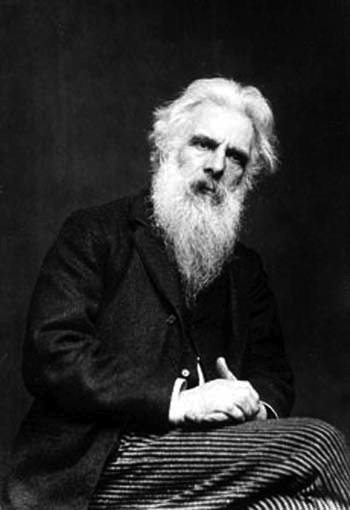
Why Eadweard Muybridge matters
Eadweard Muybridge stands at the hinge between still photography and cinema. His sequential motion studies, made first with Leland Stanford's horses in California and then in a formal research program at the University of Pennsylvania, produced the visual grammar that later motion-picture inventors built on, and his zoopraxiscope is widely treated by museums and photography historians as an ancestor of the film projector. For a collector, he is a historical figure rather than a living market: the record is anchored by institutional holdings and scholarship, auction supply is thin and dominated by archival material, and there is no gallery estate managing a contemporary program on his behalf.
- Born
- 1830-04-09, Kingston upon Thames, Surrey, England
- Nationality
- British
- Media
- Photography
- Movement
- Victorian photography, Motion studies
- Education
- Possible attendance at Queen Elizabeth's Free Grammar School, Kingston upon Thames, is asserted by some sources but disputed by biographer Gordon Hendricks; no confirmed schooling record survives. No university degree confirmed. Informal, non-degree study of photography in England, c. 1860 to 1867. Research collaboration (not enrolled study) at the University of Pennsylvania, 1883 to 1887.
- Signature motifs
- Zoopraxiscope motion studies, "Animal Locomotion" plates, Yosemite and Pacific Coast landscapes
- Representation
- Equinox Gallery, Robert Koch Gallery
By the numbers
- GBP 75,000 (approx. USD 91,987)Auction highAnimal Locomotion, complete or near-complete portfolio, Lyon & Turnbull, Edinburgh; reached twice, in January 2013 and January 2015, exact date unconfirmed
- Deceased, 1830 to 1904StatusDied Kingston upon Thames, England
- International Photography Hall of FameHall of fameInductee, year of induction unconfirmed
- Tate Britain, 2010 to 2011Major retrospectiveLarge-scale museum survey
Selected works
Click any work to view it full screen.
Biography
Eadweard Muybridge was born Edward James Muggeridge on 9 April 1830 in Kingston upon Thames, Surrey, England. He is sometimes said to have attended Queen Elizabeth's Free Grammar School in Kingston in his youth, but biographer Gordon Hendricks disputes this, noting a tradesman's son likely would not have qualified, and no confirmed schooling record survives; there is no record of a university degree. He emigrated to the United States around 1852, working first as a bookseller, and later adopted the name Eadweard Muybridge, which he believed to be the original Anglo-Saxon form of Edward. Under the pseudonym Helios, he built a reputation in San Francisco during the late 1860s and early 1870s for large-format landscape photographs, including views of Yosemite, work that earned him gold medals at the Eleventh Industrial Exhibition in San Francisco and at the 1873 Vienna International Exhibition.
In 1872, railroad magnate Leland Stanford commissioned Muybridge to settle a debate over whether a trotting horse ever has all four hooves off the ground at once. The resulting sequential photographs, refined through the late 1870s, proved that it does, and established Muybridge's method of banked, trip-wire-triggered cameras capturing successive instants of movement. In October 1874, Muybridge shot and killed Major Harry Larkyns, who was having an affair with his wife, Flora. He was tried for murder in Napa County and acquitted on the grounds of justifiable homicide, a verdict most historians attribute to jury sympathy rather than legal precedent; he resumed his photographic career afterward. Between 1883 and 1887, working with a faculty committee at the University of Pennsylvania, he produced Animal Locomotion, an eleven-volume publication of 781 collotype plates documenting the movement of humans and animals, and toured widely with his zoopraxiscope, an early device for projecting sequences of images in motion. He returned permanently to Kingston upon Thames around 1894. He died there on 8 May 1904, of prostate cancer, at the home of a cousin; he was cremated, and his ashes were buried at Woking Crematorium, Woking, Surrey.
Critical reception
Muybridge's standing rests on institutional consensus rather than a single defining review. He is an inductee of the International Photography Hall of Fame, and museums have treated his work as central to the history of both landscape photography and the moving image: the University of Pennsylvania Archives and the Philadelphia Museum of Art hold hundreds of his prints, negatives, and pieces of equipment; Stanford University Libraries preserve his photographs alongside a working zoopraxiscope; and the Smithsonian American Art Museum, Tate, and the Royal Academy of Arts all hold his work in their permanent collections. The most significant recent reassessment came with the 2010 to 2011 retrospective Eadweard Muybridge at Tate Britain, paired with a companion display at Kingston Museum in his hometown, and with Helios: Eadweard Muybridge in a Time of Change at SFMOMA the same year, both of which situated him simultaneously as a landscape and survey photographer, a documentary artist, and the pioneer of motion-study photography. No single, exact critical quotation from a named critic in a major outlet could be confirmed for this profile with sufficient certainty to reproduce verbatim.
Market
Muybridge's market is small, historical, and dominated by institutional-grade paper: complete or near-complete sets of Animal Locomotion, individual collotype plates, and, less often, glass-plate negatives or zoopraxiscope discs. The highest publicly documented price for his work is GBP 75,000 (about USD 91,987), reached twice for complete or near-complete portfolios of Animal Locomotion at Lyon & Turnbull in Edinburgh, once in January 2013 and once in January 2015; exact calendar dates for both sales are not published, and one of the two is reported against a GBP 40,000 estimate. That level stands well above the price seen for smaller lots: individual plates and small groups of plates have sold for prices ranging from roughly a few hundred dollars to just under ten thousand dollars at houses including Swann Auction Galleries and Heritage Auctions. There is no gallery estate or foundation managing his market; secondary-market dealing today runs through specialist photography dealers such as Equinox Gallery in Vancouver and Robert Koch Gallery in San Francisco, both of which currently list his work.
Top auction results
| Work | Price | Sale |
|---|---|---|
| Animal Locomotion (complete or near-complete portfolio); two sales reported at this price level | USD 91,987 (GBP 75,000) | Lyon & Turnbull, Edinburgh |
Selected exhibitions
| Years | Exhibition | Venues |
|---|---|---|
| 2010 to 2011 | Eadweard Muybridge | Tate Britain, London |
| 2010 | Helios: Eadweard Muybridge in a Time of Change | San Francisco Museum of Modern Art |
| 2010 to 2011 | Companion exhibition to the Tate Britain retrospective | Kingston Museum, Kingston upon Thames |
| undated | Exposed: Eadweard Muybridge and the Study of Motion | Heckscher Museum of Art, Huntington, New York |
| 1883 to 1887 | Motion-study and zoopraxiscope lecture-demonstrations | University of Pennsylvania, Philadelphia |
| c. 1871 to 1873 | Eleventh Industrial Exhibition (landscape photographs, gold medal) | San Francisco |
| 1873 | Vienna International Exhibition (gold medal) | Vienna |
| 2025 | Figures at the Fairmont Pacific Rim | Equinox Gallery presentation, Fairmont Pacific Rim, Vancouver |
Museum collections
- Kingston Museum, Kingston upon Thames
- University of Pennsylvania Archives, Philadelphia
- Philadelphia Museum of Art
- Stanford University Libraries and Cantor Center for Visual Arts
- Smithsonian American Art Museum, Washington, D.C.
- Tate, London
- Royal Academy of Arts, London
- San Francisco Museum of Modern Art
Awards and honors
- Gold Medal, Vienna International Exhibition (1873)
- Gold Medal, Eleventh Industrial Exhibition, San Francisco (exact year unconfirmed, early 1870s)
- International Photography Hall of Fame, Inductee (year of induction unconfirmed)
Authentication and provenance
No catalogue raisonne.
No catalogue raisonne has been published. Attribution and dating rely on the surviving glass-plate negatives held at the University of Pennsylvania Archives, the Kingston Museum and Kingston University collections database, and the original 1887 printings of Animal Locomotion.
Primary reference: https://www.eadweardmuybridge.co.uk/
What collectors should know
Muybridge is a historical rather than a market-active artist: there is no estate, no living representation, and no catalogue raisonne, so provenance and physical condition of individual prints, negatives, or portfolio sets carry unusual weight. Complete or near-complete Animal Locomotion portfolios are rare and have driven the highest prices on record, while individual plates and later reprints trade in a much lower and more accessible range, so the type and completeness of an offering matters more than the name alone. Because his most significant material sits in institutional archives such as the University of Pennsylvania and Kingston Museum, cross-checking a prospective acquisition against those holdings and against the Kingston collections database is a reasonable first step for authentication.
Further reading and resources
Data current as of 2026-07-18.

