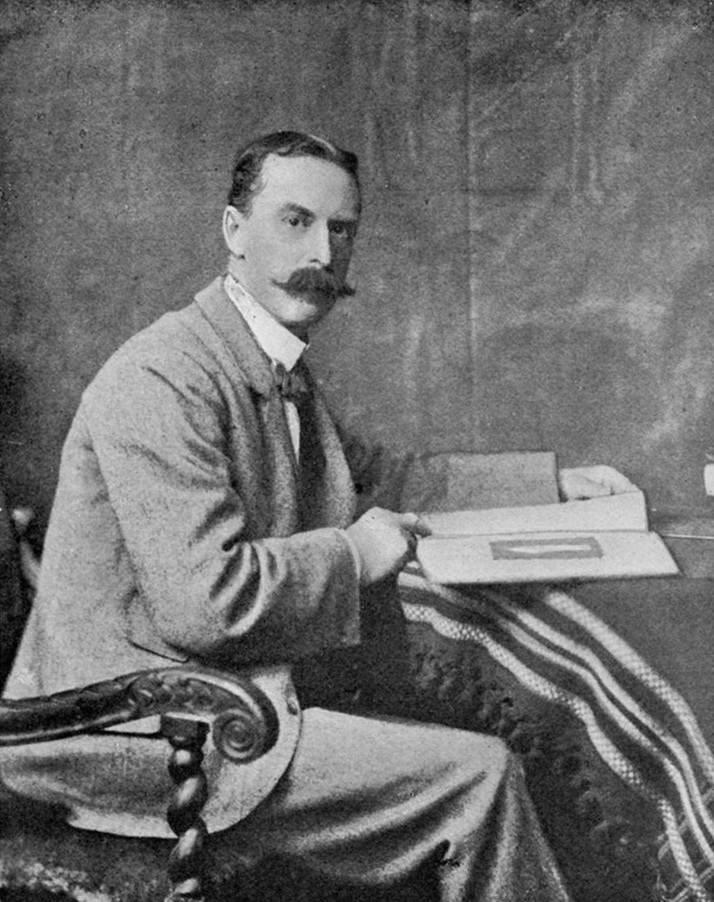
Why Edmund Blair Leighton matters
Edmund Blair Leighton was one of the most widely reproduced English painters of the late Victorian and Edwardian periods, known for meticulously detailed historical genre scenes set in an imagined medieval or Regency past. He was never elected a Royal Academician, yet he sent pictures to the Royal Academy's summer exhibition in most years for more than four decades, and images such as The Accolade and God Speed remain among the best known narrative paintings of the era, still circulating widely as reproductions today. For a collector, he represents a durable niche within Victorian narrative painting: strong public recognition and secure museum holdings, set against a thin and hard to verify auction record.
- Born
- 1852-09-21, London, England
- Nationality
- British
- Media
- Painting
- Movement
- Victorian era, Historical genre painting
- Education
- University College School, London. Evening classes, South Kensington School of Art. Heatherley School of Fine Art, London. Royal Academy Schools, London, entered 1874, five-year program.
- Signature motifs
- Medieval and Regency courtship scenes, Chivalric and Arthurian subjects
- Representation
- "No gallery or estate representation confirmed; works trade on the secondary market through major auction houses"
By the numbers
- approx. USD 1.1MAggregator-cited high (unverified)MutualArt lists a realized price up to this level for a painting, loosely associated with In Time of Peril, God Speed, or Call to Arms; the specific work, house, and sale date are not published
- 66 works, 1878 to 1920Royal Academy exhibitorNever elected a Royal Academician despite four decades of exhibiting
- No confirmed gallery or estateRepresented byWorks circulate through Christie's, Sotheby's, Bonhams, and regional houses
Selected works
Click any work to view it full screen.
Biography
Edmund Blair Leighton was born on 21 September 1852 in London, the second of three children of the genre and portrait painter Charles Blair Leighton and his wife Caroline, born Boosey. He was educated at University College School in London, leaving at fifteen to work for a tea merchant. Wanting to study art, he took evening classes at the South Kensington School of Art and then attended the Heatherley School of Fine Art on Newman Street before entering the five-year program at the Royal Academy Schools in 1874, at the age of twenty-one.
He won a ten pound premium for the best life drawing at the Royal Academy Schools in 1878 and narrowly lost the Gold Medal for Painting to Henry La Thangue in 1879. He went on to exhibit at the Royal Academy's summer exhibitions almost every year, contributing a total of sixty six pictures between 1878 and 1920, and he became a member of the Royal Institute of Oil Painters. His subject matter centered on medieval and Regency courtship and chivalry, in widely reproduced paintings such as God Speed and The Accolade, a genre in which he specialized so consistently that later commentators have described him as an artist whose enormous popular reach was never matched by full institutional recognition; he was never elected a Royal Academician or Associate.
In 1885 he married Katherine Nash; they had a son, E. J. Blair Leighton, who also became a painter, and a daughter. Leighton lived for much of his career in the Bedford Park area of Chiswick, West London. He died at home in Chiswick on 1 September 1922, three weeks before his seventieth birthday. No trial, scandal, or documented illness attaches to his life or death; his death is recorded straightforwardly in contemporary notices.
Critical reception
Leighton's contemporaries treated him as a highly skilled and popular illustrator of historical sentiment rather than an avant-garde figure, and he was never admitted to full Royal Academy membership despite four decades of exhibiting there. Later art-historical accounts, including the Art Renewal Center's assessment of him as a "prominent outsider," have framed his career as emblematic of a painter who achieved lasting popular reach, through prints and reproductions, without ever securing the institutional status of an Academician, and who left no diaries and is rarely mentioned in other artists' biographies, contributing to his relative absence from standard art-historical narratives despite the enduring popularity of individual paintings.
Market
Edmund Blair Leighton's market is that of a deceased nineteenth century genre painter with no gallery, estate, or foundation actively managing his work; paintings that come to market are consigned individually and sold through general auction houses such as Christie's, Sotheby's, Bonhams, and smaller regional rooms, rather than through a single dedicated representative. No independently documented sale with a confirmed work title, price, house, location, and date could be verified for this profile. Aggregator databases such as MutualArt report a realized price up to roughly USD 1.1 million for a Leighton painting, and market summaries loosely associate that top tier with large narrative canvases including In Time of Peril, God Speed, and Call to Arms, most likely sold at Christie's London, but the exact prices, currencies, and sale dates behind that figure are not published in accessible sources, so it should be treated as an unverified aggregate high rather than a confirmed record. With no catalogue raisonne and no fully documented public sale on record, any single price figure for this artist should be checked against a named work, house, location, and date before being relied upon.
Selected exhibitions
| Years | Exhibition | Venues |
|---|---|---|
| 1878 to 1920 | Annual Royal Academy Summer Exhibitions, 66 works total | Royal Academy, London |
Museum collections
- Manchester Art Gallery, Manchester, UK
- Auckland Art Gallery Toi o Tamaki, Auckland, New Zealand
- Leeds Art Gallery, Leeds Museums and Galleries, UK
- Towneley Hall Art Gallery and Museum, Burnley, UK
- Bristol Museum and Art Gallery, Bristol, UK
- Cardiff City Hall, Cardiff, UK
- Royal Holloway, University of London, UK
Awards and honors
- Life School premium (£10), Royal Academy Schools (1878)
- Runner-up, Gold Medal for Painting, Royal Academy Schools (lost to Henry La Thangue) (1879)
- Elected member, Royal Institute of Oil Painters (ROI)
Authentication and provenance
No catalogue raisonne.
No catalogue raisonne has been published for Edmund Blair Leighton. Verification of individual paintings relies on auction house connoisseurship and comparison with signed, dated works held in the public collections listed above.
Primary reference: https://artuk.org/discover/artists/leighton-edmund-blair-18521922
What collectors should know
There is no catalogue raisonne for Edmund Blair Leighton, and reproduction and print sellers using his name mean that buyers should distinguish original oils from decorative copies before relying on any listed price. No fully documented auction result, meaning one with a named work, price, house, location, and date, could be confirmed for this profile, so any headline figure sometimes cited by market aggregators should be treated as unverified until checked against a specific, dated sale. Because he has no representing gallery or estate, provenance, exhibition history, and comparison with the signed, dated works held at institutions such as Manchester Art Gallery and Leeds Art Gallery are the most reliable tools for authentication and valuation.
Further reading and resources
Data current as of 2026-07-10.

