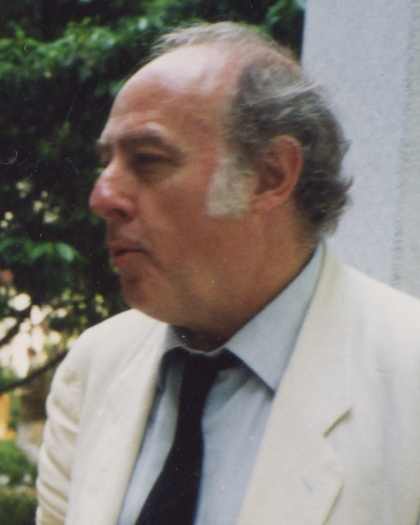
Why Eduardo Arroyo matters
Eduardo Arroyo was one of the defining figures of postwar Spanish painting, an artist whose satirical, politically charged figuration made him both a target of the Franco regime and, later, one of Spain's most honored painters. He built his reputation largely in exile in Paris, then returned home to a major retrospective and a series of national prizes once democracy took hold. For a collector, his career is a study in how a distinctive, literary, history minded style of figurative painting, sustained museum support across Europe and the United States, and continued gallery and fair presence years after his death combine to keep a market active.
- Born
- 1937-02-26, Madrid, Spain
- Nationality
- Spanish
- Media
- Painting, Printmaking, Sculpture
- Movement
- Figuration narrative, Politically committed realism
- Education
- School of Journalism, Madrid, graduated 1957; no documented formal art school training
- Signature motifs
- Satirical historical and literary subjects, Politically engaged figuration
- Representation
- "Galerie Kaléidoscope, Paris", "Galerie Ármaga, León"
By the numbers
- GBP 217,250Auction highLa marea nocturna (The Night Tide), Christie's London, 23 June 2010; reported at the time as a world auction record for the artist
- 1982National Award for Plastic Arts, SpainPremio Nacional de Artes Plásticas
- Elected 1998Real Academia de Bellas Artes de San FernandoMadrid
- Galerie Kaléidoscope; Galería ÁrmagaRepresented byParis and León, current gallery activity as of 2026
Selected works
Click any work to view it full screen.
Biography
Eduardo Arroyo Rodríguez was born on 26 February 1937 in Madrid. He trained as a journalist rather than as a painter, attending the French high school in Madrid and the Instituto de Nuestra Señora de la Almudena before graduating from the School of Journalism in Madrid in 1957. No art school degree is documented for him; he developed as a painter largely self-taught. In 1958, opposed to the Franco dictatorship, he left Spain for Paris, where he lived and worked for most of the next two decades.
In Paris he became associated with figuration narrative and a politically committed, satirical realism that used pop art's directness in the service of history and literature rather than consumer culture. His first solo exhibition, at Galerie Claude Lévin in Paris, opened in 1961. He worked across painting, printmaking, sculpture, and stage and costume design, and also wrote. After the end of the Franco era, Arroyo returned to Spain in 1976, was honored with a major retrospective, and had his Spanish citizenship restored.
His institutional standing grew through the 1980s and 1990s. The Centre Georges Pompidou in Paris gave him a large retrospective in 1982, featuring more than 160 paintings, drawings, watercolors, sculptures, and stage material, the same year he received Spain's National Award for Plastic Arts. He exhibited at the Solomon R. Guggenheim Museum in New York in 1984 and at the Museo Nacional Centro de Arte Reina Sofía in Madrid in 1998, the year he was also elected a member of the Real Academia de Bellas Artes de San Fernando. He died at his home in Madrid on 14 October 2018, at the age of 81. Major obituaries in the Spanish, French, and international art press marked his death; the documented public record does not specify a cause of death with sufficient consistency across major outlets to state one here.
Critical reception
There is no rhetoric in the work of Arroyo, but a constellation of ambivalent propositions where irony is weaponized.
Arroyo has been consistently read by critics and curators as a painter who used figuration to argue with history rather than simply depict it. Olivier Kaeppelin, former director of the Fondation Maeght, wrote of him that "there is no rhetoric in the work of Arroyo, but a constellation of ambivalent propositions where irony is weaponized," a characterization echoed across institutional writing on the artist. The Berlin critic Heinz Ohff was reported to have described his practice as a link between pop art and critical realism, a formulation frequently repeated in biographical accounts even where the original source text is not fully recoverable. The throughline in critical writing on Arroyo is his refusal to let irony collapse into decoration: his history paintings, literary subjects, and set designs are consistently framed as committed rather than merely stylish.
Market
Arroyo's best documented auction result is La marea nocturna (The Night Tide), which sold for GBP 217,250 at Christie's London on 23 June 2010, in a sale that Christie's described at the time as a world auction record for the artist. Auction estimates for his work otherwise span a wide range, from modest four figure sums for prints and smaller works at regional houses to five and six figure results for major paintings, reflecting a market built on a large and varied body of work rather than a small number of trophy pieces.
His gallery presence has continued after his death. Galería Ármaga in León presented an exhibition of his work from late 2025 into early 2026, and Galerie Kaléidoscope mounted a solo presentation of his work at the 2026 edition of Art Basel's flagship show. Some secondary sources reference higher annual sale results for Arroyo's work in 2024, 2025, and 2026, but without confirmable prices, currencies, houses, or exact dates, so those figures are not treated here as an updated auction record.
Top auction results
| Work | Price | Sale |
|---|---|---|
| La marea nocturna (The Night Tide) (2010) | GBP 217,250 | Christie's, London, 2010-06-23 |
Selected exhibitions
| Years | Exhibition | Venues |
|---|---|---|
| 1961 | First solo exhibition | Galerie Claude Lévin, Paris |
| 1982 | Retrospective, more than 160 works | Centre Georges Pompidou, Paris |
| 1984 | Solo exhibition | Solomon R. Guggenheim Museum, New York |
| 1998 | Solo exhibition | Museo Nacional Centro de Arte Reina Sofía, Madrid |
| 2013 to 2014 | Eduardo Arroyo. Pintar la literatura (Painting Literature) | Es Baluard Museu, Palma de Mallorca |
| 2021 to 2022 | Solo exhibition, posthumous | Fundación ENAIRE (with Marlborough), Santander |
| 2025 to 2026 | Exhibition by Eduardo Arroyo | Galería Ármaga, León |
| 2026 | Solo presentation, Art Basel flagship show | Galerie Kaléidoscope, Basel |
Museum collections
- Museum of Modern Art, New York
- Centre Georges Pompidou, Paris
- Museo Reina Sofía, Madrid
- Hirshhorn Museum and Sculpture Garden, Washington, D.C.
- Museo de Bellas Artes de Bilbao
- Museu Serralves, Porto
Awards and honors
- David Bright Prize, XXX Venice Biennale (1960)
- National Award for Plastic Arts, Spain (Premio Nacional de Artes Plásticas) (1982)
- Grand National Prize for Painting, Spain (1983)
- Officer, Ordre des Arts et des Lettres, France (1985)
- Elected member, Real Academia de Bellas Artes de San Fernando, Madrid (1998)
- Gold Medal of Merit in the Fine Arts, Spain (2000)
Authentication and provenance
No catalogue raisonne.
No published catalogue raisonne has been identified for Arroyo in available research. Authentication in the market currently relies on gallery expertise, auction house specialists, and the artist's documented exhibition history. No certificate of authenticity program tied to a foundation or estate was confirmed.
Primary reference: https://www.artsy.net/artist/eduardo-arroyo
What collectors should know
There is no catalogue raisonne for Eduardo Arroyo in the sources reviewed, which places extra weight on gallery and auction house expertise and on the strength of an individual work's exhibition and ownership history. His auction market shows a wide price range across venues and decades, so a single result, including the 2010 Christie's high, should be read as one data point rather than a reliable index for every work. His deep museum presence, from MoMA and the Centre Pompidou to the Reina Sofía and the Hirshhorn, together with continued gallery representation and fair presentations well after his death in 2018, are the strongest signals of a durable market, while the absence of a raisonne and the thinness of recent, fully documented sale records are the main reasons for caution.
Further reading and resources
Data current as of 2026-07-16.

