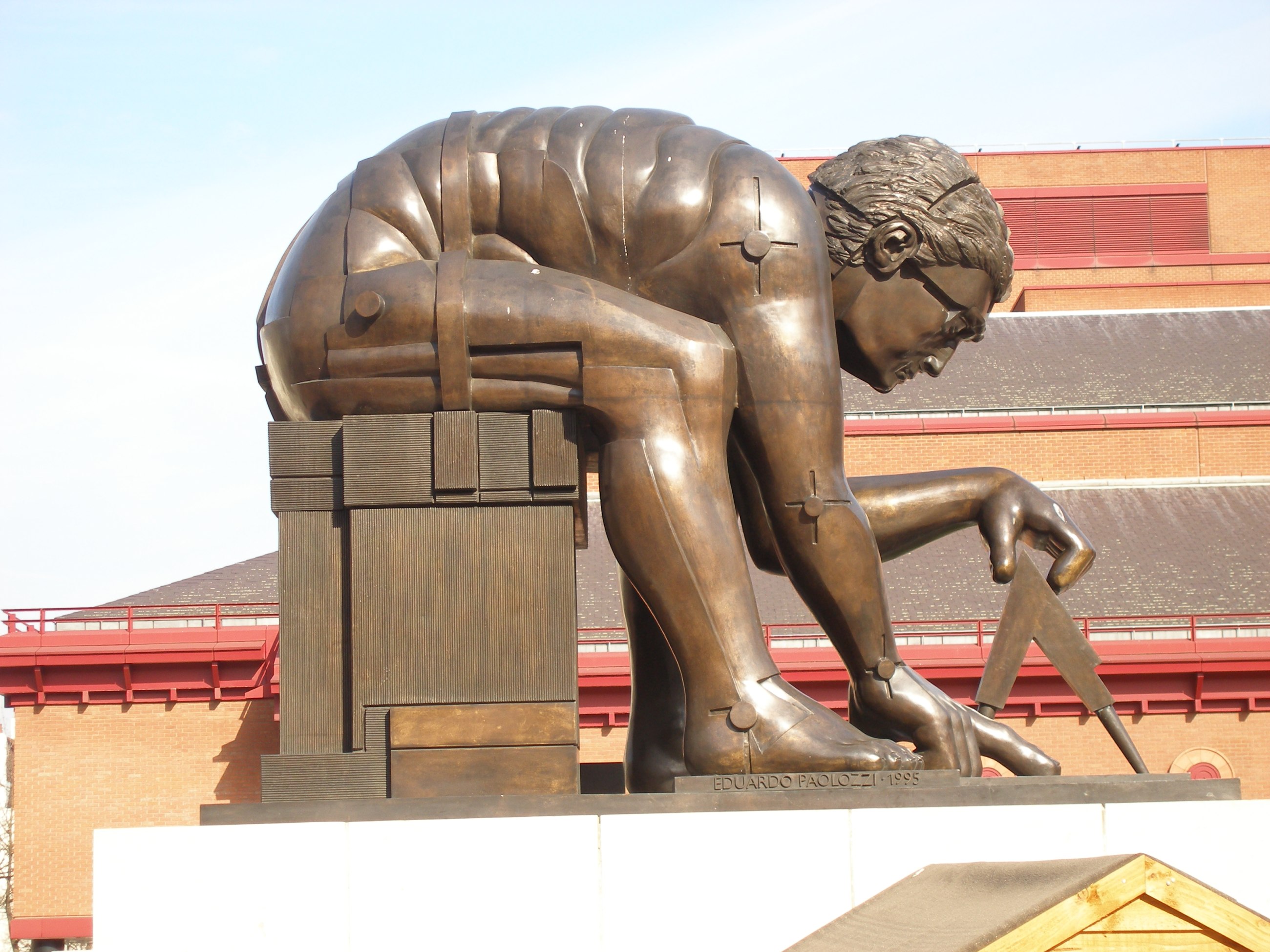
Why Eduardo Paolozzi matters
Sir Eduardo Paolozzi is credited, alongside colleagues in London's Independent Group, with laying the groundwork for Pop art nearly a decade before the movement's American breakthrough. His collages built from advertising, comic strips, and machine parts turned mass media into a subject for fine art, and his large public sculptures and mosaics, including the mosaics at Tottenham Court Road Underground station, made him one of postwar Britain's most visible artists outside the gallery system. For collectors, he represents a historically important but thinly traded market, where museum standing far outpaces public sale volume.
- Born
- 1924-03-07, Leith, Edinburgh, Scotland
- Nationality
- British (Scottish)
- Media
- Sculpture, Printmaking, Collage, Mosaic
- Movement
- Pop Art, Independent Group
- Education
- Edinburgh College of Art, 1943; brief period at St Martin's School of Art, London, 1944; Slade School of Fine Art, University College London, 1944 to 1947. No degree is documented at any of the three.
- Signature motifs
- Mechanical and robotic collage imagery, Mass-media and consumer-culture appropriation, Public mosaic and sculpture commissions
- Representation
- Piano Nobile, Eames Fine Art
By the numbers
- GBP 120,000Reported auction highTable Sculpture (Growth), reported sale, June 2007; auction house not independently confirmed
- 1989KnightedStyled Sir Eduardo Paolozzi; exact year and grade vary across sources (1986 to 1989; Knight Bachelor or KBE)
- Elected 1979Royal Academician
- British Pavilion, 1952, 1954, 1960, 1968Venice BiennaleDavid E. Bright Foundation Award, 1960 (Best Sculptor under 45), per gallery sources
Selected works
Click any work to view it full screen.
Biography
Eduardo Luigi Paolozzi was born on 7 March 1924 in Leith, the port district of Edinburgh, the eldest son of Italian immigrant parents who ran a shop in the neighborhood. He studied at Edinburgh College of Art beginning in 1943, spent a brief period at St Martin's School of Art in London in 1944, and then attended the Slade School of Fine Art at University College London from 1944 to 1947, enrolling in the sculpture and drawing diploma course. No degree from any of these schools is documented in the surviving record.
In the early 1950s Paolozzi became a founding member of the Independent Group at London's Institute of Contemporary Arts, where he presented his 1952 collage "I was a Rich Man's Plaything," widely cited as an early landmark of Pop imagery. He represented Britain in the Venice Biennale's British Pavilion in 1952, 1954, 1960, and 1968, and is credited, per gallery sources not independently reverified here, with the David E. Bright Foundation Award for best sculptor under 45 at the 1960 Biennale. His work moved across sculpture, screenprint, collage, ceramics, mosaic, and film, and he undertook major public commissions, including the mosaics at Tottenham Court Road station and cast aluminum doors for the Hunterian Art Gallery in Glasgow.
Institutional recognition followed steadily: a major exhibition at the Museum of Modern Art in 1964, a full retrospective at Tate in 1971, a retrospective at the Nationalgalerie in Berlin in 1975, and a print retrospective at the Victoria and Albert Museum in 1977. He was appointed CBE in 1968, elected a Royal Academician in 1979, named Her Majesty's Sculptor in Ordinary for Scotland in 1986, and knighted in 1989 (sources vary between 1986 and 1989 for the exact year, and between Knight Bachelor and KBE for the grade). He suffered a serious stroke around 2001 that left him largely incapacitated for the remainder of his life. He died on 22 April 2005 at a hospital in London, at the age of 81.
Critical reception
Paolozzi is consistently framed by museums and critics as a pioneer whose collage practice anticipated Pop art's fascination with advertising, comics, and consumer imagery, and whose Independent Group work at the ICA in the early 1950s predates the movement's American emergence by several years. His inclusion in four British Pavilion presentations at the Venice Biennale and retrospectives at Tate, the Nationalgalerie, and the Victoria and Albert Museum reflect sustained institutional confidence across his career. His 2005 Daily Telegraph obituary characterized his practice as balancing playful pop-culture juxtaposition, evident in works like the Tottenham Court Road mosaics, against a more serious intent, describing his own view of the work as a kind of warning against an uncreative and wasteful society.
Market
Paolozzi's auction market is modest relative to his museum standing, and the available research does not turn up a confirmed, fully sourced all-time auction record. The highest price found in current research is GBP 120,000 for the sculpture "Table Sculpture (Growth)," reported in connection with a June 2007 sale, but the auction house, city, and exact date could not be independently confirmed from available sources, so this figure should be treated as provisional rather than a verified record. Most documented results for the artist, at houses including Sotheby's and Phillips, fall well below that figure, generally in the low tens of thousands of pounds for prints and smaller sculptures. Works from the estate of his wife, Freda Paolozzi, have also come to market through Dreweatts, indicating a continuing but limited supply of studio and estate material.
Top auction results
| Work | Price | Sale |
|---|---|---|
| Table Sculpture (Growth) (2007) | GBP 120,000 | 2007-06 |
Selected exhibitions
| Years | Exhibition | Venues |
|---|---|---|
| 2026 | General Dynamic Fun | Usher Gallery, Lincoln |
| 1977 | Print retrospective | Victoria and Albert Museum, London |
| 1975 | Retrospective | Nationalgalerie, Berlin |
| 1971 | Retrospective | Tate Gallery, London |
| 1968 | documenta 4 | Kassel, Germany |
| 1964 | Major exhibition | Museum of Modern Art, New York |
| 1960 | British Pavilion, XXX Venice Biennale | Venice |
| 1947 | First solo exhibition | The Mayor Gallery, London |
Museum collections
- Tate, London
- Museum of Modern Art, New York
- National Galleries of Scotland, Edinburgh
- Nationalgalerie, Berlin
- Victoria and Albert Museum, London
Awards and honors
- British Critics' Prize (1953)
- David E. Bright Foundation Award, XXX Venice Biennale (Best Sculptor under 45) (1960)
- CBE (Commander of the Order of the British Empire) (1968)
- Elected Royal Academician, Royal Academy of Arts (1979)
- Her Majesty's Sculptor in Ordinary for Scotland (1986)
- Knighthood (Knight Bachelor) (1989)
- Goethe Medal (1991)
Authentication and provenance
No catalogue raisonne.
No published catalogue raisonne has been confirmed. The Paolozzi Foundation maintains the artist's archive and bibliography, and collectors should verify works against museum holdings, such as Tate and the National Galleries of Scotland, and Foundation records rather than a single authenticating body.
Primary reference: https://www.tate.org.uk/art/artists/sir-eduardo-paolozzi-1738
What collectors should know
Because no catalogue raisonne has been confirmed for Paolozzi, provenance and attribution should be checked against museum holdings and the Paolozzi Foundation's archive rather than a single centralized authority. His market divides fairly sharply between prints and smaller editioned works, which trade more frequently and at lower prices, and unique sculptures and estate material, which surface less often and carry more price uncertainty, as illustrated by the unresolved details around his reported auction high. Collectors should treat any single headline price for this artist with caution until the underlying sale record can be independently verified.
Further reading and resources
Data current as of 2026-07-13.

