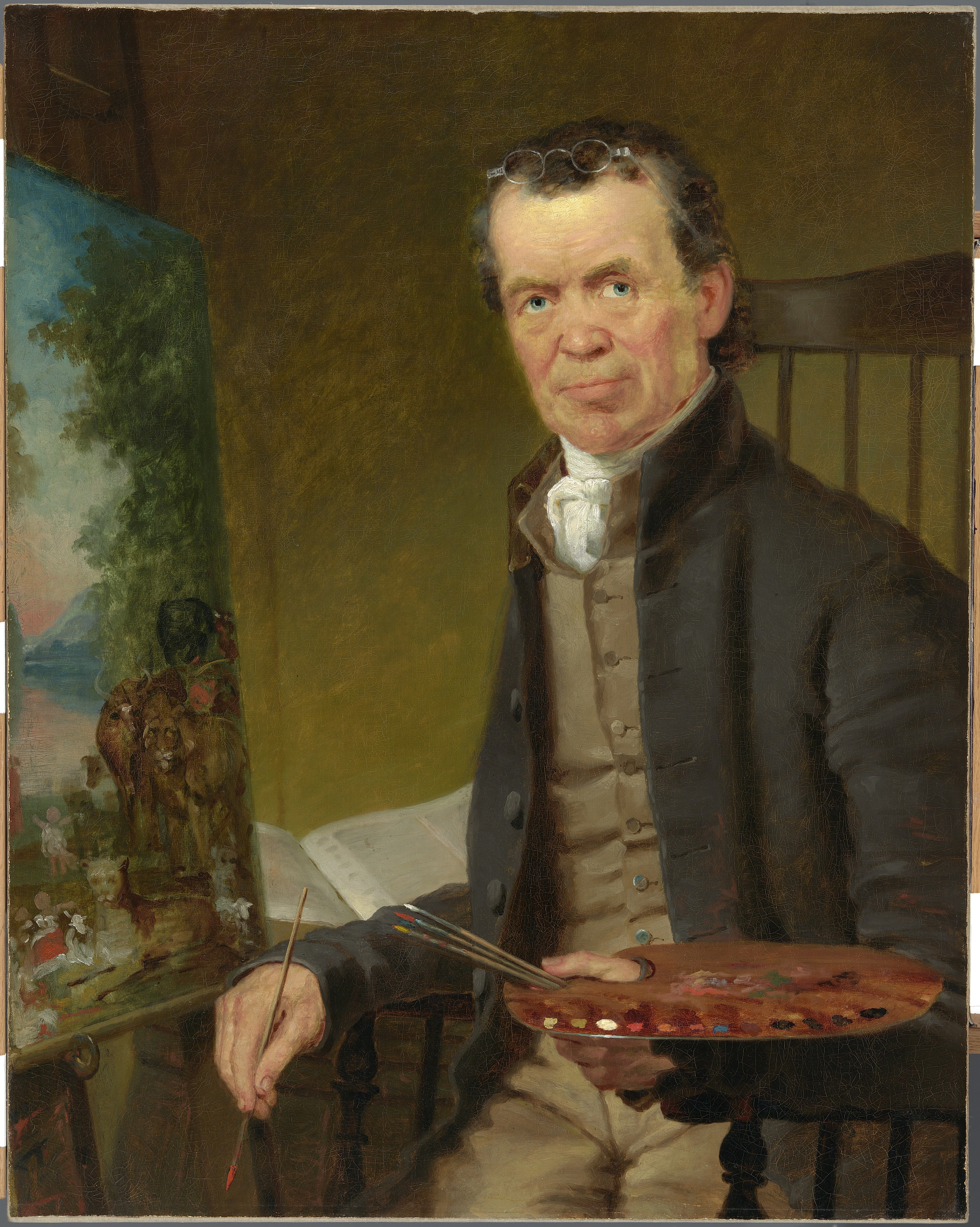
Why Edward Hicks matters
Edward Hicks is one of the most widely recognized American folk painters, remembered chiefly for the dozens of versions he painted of Peaceable Kingdom, a composition drawn from the Book of Isaiah that has become a touchstone image in American art history. He is unusual among major American painters in that his primary vocation was not art but the Quaker ministry, and his paintings are read today as much as religious and moral statements as they are pictures. For a collector, he represents a fixed, finite historical supply held mostly inside museums, with auction appearances that are infrequent and closely watched.
- Born
- 1780-04-04, Attleborough (now Langhorne), Bucks County, Pennsylvania, USA
- Nationality
- American
- Media
- Painting
- Movement
- American folk art, Naive art
- Education
- Apprenticed at about age thirteen to coach makers William and Henry Tomlinson, learning coach and sign painting. No confirmed record of academy or formal art-school training.
- Signature motifs
- "Peaceable Kingdom compositions", "Isaiah's animals of peace", "Bucks County farm and landscape scenes"
By the numbers
- USD 6.18MAuction highPeaceable Kingdom, Christie's New York, Americana Week, reported January 2008
- ca. 1811 to 1849Active periodSign and coach painter turned Quaker minister and fine artist
- None (historical estate)RepresentationHeld in museum and private collections, not by a commercial gallery
- The Kingdoms of Edward HicksMajor retrospectiveColonial Williamsburg, Philadelphia Museum of Art, Denver Art Museum, 1999 to 2000
Selected works
Click any work to view it full screen.
Biography
Edward Hicks was born April 4, 1780, in Attleborough, Bucks County, Pennsylvania, a town now known as Langhorne. No formal art schooling is documented for him; sources indicate he was apprenticed at about age thirteen to coach makers William and Henry Tomlinson, where he learned coach and sign painting, a trade typical for craftsmen of the period who lacked academy training. He later became a Quaker minister, and it was in that dual identity, painter and preacher, that he built his reputation, using his art to carry the same message of peace and moral order that he preached from the pulpit.
Hicks is best known for his repeated treatments of Peaceable Kingdom, a subject based on the prophecy in Isaiah 11:6 that the lion shall lie down with the lamb, which he painted in numerous versions over the course of his career. He died on August 23, 1849, in Newtown, Pennsylvania. According to a Peoria Riverfront Museum account of his life, more than 3,000 people attended his funeral, a mark of how well known and respected he had become in the region by the end of his life. (He is sometimes indexed as Hicks, Edward, in library and archival catalogs, but sources consistently identify him as the same single artist active in Bucks County from roughly the 1810s until his death in 1849.)
Critical reception
Institutional consensus places Hicks among the foremost American folk, or naive, painters. The Philadelphia Museum of Art and the Michener Art Museum's Bucks County Artists Database both describe him as one of the best known and most highly regarded American folk painters. Curator Carolyn J. Weekley discussed the 1999 exhibition The Kingdoms of Edward Hicks at Colonial Williamsburg, noting that in his dual roles as a Quaker minister and as a painter, Hicks conveyed moral and religious values rooted in the Isaiah prophecy of peaceful coexistence. His work has been included in exhibitions at the Museum of Modern Art (1932), the Tate Gallery (1946), the Carnegie Institute (1966), and the Whitney Museum of American Art (1980), and it was the subject of a dedicated traveling retrospective, The Kingdoms of Edward Hicks, organized by the Abby Aldrich Rockefeller Folk Art Center and shown at Colonial Williamsburg, the Philadelphia Museum of Art, and the Denver Art Museum from 1999 to 2000.
Market
The auction record for Edward Hicks is Peaceable Kingdom, which sold for USD 6,176,000 at Christie's New York during its Americana Week sale, widely reported as January 24, 2008, a price described at the time as a record for the artist and for American folk art at auction. In the same session, a circa 1835 to 1845 version of Penn's Treaty With The Indians sold for USD 3,600,000, a separate record for that subject within his output. Aggregator databases such as MutualArt report a lower maximum realized price of about USD 4,575,000 for a painting, a figure that does not match the higher, better documented Christie's result and should not be read as the standing record. More recent Hicks sales, such as a 2025 Sotheby's offering of Washington Passing the Delaware, have carried estimates in the hundreds of thousands of dollars rather than the millions, underscoring how much a single top-tier Peaceable Kingdom can dominate his auction history relative to his other subjects.
Hicks has no current commercial gallery or estate representation; his market activity runs through Americana specialists at major auction houses rather than through a standing dealer relationship, which is typical for an artist who died in 1849.
Top auction results
| Work | Price | Sale |
|---|---|---|
| Peaceable Kingdom (2008) | USD 6,176,000 (USD 6,176,000) | Christie's, New York, 2008-01-24 |
Selected exhibitions
| Years | Exhibition | Venues |
|---|---|---|
| 1999 to 2000 | The Kingdoms of Edward Hicks | Abby Aldrich Rockefeller Folk Art Center, Colonial Williamsburg, Virginia |
| 1999 to 2000 | The Kingdoms of Edward Hicks | Philadelphia Museum of Art |
| 2000 | The Kingdoms of Edward Hicks | Denver Art Museum |
| 1926 | Group exhibition | Pennsylvania Academy of the Fine Arts, Philadelphia |
| 1932 | Group exhibition | Museum of Modern Art, New York |
| 1946 | Group exhibition | Tate Gallery, London |
| 1966 | Group exhibition | Carnegie Institute, Pittsburgh |
| 1980 | Group exhibition | Whitney Museum of American Art, New York |
Museum collections
- Abby Aldrich Rockefeller Folk Art Museum, Colonial Williamsburg
- National Gallery of Art, Washington, D.C.
- Philadelphia Museum of Art
- Pennsylvania Academy of the Fine Arts, Philadelphia
- Buffalo AKG Art Museum
- Cleveland Museum of Art
- The Phillips Collection, Washington, D.C.
- National Portrait Gallery, Smithsonian Institution
Authentication and provenance
No catalogue raisonne.
No catalogue raisonne of Edward Hicks's work has been published, and none could be confirmed as in progress. Attribution rests on museum scholarship, provenance research, and connoisseurship by Americana specialists at auction houses such as Christie's and Sotheby's.
Primary reference: https://www.nga.gov/artists/1396-edward-hicks
What collectors should know
There is no catalogue raisonne for Edward Hicks, so provenance, exhibition history, and museum scholarship carry unusual weight in establishing attribution and value. Because he died in 1849, supply is fixed and finite, a large share of his known output sits in institutional collections, and top-tier works surface at auction only occasionally, which means each sale can set or reset expectations for the market as a whole. Collectors should also be aware that public figures for his auction record vary across secondary sources, so any number should be checked against a primary auction house record or a recognized market database before it is relied upon.
Further reading and resources
Data current as of 2026-07-09.

