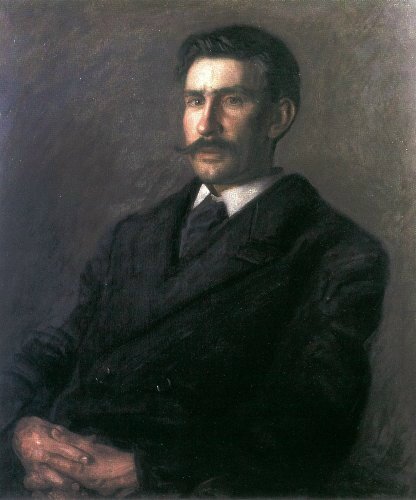
Why Edward Willis Redfield matters
Edward Willis Redfield was one of the most decorated American landscape painters of his generation, a leading figure of the New Hope art colony in Bucks County, Pennsylvania, and the artist most associated with the large-scale, single-sitting, plein-air winter landscape as an American genre in its own right. For a collector, he represents a deeply institutionalized reputation, broad museum holdings and a long record of major-exhibition prizes, paired with a market that today runs almost entirely through the auction room rather than through any current gallery or estate program.
- Born
- 1869-12-18, Bridgeville, Delaware, USA
- Nationality
- American
- Media
- Painting
- Movement
- American Impressionism, Pennsylvania Impressionism, New Hope School
- Education
- Spring Garden Institute and Franklin Institute, Philadelphia, technical schools attended in his teens, years undocumented. Pennsylvania Academy of the Fine Arts, Philadelphia, 1887 to 1889, under Thomas Anshutz, James Kelly, and Thomas Hovenden. Academie Julian, Paris, from 1889 under William Bouguereau and Tony Robert-Fleury, and the Ecole des Beaux-Arts, Paris, matriculated circa 1890. No degree is documented at any institution.
- Signature motifs
- Snow-covered winter landscapes, Delaware River Valley, Direct single-sitting plein-air technique
By the numbers
- USD 710,500Auction highWinter Sunlight, Freeman's, Philadelphia, March 30, 2014; a market database cites an unconfirmed figure near USD 744,000 without full lot details
- Full gallery, 21 paintings1915 Panama-Pacific ExpositionSan Francisco; commemorative medal awarded
- More than 30Career prizesPer the Michener Art Museum; described as second only to John Singer Sargent among American painters of the era
- 7+Museum collectionsIncluding the Met, Smithsonian American Art Museum, and National Gallery of Art
Biography
Edward Willis Redfield was born on December 18, 1869, in Bridgeville, Delaware. As a teenager he studied at two Philadelphia technical schools, the Spring Garden Institute and the Franklin Institute, before entering the Pennsylvania Academy of the Fine Arts in Philadelphia, where he trained from 1887 to 1889 under Thomas Anshutz, James Kelly, and Thomas Hovenden.
In 1889 Redfield traveled to France with his friend and fellow painter Robert Henri, enrolling at the Academie Julian in Paris to study under William Bouguereau and Tony Robert-Fleury, and later matriculating at the Ecole des Beaux-Arts. In 1893, in London, he married Elise Deligant. He returned to the United States to settle near Center Bridge (also spelled Centre Bridge) in Bucks County, Pennsylvania, where he became one of the leading painters of what came to be known as the New Hope School, or the Pennsylvania Impressionists.
Redfield developed a signature working method: he painted large canvases, often several feet across, entirely outdoors and in a single sitting, regardless of weather, producing the snow-covered rural roads and Delaware River valley scenes for which he is best known. He also painted extensively along the Maine coast, including at Boothbay Harbor and Monhegan Island. He was an active exhibitor and juror for decades at institutions including the Pennsylvania Academy of the Fine Arts, the National Academy of Design, the Corcoran Gallery of Art, and the Art Institute of Chicago, and he received an unusually large number of prizes across his career. Gallery biographies describe him as having won more awards than any American artist except John Singer Sargent. He stopped painting around 1953, in his eighties, and spent his final years working on hooked rugs and reproduction early American furniture. Redfield died on October 19, 1965, in Center Bridge, Bucks County, Pennsylvania, at age 95 or, by some accounts, 96.
Critical reception
Redfield's reputation was built early and held firmly through the twentieth century. His large winter landscapes, painted outdoors in a single session, were read by contemporaries as an unusually direct and unsentimental record of the American countryside. A curatorial note associated with the Metropolitan Museum of Art's holdings attributes to the critic and painter Guy Pene du Bois a characterization of Redfield's work as democratic and as an unbiased record of nature, a framing consistent with the broader critical consensus that prized his technique for its honesty over its polish. That standing was reinforced institutionally: an entire gallery of 21 paintings was devoted to him at the 1915 Panama-Pacific International Exposition in San Francisco, and he received more than thirty prizes, medals, and awards across his career, a record museum sources describe as second only to John Singer Sargent's among American painters of the era.
Market
Redfield's market today runs through the secondary market rather than through any current gallery or estate representation; no active commercial representative was identified in available sources. His works surface periodically at major American art auction houses, including Sotheby's, Christie's, Heritage Auctions, Bonhams, Freeman's, and Brunk Auctions. The best fully documented result is Winter Sunlight, which sold for USD 710,500 at Freeman's in Philadelphia on March 30, 2014. A separate market database (MutualArt) cites a realized price of up to USD 744,000 for a Redfield painting, but does not disclose that lot's title, auction house, or date, so this higher figure is noted only as unconfirmed rather than treated as the artist's record. No catalogue raisonne of his work has been identified.
Top auction results
| Work | Price | Sale |
|---|---|---|
| Winter Sunlight (2014) | USD 710,500 (USD 710,500) | Freeman's, Philadelphia, Pennsylvania, 2014-03-30 |
Selected exhibitions
| Years | Exhibition | Venues |
|---|---|---|
| 1900 | Paris Exposition | Paris, France |
| 1907 to 1908 | Paris Salon | Paris, France (Honorable Mention) |
| 1910 | Buenos Aires International Exposition | Buenos Aires, Argentina (Gold Medal) |
| 1915 | Panama-Pacific International Exposition | San Francisco, California (commemorative medal) |
| Early 1900s to 1930s | Recurring exhibitor and juror | Pennsylvania Academy of the Fine Arts; National Academy of Design; Corcoran Gallery of Art; Art Institute of Chicago (specific years not itemized in available sources) |
Museum collections
- Metropolitan Museum of Art, New York
- Smithsonian American Art Museum, Washington, D.C.
- National Gallery of Art, Washington, D.C.
- Art Institute of Chicago
- Brandywine River Museum of Art, Chadds Ford, Pennsylvania
- Butler Institute of American Art, Youngstown, Ohio
- University of Michigan Museum of Art, Ann Arbor
Awards and honors
- Gold Medal, Buenos Aires International Exposition (1910)
- Commemorative Medal, Panama-Pacific International Exposition (1915)
- Carnegie Prize (1918)
- Honorable Mention, Paris Salon (1907 to 1908) (1907)
Authentication and provenance
No catalogue raisonne.
No catalogue raisonne has been identified for this artist. No current commercial gallery or estate representative was found in available sources, so provenance and authentication questions are typically addressed through auction house research, museum exhibition records, and the Archives of American Art's Edward Willis Redfield papers rather than through a foundation or authentication board.
Primary reference: https://www.nga.gov/artists/42031-edward-willis-redfield
What collectors should know
Redfield's market is thin relative to his historical stature. There is no catalogue raisonne and no identified gallery or estate representative managing authentication, so provenance research and comparison against known exhibition history carry extra weight when evaluating a work. His most prized subjects remain the large winter scenes of the Delaware River valley and Bucks County countryside painted directly outdoors, and his best-documented auction result, USD 710,500 for Winter Sunlight at Freeman's in 2014, should be treated as a data point from a comparatively small, imperfectly indexed pool of public sales rather than a settled ceiling; a market database also cites an unconfirmed higher figure near USD 744,000, which lacks the title, house, and date needed to verify it.
Further reading and resources
Data current as of 2026-07-10.

