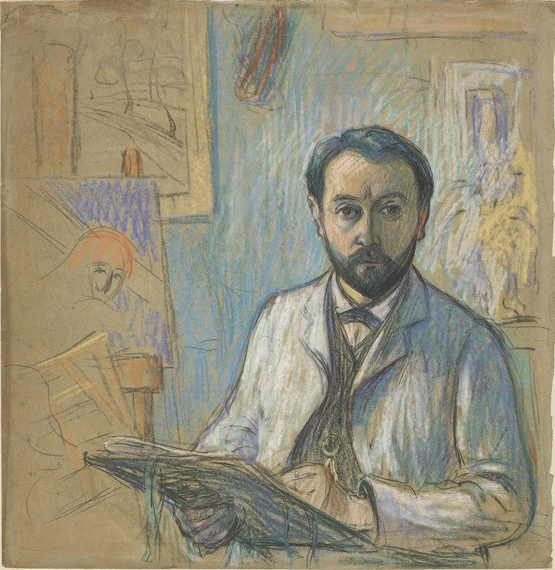
Why Emile Schuffenecker matters
Emile Schuffenecker occupies a hinge position in the history of Post-Impressionism: a former stockbroker who gave up finance for painting, became a close friend and informal financial adviser to Paul Gauguin, and helped organize the 1889 Volpini Exhibition, one of the first public showcases for the artists later grouped as Post-Impressionists. He was also among the earliest collectors of Vincent van Gogh's work. For collectors, he is a useful entry point into the Pont-Aven circle's network of painters, teachers, and dealers, at a market scale far removed from Gauguin or Van Gogh themselves.
- Born
- 1851-12-08, Fresne-Saint-Mames, France
- Nationality
- French
- Media
- Painting, Pastel
- Movement
- Post-Impressionism, Pont-Aven circle
- Education
- Studied under Paul Baudry, from 1866, and under Carolus-Duran, 1872 to 1881; attended the Academie Suisse, 1872, and the Academie Colarossi, 1883.
- Signature motifs
- Coastal Brittany and Etretat landscapes, Studio interiors and still lifes
By the numbers
- 1851 to 1934LifespanBorn Fresne-Saint-Mames, died Paris
- EUR 9,920Highest price foundRemorqueur sur la Seine aux abords du Trocadero, Lempertz, Cologne; sale date and status as a definitive all-time record are unconfirmed
- Co-organizer1889 Volpini ExhibitionCafe des Arts, Paris, alongside Paul Gauguin's circle
- Published, two volumesCatalogue raisonneCompiled by Jill-Elyse Grossvogel
Selected works
Click any work to view it full screen.
Biography
Claude-Emile Schuffenecker was born on 8 December 1851 in Fresne-Saint-Mames, in the Haute-Saone department of France. He began art instruction under Paul Baudry in 1866, and he received a first-class mention in design in 1869 as a pupil of Father Athanase. In 1872 he took a position at the stockbroking firm Bertin, where he met Paul Gauguin, while continuing to study art under Carolus-Duran, a relationship that lasted until 1881, and at the Academie Suisse.
He exhibited at the Salon from 1877 to 1881, then left finance in 1882 to devote himself fully to painting. He studied further at the Academie Colarossi in 1883. In 1886 he showed nine works at the eighth and final Impressionist Exhibition. He remained close to Gauguin through the following years, helping manage aspects of his friend's affairs, and in 1889 he was instrumental in organizing the Volpini Exhibition at the Cafe des Arts in Paris, a landmark show for the emerging Post-Impressionist and Pont-Aven circle. He was also one of the first collectors of Van Gogh's paintings.
Later in life, and after his death, Schuffenecker's reputation was clouded by persistent suspicion that he had forged or "finished" works by Van Gogh, Cezanne, and Daubigny. Scholar Jill-Elyse Grossvogel's subsequent catalogue raisonne research found no evidence that he produced Van Gogh forgeries before 1900, though the broader authenticity debate around his practice has not been fully settled. He died on 31 July 1934 at his home at 33 rue Olivier de Serres in Paris and was buried at the Montparnasse Cemetery on 3 August 1934.
Critical reception
No verified verbatim critical assessments from named critics in major outlets could be confirmed for reproduction here. What is well documented is a shift in the scholarly narrative: for decades Schuffenecker was discussed largely through the lens of the forgery accusations that followed him, particularly in relation to Van Gogh. Grossvogel's catalogue raisonne research has since reframed him more as a devoted teacher, collector, and organizer within the Pont-Aven and Post-Impressionist milieu, crediting his role in bringing the Volpini Exhibition into being and in supporting Gauguin's early career, while leaving some later attribution questions open.
Market
Schuffenecker's auction market is thin and modest in scale. The highest price identified in available public auction records is EUR 9,920, including buyer's premium, for the painting Remorqueur sur la Seine aux abords du Trocadero at Lempertz in Cologne; the exact sale date could not be confirmed, and available market data is incomplete, so this figure should not be read as a confirmed all-time record. Other tracked results sit well below that figure, with estimates commonly in the range of a few hundred to several thousand dollars or euros at regional and specialist houses. There is no evidence of a gallery or estate that currently represents him in a formal sense; his work instead circulates through a number of secondary-market dealers and appears periodically at auction.
Top auction results
| Work | Price | Sale |
|---|---|---|
| Remorqueur sur la Seine aux abords du Trocadero | EUR 9,920 | Lempertz, Cologne, Germany |
Selected exhibitions
| Years | Exhibition | Venues |
|---|---|---|
| 1877 to 1881 | Salon (Societe des Artistes Francais) | Paris |
| 1886 | 8th Impressionist Exhibition | Paris (Schuffenecker showed nine works) |
| 1889 | Volpini Exhibition | Cafe des Arts, Paris |
Museum collections
- Musee d'Orsay, Paris
- Metropolitan Museum of Art, New York
- Tate, London
- National Gallery of Art, Washington, D.C.
- Museum of Fine Arts, Houston
- Van Gogh Museum, Amsterdam
Awards and honors
- First prize in drawing, City of Paris (1868)
Authentication and provenance
Catalogue raisonne published.
A two-volume catalogue raisonne compiled by scholar Jill-Elyse Grossvogel documents his paintings and pastels. Schuffenecker was long rumored to have forged works attributed to Van Gogh and other artists, but Grossvogel's research found no evidence of Van Gogh forgeries predating 1900. Provenance and museum curatorial review remain central to authenticating individual works.
Primary reference: https://www.musee-orsay.fr/fr/ressources/repertoire-artistes-personnalites/emile-schuffenecker-21806
What collectors should know
Authentication rests on Jill-Elyse Grossvogel's published catalogue raisonne, and provenance carries extra weight given the historical forgery accusations attached to his name, particularly for works said to date from around or after 1900. No gallery or estate currently represents him; buyers should expect to transact through auction houses and independent dealers rather than a single authorized source. His broad presence in major museum collections, including the Musee d'Orsay, the Metropolitan Museum of Art, and the Van Gogh Museum, reflects historical importance rather than market depth, and recorded auction prices remain modest relative to his better-known Pont-Aven contemporaries.
Further reading and resources
Data current as of 2026-07-13.

