Why Emilio Isgro matters
Emilio Isgro is the artist most closely identified with cancellatura, the practice of erasing lines of printed text from books, newspapers, encyclopedias, and maps to leave behind a new, reduced field of meaning. Developed in Milan in the early 1960s, the technique placed him at the center of Italian conceptual art alongside the Fluxus and visual poetry movements of the period, and it has anchored a career spanning painting, poetry, fiction, theater, and film. For a collector, he represents a well-documented, museum-endorsed conceptual practice whose international market recognition, marked by his work's presence in the Centre Pompidou's collection and a dedicated 2024 program at Rome's national gallery of modern art, appears to be building well after decades of primarily Italian institutional support.
- Born
- 1937-10-06, Barcellona Pozzo di Gotto, Sicily, Italy
- Nationality
- Italian
- Media
- Conceptual art, Painting, Works on paper
- Movement
- Conceptual art
- Education
- Liceo Classico "Luigi Valli," Barcellona Pozzo di Gotto, maturita classica (mid-1950s); no university or formal art-academy training documented
- Signature motifs
- "Cancellatura (erasure of printed text)", "Erased encyclopedias, books, and maps"
- Representation
- "Cardi Gallery", "Galleria d'Incontro"
By the numbers
- First Prize, 1977Sao Paulo BiennialXIV Bienal de Sao Paulo
- 4 editionsVenice Biennale1972, 1978, 1986, 1993
- Dedicated program, 2024GNAM Rome"A Year with Emilio Isgro"
- Cardi Gallery; Galleria d'IncontroRepresented by
Biography
Emilio Isgro was born on October 6, 1937, in Barcellona Pozzo di Gotto, a town in the Sicilian province of Messina. He attended elementary school, middle school, and the Liceo Classico "Luigi Valli" in his hometown, completing his maturita classica, the Italian classical high school diploma, in the mid-1950s. He has no documented university or art-academy training; gallery biographies consistently describe him as having "a background in classical studies and no formal artistic training."
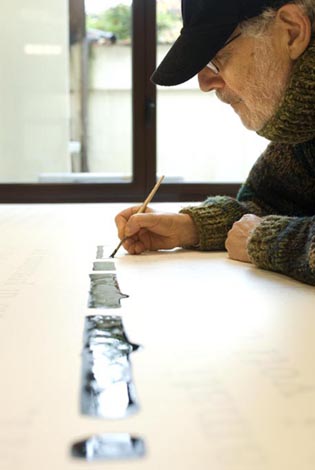
In 1956, the same year he finished school, Isgro moved to Milan and published his first book, a collection of poems titled Fiere del Sud. He spent his early career working as a writer and journalist before turning to the visual arts. In the early 1960s he began developing cancellatura, using a brush, ink, or paint to blot out most of a printed text while leaving isolated words or fragments visible, a gesture he described as not mere negation but the transformation of a negative sign into a positive, meaning-making action. He applied the technique to encyclopedias, dictionaries, maps, and eventually to his own earlier writing.
Isgro represented Italy at the Venice Biennale in 1972, 1978, 1986, and 1993, and won First Prize at the XIV Bienal de Sao Paulo in Brazil in 1977. He has continued to work across media, as a painter, poet, novelist, playwright, and director, while remaining based in Milan, where multiple current gallery and institutional biographies confirm he lives and works today.
Critical reception
Isgro is treated by Italian institutions as a foundational figure of postwar conceptual art, with a critical narrative that traces a straight line from his early literary erasures to a late-career surge of museum attention. Rome's Galleria Nazionale d'Arte Moderna e Contemporanea gave him a major retrospective in 2013 and then, in 2024, dedicated an entire year of programming to him under the title "A Year with Emilio Isgro," framing him as a defining figure in Italian culture. Germano Celant curated a major exhibition of his work at the Fondazione Giorgio Cini in Venice in 2016, the same year Palazzo Reale in Milan mounted an anthological show, and the Centro Pecci in Prato had done the same in 2008. That institutional momentum has recently moved outward from Italy, with his work held in the Centre Pompidou's collection and London's Estorick Collection and Naples's Capodimonte museum both staging solo exhibitions in 2026. Across these venues, critics and curators consistently frame cancellatura not as an act of destruction but as a generative one, a way of making new meaning visible by subtracting language.
Market
Isgro's public auction footprint is modest and concentrated in Italy. Documented results include EUR 57,351 at Dorotheum, EUR 31,250 at ANCA Aste, EUR 28,000 at Aste Bolaffi for the 1970 work Il nome di Carmen, and USD 36,300 at a Sotheby's Paris Contemporary Discoveries sale around February 2026 for Errore di Stampa libro cancellato, 1971. The Dorotheum result is the highest documented in available research, though its exact work title and sale date could not be confirmed, and no six-figure or higher sale has been verified, so this profile does not assert an all-time auction record.
There is no published catalogue raisonne for Isgro. Authentication runs through the Fondazione Emilio Isgro, which has collaborated directly with institutions such as the Estorick Collection in London on recent exhibitions. Cardi Gallery and Galleria d'Incontro are the galleries most clearly documented as current representation. Tornabuoni Arte staged his major 2025 to 2026 Rome retrospective, and several other Italian galleries, including M77, Studio Guastalla, and OSART Gallery, exhibit and deal in his work on a regular basis without a documented exclusive relationship.
Selected exhibitions
| Years | Exhibition | Venues |
|---|---|---|
| 2025 to 2026 | Rosso Shakespeare | Tornabuoni Art, Rome |
| 2026 | Erasing to Create | Estorick Collection of Modern Italian Art, London |
| 2026 | Isgro. Canto Napoli | Museo e Real Bosco di Capodimonte, Naples |
| 2024 | A Year with Emilio Isgro | Galleria Nazionale d'Arte Moderna e Contemporanea, Rome |
| 2016 | Major retrospective curated by Germano Celant | Fondazione Giorgio Cini, Venice |
| 2016 | Anthological exhibition | Palazzo Reale, Milan |
| 2013 | Anthological exhibition | Galleria Nazionale d'Arte Moderna e Contemporanea, Rome |
| 1972 to 1993 | Venice Biennale | Venice, Italy (editions of 1972, 1978, 1986, and 1993) |
Museum collections
- Centre Pompidou, Paris
- Galleria Nazionale d'Arte Moderna e Contemporanea, Rome
- Palazzo del Quirinale, Rome
- Museo del Novecento, Milan
- Musees Royaux des Beaux-Arts, Brussels
- MART, Museo d'Arte Moderna e Contemporanea di Trento e Rovereto
Awards and honors
- First Prize, XIV Bienal de Sao Paulo (1977)
Authentication and provenance
No catalogue raisonne.
No published catalogue raisonne has been confirmed for this artist. Authentication runs through the Fondazione Emilio Isgro, which has collaborated directly with institutions such as the Estorick Collection on recent retrospectives.
Primary reference: https://www.emilioisgro.info/en/
What collectors should know
Isgro's market trades mostly within Italy and at a modest scale relative to his institutional standing, so collectors should expect thin liquidity and should treat any single high-water auction figure with caution until it can be tied to a verifiable primary sale record. The absence of a catalogue raisonne makes provenance and gallery-backed authentication, particularly through Cardi Gallery, Galleria d'Incontro, and the Fondazione Emilio Isgro, especially important when evaluating a work. At the same time, the pace of museum activity, including his presence in the Centre Pompidou's collection and back-to-back 2026 exhibitions in London and Naples, suggests his international institutional profile is still expanding, which is typically the kind of signal that precedes, rather than follows, broader market growth.
Further reading and resources
Data current as of 2026-07-13.

