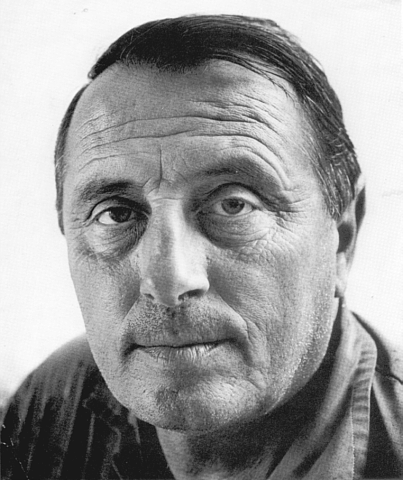
Why Ennio Morlotti matters
Ennio Morlotti was one of the painters who carried Italian art from the Corrente circle of the 1930s through the post-war reckoning with abstraction, arriving at a materic, landscape-rooted style that critics placed in dialogue with both Cezanne and Italian Informel. His inclusion in the Fronte Nuovo delle Arti, his repeated presence at the Venice Biennale from the early 1950s through 1988, and a shared Comune di Venezia prize in 1962 place him among the significant Italian painters of his generation, even though his market today remains modest and largely domestic to Italy.
- Born
- 1910-09-21, Lecco, Italy
- Nationality
- Italian
- Media
- Painting
- Movement
- Corrente, Fronte Nuovo delle Arti, Italian Informel
- Education
- Accademia di Belle Arti di Firenze, c. 1936 to 1937, under Felice Carena; Accademia di Brera, Milan, c. 1939 to 1942, under Aldo Carpi and Achille Funi
- Signature motifs
- Vegetazione landscapes, Bagnanti figures, Materic paint surfaces
- Representation
- Archivio Opere Ennio Morlotti, estate archive, Milan
By the numbers
- EUR 201,600Auction highCollina a Imbersago (Paesaggio con figure), Il Ponte Casa d'Aste, Milan, 2023
- 1962Venice Biennale prizeComune di Venezia prize, ex aequo with Giuseppe Capogrossi, 31st Venice Biennale
- Archivio Opere Ennio MorlottiRepresented byEstate archive, Milan
- 1910 to 1992LifespanLecco to Milan, Italy
Biography
Ennio Morlotti was born on 21 September 1910 in Lecco, Italy. Before committing to painting in 1936, he worked as a factory hand and an accountant. He earned his artistic maturity certificate at the Istituto d'arte di Brera in Milan, then studied at the Accademia di Belle Arti in Florence under Felice Carena, roughly 1936 to 1937, followed by a study trip to Paris in 1937. He resumed his training at the Accademia di Brera in Milan under Aldo Carpi and Achille Funi, into the early 1940s.
In Milan, Morlotti became associated with Corrente, the anti-fascist artistic circle of the late 1930s, and after the war he joined the Fronte Nuovo delle Arti alongside painters such as Renato Birolli and Emilio Vedova, and later the loose grouping known as Gli Otto. He returned to Paris after 1947, deepening his engagement with post-war European painting. Over the following decades his work moved toward dense, materic surfaces built from landscape and vegetation ("Vegetazione") and, later, monumental bathing figures ("Bagnanti") that critics read as a renewed dialogue with Cezanne. He exhibited at the Venice Biennale in 1952, 1954, 1962, 1964, and 1988, and shared the Comune di Venezia prize with Giuseppe Capogrossi in 1962. He died suddenly at his home in Milan on 15 December 1992.
Critical reception
Morlotti's early work drew comparison to Giorgio Morandi; at a Galleria Il Milione group show around 1940, the critic Roberto Longhi is recorded as having asked who the interesting "Morandi-like" painter was, a remark cited by the Archivio Morlotti as an early sign of critical attention. His late Bagnanti figures, shown at the 1988 Venice Biennale, were noted by critics including Raffaele Tassi and Giovanni Testori for their expressive force and what the artist's archive describes as a "new" and demanding pictorial substance. Across his career, critics have generally situated Morlotti between figuration and the Italian informal or materic tendency, an artist who used landscape and the body as vehicles for an increasingly abstracted, heavily worked paint surface. No exact, independently verifiable press quotations beyond the Longhi anecdote could be confirmed for this profile.
Market
Morlotti's auction market is modest in scale and concentrated in Italian salerooms, with occasional appearances at international houses. The current documented auction high is Collina a Imbersago (Paesaggio con figure), sold for EUR 201,600 at Il Ponte Casa d'Aste in Milan on 28 to 29 November 2023, which the auction house described as a new record for the artist. Most other recorded results for his paintings, drawings, and pastels fall well below this figure, typically in the low thousands to tens of thousands of euros, reflecting a market driven primarily by Italian institutional and private collecting rather than international demand.
Top auction results
| Work | Price | Sale |
|---|---|---|
| Collina a Imbersago (Paesaggio con figure) | USD 220,000 (EUR 201,600) | Il Ponte Casa d'Aste, Milan, Italy, 2023-11-29 |
Selected exhibitions
| Years | Exhibition | Venues |
|---|---|---|
| 1962 | 31st Venice Biennale, personal room | XXXI Biennale Internazionale d'Arte, Venice |
| 1988 | 43rd Venice Biennale, Bagnanti series | XLIII Biennale di Venezia |
| 1964 | 32nd Venice Biennale | XXXII Biennale Internazionale d'Arte, Venice |
| 1954 | 27th Venice Biennale | XXVII Biennale di Venezia |
| 1952 | 26th Venice Biennale, La siesta | XXVI Biennale di Venezia |
| 1956 | Guggenheim International Award | Solomon R. Guggenheim Museum, New York |
| 1963 | The Dunn International Award | Beaverbrook Art Gallery, Fredericton; Tate Gallery, London |
| 1950 | Five Italian Painters | Catherine Viviano Gallery, New York |
Museum collections
- MAC, Museo d'Arte Contemporanea di Lissone
- GAMeC, Galleria d'Arte Moderna e Contemporanea, Bergamo
- Museo MAGA, Gallarate
- Museo Carandente, Palazzo Collicola, Spoleto
- Museo Novecento, Florence
- MAGI 900, Pieve di Cento
- Galleria civica Ezio Mariani, Seregno
Awards and honors
- Prize of the Comune di Venezia, ex aequo with Giuseppe Capogrossi, 31st Venice Biennale (1962)
- Recognition, The Dunn International Award (1963)
- Premio Morlotti established in his honor by the Comune di Imbersago (posthumous) (1996)
Authentication and provenance
No catalogue raisonne.
No published catalogue raisonne is confirmed for Morlotti. His estate is documented by the Archivio Opere Ennio Morlotti in Milan, which holds archival records, organizes exhibitions of his work, and is the primary reference point for provenance questions.
Primary reference: https://archiviomorlotti.com/en/biography/
What collectors should know
There is no published catalogue raisonne for Morlotti. His estate and archival records are held by the Archivio Opere Ennio Morlotti in Milan, which functions as the primary point of reference for provenance and documentation rather than a commercial gallery, and no exclusive gallery representation for the estate could be confirmed as of this writing. His works appear at Italian auction houses with some regularity and occasionally at international ones, but the sample of high-value sales is small, so any single result, including the 2023 record, should be read in the context of a thin and largely domestic market rather than as a stable pricing trend.
Further reading and resources
Data current as of 2026-07-16.

