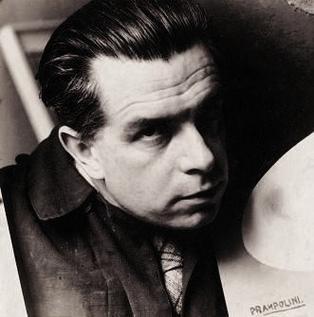
Why Enrico Prampolini matters
Enrico Prampolini was one of the central figures of the second generation of Italian Futurism, a painter, sculptor, and stage designer whose work moved between Futurist mechanical imagery, Constructivism, and the polymaterial abstraction he developed in the 1930s. His work is held by the Museum of Modern Art, the Guggenheim, and the Galleria Nazionale d'Arte Moderna e Contemporanea in Rome, giving him firm institutional standing. For a collector, he represents a historically important but thinly traded corner of the early twentieth century Italian avant-garde market, where museum recognition is strong but public sale data is sparse.
- Born
- 1894-04-20, Modena, Italy
- Nationality
- Italian
- Media
- Painting, Sculpture, Scenography
- Movement
- Futurism, Constructivism
- Education
- Studied in Rome under Duilio Cambellotti at the Academy of Fine Arts, sources vary between Accademia di Belle Arti di Roma and Accademia di San Luca; left before completing a degree, after publishing an anti-academic manifesto. Earlier general schooling in Lucca, Chiaravalle Marche, and Turin.
- Signature motifs
- Mechanical Art, Polymaterial abstraction, Cosmic and mechanical imagery
- Representation
- Fondazione Sergio Poggianella (heirs' deposit and exhibition partner), FPAC Francesco Pantaleone Arte Contemporanea, Palermo, ML Fine Art, Milan
By the numbers
- 1894 to 1956LivedBorn Modena, died Rome
- EUR 130,000 (unconfirmed)Reported auction highLa sezione d'oro (Carmen Boni); auction house and exact date not confirmed. Best-documented dated sale: EUR 43,400, Simultaneita ritmica, Finarte, Milan, 2007-02-22.
- Italian Futurism, second generationMovement
- MoMA; Guggenheim; GNAM RomeMuseum collectionsamong others
Biography
Enrico Prampolini was born on 20 April 1894 in Modena, Italy. He received his general schooling in Lucca, Chiaravalle Marche, and Turin before studying in Rome under Duilio Cambellotti at the Academy of Fine Arts. Sources vary on whether this was the Accademia di Belle Arti di Roma or the Accademia di San Luca. He left before completing a degree, following the publication of an anti-academic manifesto, "Bombardiamo le accademie e industrializziamo l'arte" ("Let's bomb academies and industrialize art"). He soon joined the circle around Giacomo Balla and aligned himself with Futurism.
Prampolini became a prolific theorist and practitioner across painting, sculpture, and stage design, co-authoring the Manifesto of Mechanical Art and developing what he called "cosmic" and mechanical abstraction. In the 1930s he moved toward polymaterial paintings that incorporated non-traditional surfaces and materials. He contributed design and scenographic work to major state exhibitions, including the 1932 Exhibition of the Fascist Revolution in Rome, and biographical sources credit him with the Accademia d'Italia's Premio accademico per la pittura that year, a 1955 vice-presidency of UNESCO's Comitato Nazionale Arti Plastiche, and a 1955 professorship of scenography at the Accademia di Brera in Milan. In 1956 Italy's Head of State awarded him a gold medal for merit in art, culture, and teaching, a fact independently confirmed across multiple sources consulted for this profile.
Enrico Prampolini died on 17 June 1956 in Rome, Italy. In 1961 the Galleria Nazionale d'Arte Moderna in Rome dedicated a major retrospective to his work. His heirs later donated his documentary archive to the Centro Ricerca e Documentazione Arti Visive del Comune di Roma in 1992, and a substantial group of works remains on deposit with the heirs and the Fondazione Sergio Poggianella.
Critical reception
Historians place Prampolini among the leading figures of the second wave of Italian Futurism and credit him with an early move toward Surrealist and abstract currents within Italian art of the interwar period. His role as painter, scenographer, sculptor, and theorist, and his contribution to manifestos on mechanical art, are consistently cited as central to his standing in the Italian avant-garde. The 1961 retrospective at the Galleria Nazionale d'Arte Moderna in Rome and his continued presence in major museum collections in Italy, Europe, and the United States reflect sustained institutional interest. No verifiable, attributable verbatim critical assessments from named critics in major outlets were located for this profile.
Market
Prampolini's auction market is thin and unevenly documented, and no single confirmed all-time auction record could be established from available sources. The best-documented sale with a confirmed auction house and date is Simultaneità ritmica (1955), reported at EUR 43,400 at Finarte in Milan on 22 February 2007, though the currency figure is as reported and not independently confirmed. A higher figure of roughly EUR 130,000 has also been reported for La sezione d'oro. Paesaggio femminile di un'attrice (Carmen Boni), but the auction house and exact sale date for that result are unconfirmed, so it should be treated as an unverified high point rather than an established record. There is no single, exclusive gallery or estate representative; his heirs' holdings are on deposit with the Fondazione Sergio Poggianella, which partnered with FPAC Francesco Pantaleone Arte Contemporanea in Palermo for a 2025 exhibition, while ML Fine Art in Milan has separately exhibited and dealt in his work.
Top auction results
| Work | Price | Sale |
|---|---|---|
| Simultaneità ritmica (1955) | EUR 43,400 (currency as reported; not independently confirmed) | Finarte, Milan, 2007-02-22 |
Selected exhibitions
| Years | Exhibition | Venues |
|---|---|---|
| 2025 to 2026 | Prampolini Burri. Of Matter | Giancarlo and Danna Olgiati Collection, Lugano |
| 2025 | (DI)SEGNO IN SEGNO. Enrico Prampolini. Opere e Taccuini 1915-1955 | FPAC Francesco Pantaleone Arte Contemporanea, Palermo |
| 2023 | Enrico Prampolini. Opere dal 1926 al 1941 | ML Fine Art, Milan |
| 1961 | Retrospective | Galleria Nazionale d'Arte Moderna, Rome |
| 1932 | Exhibition of the Fascist Revolution | Rome (design and scenography contribution) |
Museum collections
- Museum of Modern Art, New York
- Solomon R. Guggenheim Museum, New York
- Brooklyn Museum, New York
- Galleria Nazionale d'Arte Moderna e Contemporanea, Rome
- MART, Museo di arte moderna e contemporanea di Trento e Rovereto
- Galleria Civica d'Arte Moderna e Contemporanea (GAM), Turin
- Museo Novecento, Florence
- Wolfsoniana, Genoa
Awards and honors
- Premio accademico per la pittura, Accademia d'Italia (1932)
- Vice-President, Comitato Nazionale Arti Plastiche, UNESCO (1955)
- Professore ordinario di scenografia, Accademia di Brera, Milan (1955)
- Gold medal for merit in Art, Culture, and Teaching, conferred by the Head of State of Italy (1956)
Authentication and provenance
No catalogue raisonne.
No published catalogue raisonne has been identified for Prampolini. His documentary archive was donated by his heirs to the Centro Ricerca e Documentazione Arti Visive del Comune di Roma in 1992, and a body of works remains on deposit with the heirs and Fondazione Sergio Poggianella; these are the primary points of reference for provenance research.
Primary reference: https://en.wikipedia.org/wiki/Enrico_Prampolini
What collectors should know
There is no published catalogue raisonne for Prampolini, and no certificate-of-authenticity program; provenance research depends on the artist's archive at the Centro Ricerca e Documentazione Arti Visive del Comune di Roma and on the heirs' holdings deposited with the Fondazione Sergio Poggianella. His representation is distributed rather than exclusive, spread across a foundation, a partner gallery, and another dealer who has shown his work. His public auction record is thin and inconsistent: the only sale with a confirmed auction house and date is a relatively modest EUR 43,400 result at Finarte in Milan in 2007, while a higher, widely cited figure of roughly EUR 130,000 lacks a confirmed venue or date. Collectors should treat any single price point with caution and prioritize direct verification of provenance for individual works.
Further reading and resources
Data current as of 2026-07-16.

