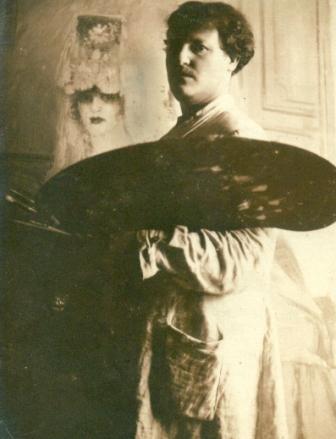
Why Federico Beltrán Masses matters
Federico Beltrán Masses was among the most celebrated Spanish portrait and Symbolist painters of the 1910s to 1930s, a Cuban-born artist who moved in royal, aristocratic, and Hollywood circles and whose nocturnal, richly colored images of women made him a fixture of Madrid, Paris, and London exhibition seasons. For collectors, he represents a once-famous name that fell into relative obscurity after his death and has since drawn renewed curatorial and dealer attention, though his auction market remains thin and only partially documented.
- Nationality
- Spanish (born in Cuba)
- Media
- Painting, Watercolor
- Movement
- Symbolism, Art Deco portraiture
- Education
- Escola de la Llotja (Barcelona School of Fine Arts), enrolled c. 1903; studied under Joaquin Sorolla in Madrid from 1905, copying old masters at the Museo del Prado
- Signature motifs
- Nocturnal Symbolist scenes, Exoticized female portraiture
By the numbers
- GBP 52,500Auction result (reported, unverified)Sotheby's, 2020; secondary-source reported, not confirmed against a primary sale record
- 1920Venice BiennaleReportedly given an entire pavilion, including Salome; not independently confirmed
- France, 1927Legion of HonourExact rank disputed across sources (Chevalier vs Commander)
- Spain, 1924Order of Isabella the Catholic
Selected works
Click any work to view it full screen.
Biography
Federico Armando Beltrán Masses was born in 1885 in Güira de Melena, Cuba, to Spanish parents; sources disagree on the exact day and month of his birth, though the year and place are well corroborated by museum records. His family returned to Barcelona in 1893, and he began his formal art training there at the Escola de la Llotja, the Barcelona School of Fine Arts, enrolling around 1903. In 1905 he moved to Madrid, where he studied under Joaquín Sorolla and spent time copying the old masters at the Museo del Prado.
His career gained momentum quickly. A 1916 solo exhibition in Madrid was reportedly visited by King Alfonso XIII, and that same year he won a prize at the Société Nationale des Beaux-Arts in Paris, launching him as a fashionable society portraitist. In 1919 he organized the Exposition Hispano-Français des Beaux-Arts, and in 1920 he exhibited at the XII Venice Biennale, where he reportedly had an entire pavilion dedicated to his work, including the nude Salomé; that provenance detail is not independently confirmed. Honors followed: the Order of Isabella the Catholic in Spain in 1924, exhibitions at the Wildenstein Galleries in New York and Palm Beach in 1925, and the French Legion of Honour in 1927 (sources differ on whether he held the rank of Chevalier or Commander).
His 1929 exhibition at the New Burlington Galleries in London carried a catalogue introduction by the critic P. G. Konody. Ahead of that show, he reportedly told The London Magazine that he was nervous about the London reception, comparing his anxiety to that of a student awaiting judgment. He went on to show at the Royal Watercolour Society in London in 1934 and at the Burlington Galleries in 1938. He was a member of the Real Academia de Bellas Artes de San Fernando in Madrid and of academies in Barcelona, Zaragoza, Lisbon, Cordoba, Malaga, and Paris. He died on 4 October 1949 in Barcelona; the exact cause of death is not documented in the sources reviewed for this profile. His death is confirmed by the Centre Pompidou, the Musee d'Orsay, and the Museo del Prado.
Critical reception
In his own time, Beltrán Masses was closely associated with a lush, color-driven Symbolism applied to psychologically charged portraits, most often of women, and with nocturnal scenes that critics linked to a distinctly Spanish romantic sensibility. Wikipedia's account of the period describes the French critic Camille Mauclair as ranking him among the few contemporaries who grasped art's moral responsibilities and as comparing his stature to that of Ignacio Zuloaga, though the exact original wording of that assessment is not independently confirmed. Reviewing his 1929 London exhibition, the critic P. G. Konody, writing in the Daily Mail, is reported to have praised his romantic sensibility and use of color while noting inconsistencies in his drawing. Later writers, including pieces in The London Magazine and Spears, have framed him as a once-famous painter of the Jazz Age whose reputation faded after his 1949 death and who has since become a subject of rediscovery.
Market
Beltrán Masses's saleroom history is far less documented than his exhibition record. The best-supported public auction result found in current research is a GBP 52,500 sale reported by a French market-analysis site for an unspecified painting of women, said to have been sold at Sotheby's in 2020; neither the exact title, sale date, nor sale location within Sotheby's could be confirmed against a primary auction record, so this figure should be treated as indicative rather than a confirmed all-time high. Other recorded results, such as an approximately 8,000-euro sale reported by a French auction listing site, sit well below that figure, and dealer asking prices on retail platforms such as 1stDibs are not auction results and cannot be used to establish a record. Renewed interest in his work has come through posthumous surveys, including a 2012 exhibition on his Jazz Age period reported in the Spanish press and gallery presentations by Stair Sainty Gallery, Stephen Ongpin Fine Art, and Papillon Gallery, though no gallery or estate currently lists itself as his standing representative.
Top auction results
| Work | Price | Sale |
|---|---|---|
| Painting of women (exact title not documented) (2020) | GBP 52,500 | Sotheby's, Likely London, not explicitly confirmed |
Selected exhibitions
| Years | Exhibition | Venues |
|---|---|---|
| 1916 | Solo exhibition | Madrid, reportedly visited by King Alfonso XIII |
| 1919 | Exposition Hispano-Francais des Beaux-Arts | Paris |
| 1920 | XII Venice Biennale | Venice; reportedly given a dedicated pavilion, including Salome (not independently confirmed) |
| 1925 | Wildenstein Galleries | New York and Palm Beach |
| 1929 | New Burlington Galleries | London, catalogue introduction by critic P. G. Konody |
| 1934 | Royal Watercolour Society | London |
| 1938 | Burlington Galleries | London |
| 2012 | El pintor de la era del jazz | Reported venue Museo Casa Lis, Salamanca; title, year, and venue per press report, not independently confirmed |
Museum collections
- Centre Pompidou, Musee National d'Art Moderne, Paris
Awards and honors
- Prize, Societe Nationale des Beaux-Arts, Paris (1916)
- Order of Isabella the Catholic, Spain (1924)
- Legion of Honour, France (exact rank disputed) (1927)
- Knight, Order of Malta
- Member, Real Academia de Bellas Artes de San Fernando, Madrid
Authentication and provenance
No catalogue raisonne.
No published catalogue raisonne has been located, and no certificate-of-authenticity program is documented. Attribution currently relies on museum provenance files and dealer expertise, notably Stair Sainty Gallery's research on the artist.
Primary reference: https://www.museodelprado.es/aprende/enciclopedia/voz/beltran-masses-federico-armando/7f28d966-9af2-42bf-bcb2-7fa66f8715d3
What collectors should know
Beltrán Masses has no published catalogue raisonne and no formal authentication body; attribution depends on museum provenance files and on the expertise of dealers such as Stair Sainty Gallery, which has organized survey exhibitions of his work. His auction record is thin and inconsistently reported, so any single high price, including the GBP 52,500 result cited above, should be checked against a primary auction-house record rather than treated as definitive. He currently has no confirmed standing gallery or estate representation, which places added weight on institutional exhibition history and museum holdings, at Centre Pompidou, as signals of quality and importance.
Further reading and resources
Data current as of 2026-07-13.

