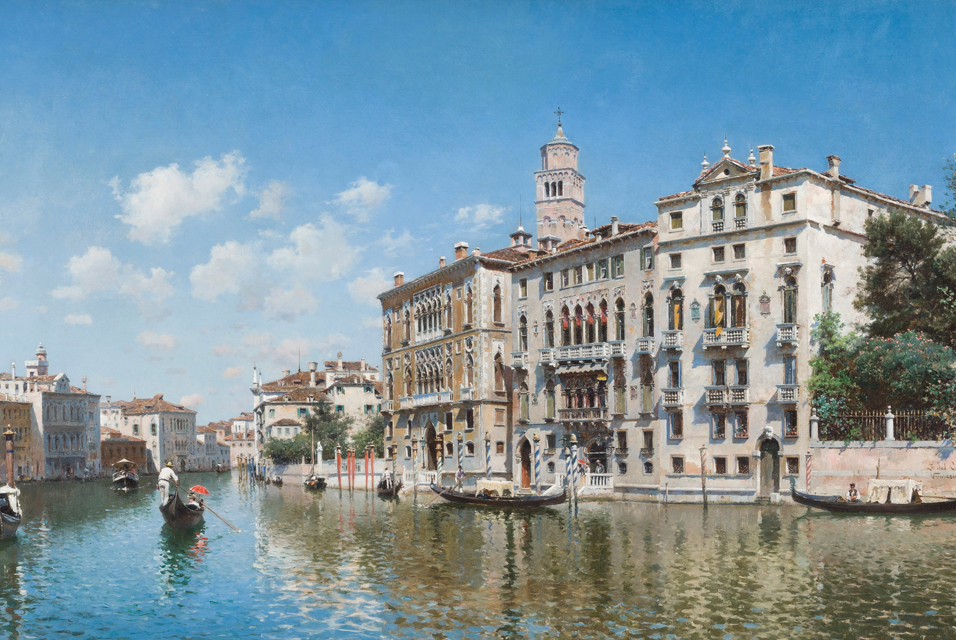
Why Federico del Campo matters
Federico del Campo was a Peruvian-born painter who built his career in Venice, producing luminous canal views in the vedute tradition of Canaletto and Guardi. His paintings were collected by European aristocracy in his lifetime and today anchor a specialist corner of the 19th-century painting market, with an auction high reported at approximately USD 685,000 across auction-market databases. For collectors, he is a case study in a historic artist with no estate and no catalogue raisonne, where attribution and value depend heavily on dealer and auction-house expertise.
- Nationality
- Peruvian
- Media
- Painting, Oil on canvas
- Movement
- Academic art, Vedute (view painting)
- Education
- Real Academia de Bellas Artes de San Fernando, Madrid, enrolled c. 1865, studied under Lorenzo Valles. Earlier training in Lima, possibly at a small school and/or with the Italian painter Leonardo Barbieri, is not documented with certainty.
- Signature motifs
- Venice canal views, Vedute in the Canaletto and Guardi tradition
- Representation
- Rehs Galleries (secondary market), Gallery 19C (secondary market)
By the numbers
- USD 685,000 (approx.)Auction highFigure repeated across auction-market databases; exact work, sale house, and date are not consistently documented across sources
- Secondary market: Rehs Galleries, Gallery 19CRepresented byNo estate representation is documented
Selected works
Click any work to view it full screen.
Biography
Federico del Campo was born in Lima, Peru, in 1837. Little is documented with certainty about his early artistic training in Lima; some sources describe basic schooling there and a possible connection to the Italian painter Leonardo Barbieri, but this is not firmly established in the archival record.
By around 1865 he had traveled to Madrid, where he enrolled at the Real Academia de Bellas Artes de San Fernando and studied under the history painter Lorenzo Valles. He is also said to have spent time in Paris observing new artistic developments before the outbreak of the Franco-Prussian War in 1870. He went on to settle in Venice, where he specialized in canal and lagoon views aimed at the European and American export market. His work was shown at the Vienna International Exhibition in 1873 and the Philadelphia Centennial Exhibition in 1876. From 1880 his work appeared regularly at the Salon des Artistes Francais in Paris. Period exhibition reports cited by dealers state that his paintings entered British aristocratic collections, including those described as belonging to the Queen, the Princess of Wales, and the Duchess of Edinburgh, though these references come from secondary accounts rather than confirmed museum records. In 1893 the London dealer Arthur Tooth and Sons organized a dedicated exhibition of his paintings in Chicago to coincide with the World's Columbian Exposition.
Very little is documented about the last two decades of his life. He died in 1923; an obituary appeared in the Toulouse newspaper La Depeche on November 11, 1923. The exact date and place of his death are not conclusively documented in available sources, though some secondary accounts suggest London.
Critical reception
Contemporary criticism of del Campo is sparse in the accessible record. Dealers researching the artist cite a brief notice in the Toulouse publication Le Midi Artiste from 1879 as evidence of favorable period reception, commenting on the clarity and appeal of his Venice views, though the exact wording of that notice could not be independently confirmed here. Later assessments have generally placed him among the more accomplished later practitioners of the vedute tradition established by Canaletto and Guardi, valued in the market for decorative and topographical appeal rather than treated as a major subject of academic art history.
Market
Del Campo's highest documented auction result is reported at approximately USD 685,000, a figure repeated across several auction-market databases. Sources do not agree, however, on the exact work, sale house, or sale date behind that figure, so it should be read as an approximate high rather than a precisely dated record. Other auction results are considerably lower, though available sources do not provide a reliable, consistent list of comparable sales. He has no living representation; his work moves through the secondary market and specialist 19th-century dealers, notably Rehs Galleries in New York and Gallery 19C.
Top auction results
| Work | Price | Sale |
|---|---|---|
| Venice canal view (exact title, sale house, and date vary by source) | USD 685,000 |
Selected exhibitions
| Years | Exhibition | Venues |
|---|---|---|
| 1873 | International Exhibition | Vienna |
| 1876 | Centennial International Exhibition | Philadelphia |
| 1880 onward | Salon des Artistes Francais | Paris |
| 1893 | Special exhibition of paintings by Federico del Campo | Arthur Tooth and Sons, Chicago, tied to the World's Columbian Exposition |
Authentication and provenance
No catalogue raisonne.
No catalogue raisonne or estate has been identified for del Campo. He has no living representation; his paintings are handled on the secondary market, principally by Rehs Galleries and Gallery 19C, and attribution relies on dealer and auction house scholarship rather than a certificate program.
Primary reference: https://rehs.com/eng/bio/federico-del-campo/
What collectors should know
There is no catalogue raisonne and no estate for Federico del Campo, so attribution and condition assessment depend on the expertise of specialist dealers and auction houses rather than a certificate program. His auction market is thin and unevenly documented: a single result reported at approximately USD 685,000 stands well above the bulk of his sales, which more often land far lower, so any one price should be read with caution rather than as a market average. Basic biographical facts, including his exact birth date, his precise death date, and where he died, are not fully settled in the public record, and collectors should expect gaps in provenance and documentation for works from his final two decades.
Further reading and resources
Data current as of 2026-07-10.

