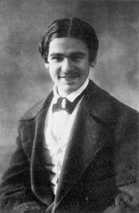
Why Filippo de Pisis matters
Filippo de Pisis is one of the most literary painters of Italian modernism, a figure whose still lifes and views of Venice, Paris, and Rome sit at the crossroads of metaphysical painting and a lifelong career as a published poet and prose writer. For a collector, he represents a deeply institutionalized but comparatively thin market: a painter with a dedicated museum, decades of Venice Biennale presence, and holdings across major European and American collections, set against auction data that remains sparse and, at the very top end, poorly documented.
- Born
- 1896-05-11, Ferrara, Italy
- Nationality
- Italian
- Media
- Painting, Works on paper
- Movement
- Pittura Metafisica (Metaphysical painting), Novecento Italiano
- Education
- University of Bologna, Faculty of Letters, laurea in Lettere, 1920 (enrollment year given as 1914 or 1916 across sources)
- Signature motifs
- Still-life with flowers, Venetian and Parisian views
- Representation
- "No confirmed current gallery representation (artist deceased since 1956); works circulate through multiple secondary-market dealers and auction houses"
By the numbers
- USD approx. 151,400Auction high (reported)MutualArt aggregate figure; specific work, auction house, and sale date not publicly disclosed
- 1948 and 1950Venice Biennale personal rooms30 works shown in 1948, 13 works in 1950, per gallery-sourced exhibition records; exact counts not independently corroborated
- FerraraMuseum named in his honorFilippo de Pisis Museum; founding year not confirmed in current sources
- No confirmed current galleryRepresented byDeceased 1956; market activity spread across multiple secondary-market dealers and auction houses
Biography
Filippo de Pisis was born Luigi Filippo Tibertelli on 11 May 1896 in Ferrara, Italy, the third of seven children in a family that educated its children at home with priests and private tutors before he moved on to a private high school and then a gymnasium in Bologna. He began studying drawing at around age six, first with the Ferrara painter Odoardo Domenichini and later with the brothers Angelo and Giovan Battista Longanesi-Cattani.
He enrolled in the Faculty of Letters at the University of Bologna, in either 1914 or 1916 depending on the source, and graduated in 1920 with a laurea in Lettere, writing a thesis on Ferrarese Gothic painters under Igino Benvenuto Supino. After graduating he moved to Rome, where he worked as a high school teacher for about four years while immersing himself in the capital's literary and artistic circles and developing the loose, atmospheric style that critics later linked to metaphysical painting.
De Pisis went on to divide his working life between Italy and Paris, exhibiting steadily through the interwar decades, including at the Salon de l'Escalier and the Jeu de Paume in Paris and at the Quadriennale in Rome. He showed at the Venice Biennale nearly every edition from 1926 through the year of his death, and the Biennale gave him personal rooms in 1948 and again in 1950. Comprehensive records of lifetime prizes are not established in current reference sources; the clearest institutional honor documented is a retrospective the Venice Biennale held in his memory in 1956, the year of his death. He died on 2 April 1956, according to the great majority of major reference sources in Milan, Italy, though a smaller number of sources give the nearby town of Brugherio or Monza as the specific location. He is buried in the Certosa cemetery in his native Ferrara. His home city later named its museum of modern and contemporary art in his honor.
Critical reception
De Pisis is consistently framed by museums and Italian reference sources as a painter who carried his identity as a poet directly into his visual work, using a fluid, almost impressionistic brushwork to hold landscapes, flowers, and self-portraits inside a broader metaphysical and Novecento conversation. The steady institutional attention paid to him since his death, including the museum named for him in Ferrara, a solo show at Museo Novecento in Florence in 2022, an exhibition built around a single painting at CUBO Unipol in Bologna in 2024 to 2025, and a 2026 exhibition in Lecce examining his ties to the Italian painters of Paris, points to sustained scholarly rather than purely market-driven interest. No exact, attributable critical quotation from a named critic in a major outlet could be confirmed in current research, so none is reproduced here.
Market
De Pisis's auction market is modest in volume and only partly documented at the top end. The aggregator MutualArt reports a highest realized price of roughly USD 151,400 for the artist, but does not publicly disclose the specific work, auction house, or sale date behind that figure, so it should be read as an indicative ceiling rather than a fully sourced record. More typical, and fully documented, is a 1949 still life, Natura morta, which sold for a hammer price of EUR 4,375 at Gregory's Aste in Italy on 16 December 2025, illustrating the mid-market range where most of his works actually trade. He has no current gallery representation in the sense used for living artists; his market activity is spread across multiple secondary-market dealers and Italian auction houses rather than concentrated with a single gallery.
Top auction results
| Work | Price | Sale |
|---|---|---|
| Natura morta (1949) (1949) | EUR 4,375 (hammer) | Gregory's Aste, Italy, 2025-12-16 |
Selected exhibitions
| Years | Exhibition | Venues |
|---|---|---|
| 2026 | Filippo de Pisis e gli Italiens de Paris | Fondazione Biscozzi | Rimbaud, Lecce |
| 2024 to 2025 | Filippo de Pisis. Nascita di un quadro (Birth of a Painting) | CUBO, Gruppo Unipol, Bologna |
| 2022 | Filippo de Pisis. L'illusione della superficialita | Museo Novecento, Florence |
| 1950 | La Biennale di Venezia | Personal room, Venice Biennale (13 works) |
| 1948 | La Biennale di Venezia | Personal room, Venice Biennale (30 works) |
| 1935 | Exposition d'art italien | Jeu de Paume, Paris |
| 1925 | III Biennale di Roma | Palazzo delle Esposizioni, Rome |
Museum collections
- Museo d'Arte Moderna e Contemporanea Filippo de Pisis, Ferrara
- Centre Pompidou, Paris
- Museum of Modern Art, New York
- Peggy Guggenheim Collection, Venice
- Pinacoteca di Brera, Milan
- Galleria Nazionale d'Arte Moderna e Contemporanea, Rome
Awards and honors
- Posthumous retrospective, Venice Biennale (1956)
Authentication and provenance
No catalogue raisonne.
No published catalogue raisonne has been identified for this artist. Verification relies primarily on museum and archival documentation rather than a certificate program, and no single gallery or foundation is confirmed as his official representative or authenticating body.
Primary reference: https://www.artnet.com/artists/filippo-de-pisis/
What collectors should know
There is no confirmed catalogue raisonne for Filippo de Pisis, and no single gallery or archive is documented as his official representative; verification relies on museum and archival documentation rather than a formal certification body. Public auction data is thin, and the reported all-time high of roughly USD 151,400 lacks the underlying work, house, and date needed to treat it as a fully documented record, so collectors should weigh it as a rough ceiling rather than a precise benchmark. Sources also differ modestly on the exact place of death, Milan versus a clinic near Monza, though the date, 2 April 1956, is not in dispute. Given the depth of museum holdings against a comparatively small and unevenly documented auction record, provenance and institutional exhibition history carry unusual weight in valuing any individual work.
Further reading and resources
Data current as of 2026-07-13.

