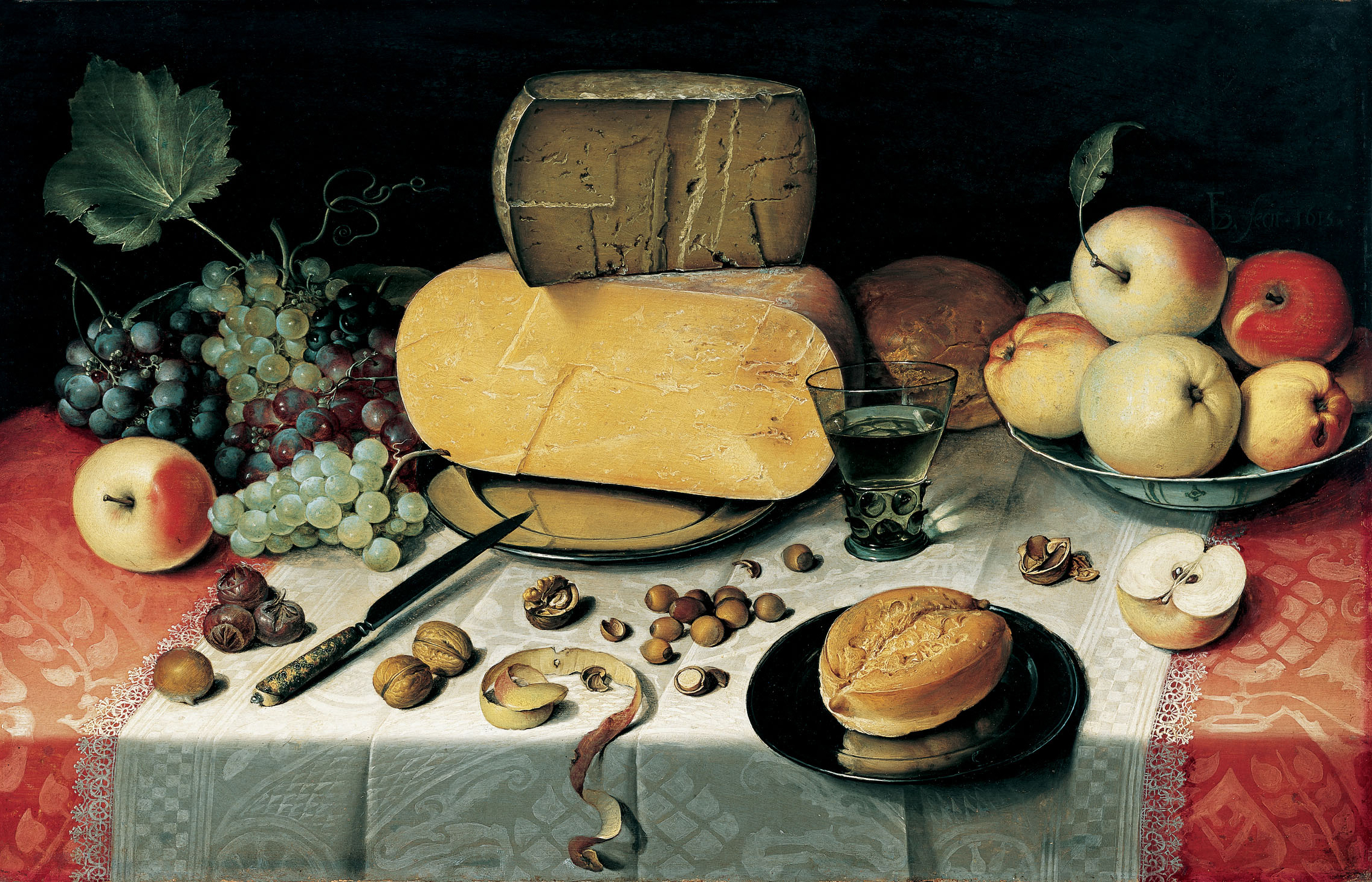
Why Floris Claesz. van Dijck matters
Floris Claesz. van Dijck is one of the founding figures of Dutch still-life painting. Working in Haarlem in the first decades of the 1600s, he was among the earliest artists to develop the "ontbijt," or breakfast and banquet display piece, a table laid with cheese, fruit, nuts, and tableware, rendered with a level of descriptive precision that shaped the genre for the century that followed. For a collector, he matters less as a market name and more as an origin point: fewer than twenty works survive, nearly all of them already in museum collections, so his significance is scholarly and historical rather than transactional.
- Nationality
- Dutch
- Media
- Painting
- Movement
- Dutch Golden Age, Still-life painting
- Education
- No school, master, or degree documented. Likely trained through workshop apprenticeship, the standard route for the period. He is reported to have traveled to Italy and was in Rome around 1600, returning to Haarlem by 1606.
- Signature motifs
- Banquet still life (ontbijt), Laid tables with cheese, fruit, and nuts
By the numbers
- c. 1575 to 1651Active eraDutch Golden Age, based in Haarlem
- Fewer than 20Known worksextremely rare on the market
- National Gallery, Rijksmuseum, Frans Hals MuseumMuseum collections
- Not publicly documentedAuction recordno verified top sale identified in current research
Biography
Floris Claesz. van Dijck, also recorded as Floris van Dyck or Floris van Dijck, was born around 1575 in Delft. Little is documented about his early training, which is typical for a Dutch painter of this period, when instruction generally happened through workshop apprenticeship rather than any formal school. He reportedly traveled to Italy and was in Rome around 1600.
By 1606 he was established in Haarlem, where he spent the rest of his career. There he became a pioneering practitioner of the still-life "display piece," painting richly laid tables of cheese, fruit, nuts, and bread rendered in careful, even light. He is credited by art historians with influencing the younger Haarlem still-life painter Pieter Claesz, among others, though no direct teacher-pupil relationship is documented. Van Dijck died in Haarlem before 26 April 1651.
Critical reception
Van Dijck's still lifes were admired in his own lifetime. The Haarlem chronicler Theodorus Schrevelius praised his skill in the seventeenth century, a tribute preserved in museum commentary on his work. Modern scholarship has continued to treat him as a foundational figure in the genre, and his paintings have been included in major thematic surveys of Dutch Golden Age still life, among them "Slow Food: Still Lifes of the Golden Age" at the Mauritshuis in 2017 and two Grasset Collection touring exhibitions, in San Diego in 2016 and St. Petersburg, Florida in 2019.
Market
No all-time auction record for Floris Claesz. van Dijck could be verified across the auction databases, gallery listings, and market press reviewed for this profile. This is consistent with the small size of his known body of work, most of which is already held by national and municipal museum collections rather than circulating through private hands or the auction market. Collectors should treat any claimed sale price for this artist with caution unless it can be traced to a named auction house, lot, and date.
Selected exhibitions
| Years | Exhibition | Venues |
|---|---|---|
| 2019 | A Feast for the Eyes: European Masterpieces from the Grasset Collection | Museum of Fine Arts, St. Petersburg, Florida |
| 2017 | Slow Food: Still Lifes of the Golden Age | Mauritshuis, The Hague |
| 2016 | Brueghel to Canaletto: European Masterpieces from the Grasset Collection | The San Diego Museum of Art |
Museum collections
- National Gallery, London
- Rijksmuseum, Amsterdam
- Frans Hals Museum, Haarlem
Authentication and provenance
No catalogue raisonne.
No catalogue raisonne has been published. Fewer than twenty works are firmly attributed to him, and attributions are maintained through the RKD Netherlands Institute for Art History and the holding museums rather than through a certificate program.
Primary reference: https://rkd.nl/en/explore/artists/25231
What collectors should know
Van Dijck's market is defined by scarcity rather than by price history. With fewer than twenty works firmly attributed to him and no published catalogue raisonne, attribution rests on the scholarship of the RKD Netherlands Institute for Art History and the curatorial departments of the museums that hold his paintings, principally the National Gallery in London, the Rijksmuseum in Amsterdam, and the Frans Hals Museum in Haarlem. Any work offered as his should come with clear provenance and institutional or scholarly support, given how thin the surviving record is.
Further reading and resources
Data current as of 2026-07-09.

