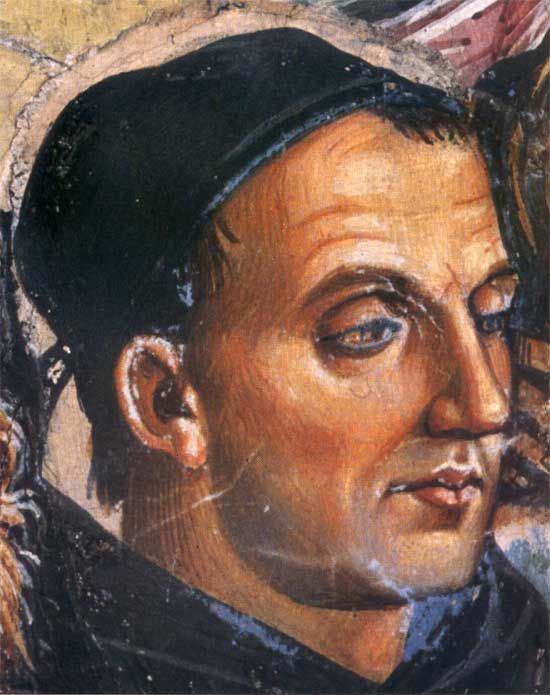
Why Fra Angelico matters
Fra Angelico stands among the founding figures of the Early Renaissance, a Dominican friar whose gold-ground panels and Florentine fresco cycles fused Gothic devotion with the new naturalism of the fifteenth century. His work is held almost entirely by museums, churches, and libraries rather than private hands, so for a collector he represents less a liquid market and more a benchmark: a name whose scarcity at auction, museum-anchored provenance, and near-universal art-historical standing make any authenticated sale a market event in itself.
- Nationality
- Italian
- Media
- Panel painting, Fresco, Manuscript illumination
- Movement
- Early Renaissance
- Education
- No formal art academy. Dominican religious formation at the Convent of San Domenico, Fiesole, entered as a novice c. 1420 to 1422. Artistic training is undocumented; scholars propose the Florentine workshop of Lorenzo Monaco as a likely source.
- Signature motifs
- Gold-ground devotional panels, San Marco fresco cycle, Serene Annunciations and Madonnas
- Representation
- "Not applicable; a 15th-century artist with no gallery or estate representation. Works are held exclusively by museums, churches, and libraries."
By the numbers
- approx. USD 6.4MAuction highCrucifixion, over GBP 5 million, Christie's London, 6 July 2023
- 1982BeatifiedPope John Paul II, Vatican City
- 1417First recorded as painterDocumented in Florentine archives
- NoneRepresented byWorks held only in museums, churches, and libraries
Selected works
Click any work to view it full screen.
Biography
Fra Angelico was born Guido di Pietro around 1395 in Vicchio, in the Mugello region of the Republic of Florence. He is first documented as a painter in 1417, and around 1420 to 1422 he entered the Dominican convent of San Domenico at Fiesole as a novice, taking the name Fra Giovanni. No school or formal apprenticeship is documented for his artistic training, though scholars have long proposed that he passed through the Florentine workshop of Lorenzo Monaco.
As a friar-painter he worked across Florence, Fiesole, Cortona, Perugia, and finally Rome. His best-known body of work is the fresco cycle he painted after 1436 for the Dominican friary of San Marco in Florence, whose rebuilding was funded by Cosimo de' Medici, alongside gold-ground altarpieces and panels produced for churches and patrons across Tuscany. Later in his career he was called to Rome to paint chapels for the papacy, and he died there on 18 February 1455. He was buried in the Dominican church of Santa Maria sopra Minerva in Rome. He was beatified by Pope John Paul II in 1982 and, in 1984, was declared the patron of Catholic artists, a designation that reflects both his religious life and the enduring reputation of his painting.
Critical reception
Fra Angelico's reputation was established almost immediately after his death: writers of the period soon praised him as the Angelic Painter, the honorific from which his familiar name derives. Modern scholarship, echoed in major retrospectives at the Metropolitan Museum of Art (2005 to 2006), the Prado (2019 to 2020), and the joint Palazzo Strozzi and Museo di San Marco exhibition (2025 to 2026), consistently frames him as a bridge figure: a painter of unusually direct religious feeling who nonetheless absorbed the spatial and naturalistic advances of the early Florentine Renaissance. His 1982 beatification and 1984 designation as patron of Catholic artists further cemented a critical and devotional reputation that has remained remarkably stable across nearly six centuries.
Market
Fra Angelico's market is defined by extraordinary scarcity rather than by trading volume. The Art Newspaper has noted that only two of his works reached significant auction prices this century before 2023. The current auction record is Crucifixion, a devotional panel sold at Christie's London on 6 July 2023 for over GBP 5 million (reported at roughly USD 6.4 million), which press coverage at the time described as a new record for the artist. Because works by his hand are held almost entirely by museums, churches, and libraries and rarely reach the open market, this sale stands as an isolated data point rather than part of a continuous price trend.
Top auction results
| Work | Price | Sale |
|---|---|---|
| Crucifixion | USD 6,400,000 (over GBP 5,000,000 (exact hammer price not publicly disclosed)) | Christie's, London, 2023-07-06 |
Selected exhibitions
| Years | Exhibition | Venues |
|---|---|---|
| 2025 to 2026 | Angelico | Fondazione Palazzo Strozzi and Museo di San Marco, Florence |
| 2019 to 2020 | Fra Angelico and the Rise of the Florentine Renaissance | Museo Nacional del Prado, Madrid |
| 2005 to 2006 | Fra Angelico | The Metropolitan Museum of Art, New York |
| 1955 | Quincentenary exhibition (500th anniversary of his death) | Florence |
| 1968 | The Great Age of Fresco: Giotto to Pontormo | The Metropolitan Museum of Art, New York |
| c. 1436 onward | Fresco cycle (permanent, in situ) | Dominican friary of San Marco, Florence |
Museum collections
- Musee du Louvre, Paris
- Gemaldegalerie, Berlin
- The Metropolitan Museum of Art, New York
- National Gallery of Art, Washington, D.C.
- Vatican Museums, Vatican City
- Alte Pinakothek, Munich
- Rijksmuseum, Amsterdam
- Museo di San Marco, Florence
- Uffizi Galleries, Florence
Awards and honors
- Beatified by Pope John Paul II, Vatican City (1982)
- Declared Patron of Catholic Artists by Pope John Paul II (1984)
Authentication and provenance
No catalogue raisonne.
No catalogue raisonne is documented for Fra Angelico. Attribution rests on scholarly connoisseurship built up across major retrospectives (Metropolitan Museum, Prado, Palazzo Strozzi and Museo di San Marco), on archival documents from the Dominican orders he served, and on provenance tracing through church, library, and museum custody. Works by his hand rarely appear on the open market, which places additional weight on documented provenance and expert attribution rather than a published, numbered catalogue.
Primary reference: https://www.metmuseum.org/essays/fra-angelico-guido-di-pietro-ca-1395-1455
What collectors should know
Because Fra Angelico's works are concentrated in museums, churches, and libraries, and because no catalogue raisonne exists, any work presented for sale carries an unusually heavy burden of documented provenance and outside expert attribution. The auction record itself was set by a devotional panel rather than a major altarpiece, a reminder that scale and location within his body of work matter as much as authorship when a rare piece does reach the market. Given the extreme rarity of transactions, collectors should treat any single Fra Angelico sale as an exceptional event rather than as a signal of a broader, tradeable market.
Further reading and resources
Data current as of 2026-07-09.

