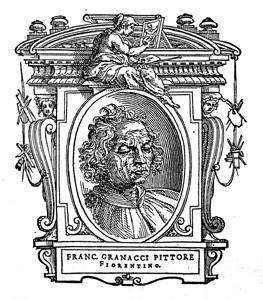
Why Francesco Granacci matters
Francesco Granacci was a Florentine Renaissance painter, trained alongside Michelangelo in the workshop of Domenico Ghirlandaio and later in Lorenzo de' Medici's sculpture garden. He matters to collectors and historians less as a market star in his own right and more as a documented link between the late Quattrocento workshop tradition and the generation that produced the High Renaissance. His panels sit today in the Uffizi, the Metropolitan Museum of Art, and the National Gallery, London, and his career offers a case study in how attribution, provenance, and connoisseurship, rather than a modern auction record, establish value for an Old Master with no catalogue raisonne.
- Nationality
- Italian
- Media
- Panel painting, Fresco
- Movement
- Renaissance, Florentine School
- Education
- Apprenticeship in the workshop of Domenico Ghirlandaio, Florence (undated). Studied in Lorenzo de' Medici's sculpture garden at San Marco under Bertoldo di Giovanni alongside Michelangelo; exact dates undocumented. No formal degrees existed for Renaissance-era artists.
- Signature motifs
- Sacred narrative panel painting, Ghirlandaio-derived figural grouping
By the numbers
- Florence, late 1400s to 1543ActiveRenaissance painter, pupil of Domenico Ghirlandaio
- 30 November 1543DiedFlorence, buried at the church of Sant'Ambrogio
- None publishedCatalogue raisonneAttribution relies on museum scholarship and connoisseurship
- Uffizi, the Met, National Gallery London, and othersMuseum presenceSee Collections
Selected works
Click any work to view it full screen.
Biography
Francesco Granacci, also recorded as Francesco di Andrea di Marco, was born in 1469 (a minority of catalogue sources, including the Art Renewal Center and Harvard Art Museums, instead give 1477). Most major reference sources, including Wikipedia and the Metropolitan Museum of Art, give his birthplace as Villamagna, though Virtual Uffizi lists Volterra; the balance of sourcing favors Villamagna. He trained in Florence in the workshop of Domenico Ghirlandaio, where he formed a lifelong friendship with Michelangelo Buonarroti. The two young painters also frequented Lorenzo de' Medici's sculpture garden near the convent of San Marco, studying sculpture under Bertoldo di Giovanni; no source gives Granacci's precise dates of attendance.
Granacci worked mainly in Florence for the rest of his career. He died there in 1543; Wikipedia gives the precise date of 30 November 1543, a detail not independently confirmed elsewhere in the sourcing used for this profile, though the year and Florence as the place of death are corroborated by RKD, the Metropolitan Museum, and the National Gallery. Wikipedia and Virtual Uffizi agree that he was buried in the church of Sant'Ambrogio in Florence.
Critical reception
Scholarly treatment of Granacci, running from Vasari's sixteenth-century Lives through modern museum catalogues, presents him as a technically capable painter whose style bridges Ghirlandaio's workshop naturalism and the monumental figuration associated with Michelangelo. A recurring theme in the academic literature, including a JSTOR study titled "Francesco Granacci and Some Questions of Identity," is the difficulty of separating Granacci's autograph work from paintings produced by his circle or by anonymous followers; auction and museum catalogues accordingly sometimes list works as Circle of Francesco Granacci or Pseudo Granacci rather than as the artist himself. No exact, attributable critic quotation from a named writer in a major outlet could be confirmed for this profile.
Market
Public auction data for Granacci is thin and partly held behind paywalled databases, so no all-time record price can be stated with confidence as of 2026-07-11. Christie's London has offered a panel titled The Nativity, attributed to Granacci, with a published estimate of £70,000 to £100,000; the realized price is not visible in the freely accessible listing. MutualArt's tracking separately notes realized prices for paintings attributed to Granacci reaching into the mid six figures, up to roughly USD 362,500, but the specific work, sale date, and auction house behind that figure are not confirmed in public sources. Collectors should treat any single reported sale price for this artist with caution until the underlying lot can be verified.
Museum collections
- Uffizi Galleries, Florence
- The Metropolitan Museum of Art, New York
- National Gallery, London
- Honolulu Museum of Art
Authentication and provenance
No catalogue raisonne.
No catalogue raisonne has been published. Attribution rests on museum scholarship, Giorgio Vasari's contemporary account in the Lives, and connoisseurship. Some panels are catalogued only as Circle of Francesco Granacci or Pseudo Granacci, reflecting ongoing academic debate over which works are autograph.
Primary reference: https://www.nationalgallery.org.uk/artists/francesco-granacci
What collectors should know
There is no catalogue raisonne for Granacci, so establishing that a given panel is autograph depends on museum scholarship, provenance history, and connoisseurship rather than a single reference catalogue. Buyers should pay close attention to cataloguing language: a work described as Circle of Francesco Granacci or Pseudo Granacci carries materially different authorship confidence, and by extension value, than one attributed to the artist outright. Public auction data is sparse and partly inaccessible without paid databases, so a single high or low result should not be read as a stable market benchmark. The strongest signal of authenticity remains a documented link to the examples already established in major public collections, including the Uffizi, the Metropolitan Museum of Art, and the National Gallery, London.
Further reading and resources
Data current as of 2026-07-11.

