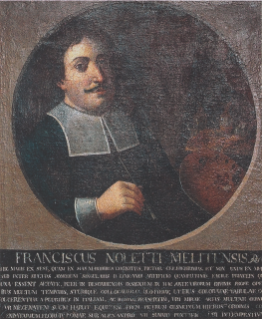
Why Francesco Noletti matters
Francesco Noletti, known to history mainly as il Maltese, was a specialist still-life painter working in Rome in the middle of the seventeenth century, best remembered for elaborate depictions of oriental carpets, cushions, armor, and precious objects. His case matters to collectors less for market size than for identity: for much of the nineteenth and twentieth centuries his paintings circulated under a different name, Francesco Fieravino, and modern archival research has only recently reunited that scattered body of work under his own name. Paintings from that reconstructed oeuvre are now held by institutions such as the Museo de Bellas Artes de Bilbao.
- Nationality
- Maltese
- Media
- Painting
- Movement
- Baroque, Roman Baroque still-life painting
- Education
- No documented school or named master. Sources describe him leaving Malta for Rome as a young man to study painting, and a Templum Auctions catalogue notes that by around 1640 he had settled in Rome, married, and worked in a professional relationship with the painter Andrea Sacchi.
- Signature motifs
- Oriental carpet still lifes, Arrangements of armor and precious objects
By the numbers
- EUR 100,000Auction highStill life of a carpet, catalogued as Francesco Noletti, called il Maltese, Dorotheum, Vienna, 2016
- c. 1611 to 1654Life datesValletta, Malta to Rome
- Il Maltese; Francesco FieravinoKnown aliasesHistorical name confusion now resolved by modern scholarship to a single artist
- None; historical artistRepresented byWorks circulate through Old Master specialist dealers and auction houses
Selected works
Click any work to view it full screen.
Biography
Francesco Noletti was born around 1611, most sources say probably in Valletta, Malta, though the birthplace carries a question mark in the scholarly literature. No documented school or named master survives for his training; reference sources describe him leaving Malta for Rome as a young man to study painting, and a Templum Auctions catalogue notes that by around 1640 he had settled in Rome, married, and worked in a professional relationship with the painter Andrea Sacchi. In Rome he developed the carpet still life into his signature subject: densely patterned Ottoman and Persian rugs draped over tables and laid alongside armor, musical instruments, fruit, and sweetmeats, rendered with a strong contrast of light and shadow.
For generations, much of his output was misattributed. Cataloguers long assigned his paintings to an artist named Francesco Fieravino, and some works were confused with those of a separate, largely unknown painter, Benedetto Fioravanti. The nickname il Maltese, a reference to his Maltese origin, survived in the literature even as the underlying identity behind it was unsettled. It was the art historian Keith Sciberras, working from archival records including a posthumous portrait long held at the University of Malta, who reconstructed Noletti's biography and reattributed the carpet still-life group to him.
Noletti died in Rome on 4 December 1654. Italian sources note that his death certificate described him as a "celebrated painter." No later activity is recorded anywhere, and there is no ambiguity in modern reference sources about his status: he is a seventeenth-century, deceased Old Master.
Critical reception
Scholarly attention to Noletti is modest in volume but significant in consequence, because it has been reconstructive rather than purely appreciative. The core critical narrative, developed by Keith Sciberras and reflected in museum catalogue essays for institutions such as the Bilbao Fine Arts Museum, is one of correcting a long-standing case of mistaken identity: paintings once dispersed under the name Francesco Fieravino, and occasionally confused with a separate painter, Benedetto Fioravanti, have been reassembled into a single, coherent body of work by Noletti. Within that reassembled oeuvre, writers consistently single out his carpet still lifes for their naturalistic handling of light and pattern and for the sheer density of luxury objects he could arrange convincingly on a canvas. No exact, attributable critical quotation from a named critic in a major outlet could be confirmed for this profile, so none is reproduced here.
Market
Noletti's auction footprint is thin and specialized, consistent with an Old Master whose oeuvre is small, unsigned, and only recently stabilized under his own name. The highest price identified in current research is EUR 100,000 for a still life catalogued as "Francesco Noletti, called il Maltese," sold at Dorotheum in Vienna against an estimate of EUR 80,000 to 120,000. Beyond that result, his works appear occasionally at Old Master sales at houses such as Sotheby's and through specialist dealers, generally at lower prices and sometimes only as attributions rather than firm authorship. There is no dedicated gallery or estate managing his market; paintings move through the ordinary channels of Old Master dealers and auction houses.
Top auction results
| Work | Price | Sale |
|---|---|---|
| Still life of a carpet (catalogued as Francesco Noletti, called il Maltese) (2016) | EUR 100,000 | Dorotheum, Vienna, 2016-04-19 |
Selected exhibitions
| Years | Exhibition | Venues |
|---|---|---|
| 2016 | Francesco Noletti: The Grand Roman Baroque Carpet Still-Life | Old University, Valletta Campus, University of Malta |
Museum collections
- Museo de Bellas Artes de Bilbao, Bilbao
Authentication and provenance
No catalogue raisonne.
No catalogue raisonne exists and there is no certificate-of-authenticity program. The oeuvre, more than forty known paintings, none signed, is established through connoisseurship and archival research rather than a published catalogue, most notably the work of art historian Keith Sciberras.
Primary reference: https://en.wikipedia.org/wiki/Francesco_Noletti
What collectors should know
Because no catalogue raisonne exists and none of his more than forty known paintings are signed, attribution is the central issue for any Noletti or "il Maltese" work on the market: provenance chains, technical examination, and comparison to securely attributed museum examples, such as those at the Museo de Bellas Artes de Bilbao, matter more here than for most artists of his period. Buyers should also expect that older catalogue entries, gallery labels, or provenance documents may still use the name Francesco Fieravino rather than Noletti, since the identification is a relatively recent scholarly correction. Public auction data is sparse enough that a single result, such as the EUR 100,000 Dorotheum sale, should be treated as an indicative data point rather than a stable pricing benchmark.
Further reading and resources
Data current as of 2026-07-16.

