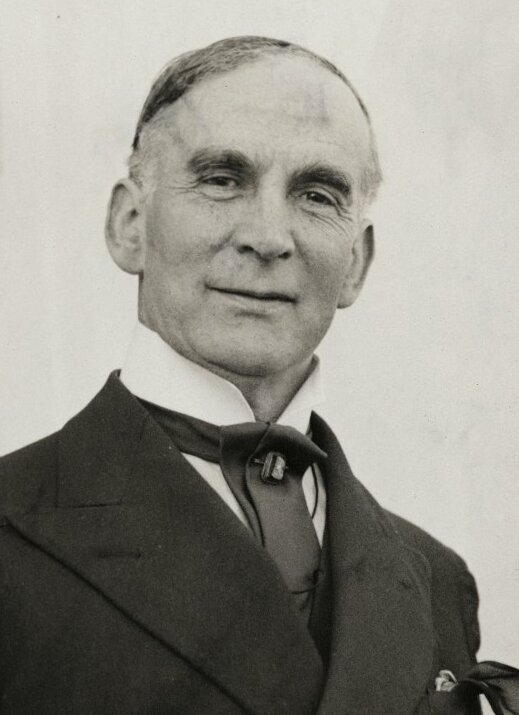
Why Frank O. Salisbury matters
Frank O. Salisbury was one of the most in-demand portrait and ceremonial painters of the British and American establishment in the first half of the twentieth century, credited with portraits of roughly two dozen members of the British Royal Family and five United States presidents, plus the official White House portrait of Franklin D. Roosevelt. His large historical canvases, among them The Passing of the Unknown Warrior for King George V and The Presentation of the Freedom of the City to Winston Churchill for the Guildhall, and his stained glass windows for Methodist institutions on both sides of the Atlantic, place him inside several of the twentieth century's most prominent national collections, from the Royal Collection to the White House. For collectors, he is a useful case study in the gap between institutional prestige and a documented auction market: his commissioned works sit in some of the world's most visited public collections, while his secondary market is thin, dominated by minor works and portrait studies, and lacks a confirmed high-value benchmark for an original painting.
- Born
- 1874-12-18, Harpenden, Hertfordshire, England
- Nationality
- British
- Media
- Painting, Stained glass
- Movement
- Academic portraiture, Historical and ceremonial painting
- Education
- Heatherley's School of Fine Art, London; Royal Academy Schools, London, 1892 to 1897 (Landseer Scholarship, 1896)
- Signature motifs
- Royal and presidential portraiture, Ceremonial history painting, Stained glass windows
- Representation
- Estate of Frank O. Salisbury, rights administered by DACS; no current commercial gallery representation identified
By the numbers
- USD 76,375Auction high (documented)Christie's, 2001; exact sale date and city not confirmed. Inscribed photograph after his 1947 FDR portrait, not the original oil
- 70 works, 1899 to 1943Royal Academy exhibitorNever elected a Royal Academician
- CVO, 1938HonorCommander of the Royal Victorian Order
- 25+ British royals; 5 US presidentsSittersPer Woolley & Wallis, citing his reputation as 'Britain's Painter Laureate'
Selected works
Click any work to view it full screen.
Biography
Francis Owen Salisbury, known professionally as Frank O. Salisbury, was born on 18 December 1874 in Harpenden, Hertfordshire, England. He apprenticed in stained glass in nearby St Albans before training formally at Heatherley's School of Fine Art in London and then at the Royal Academy Schools, where he studied from 1892 to 1897 on a scholarship and won the Landseer Scholarship in 1896, which funded a period of study in Italy. His first work was accepted at the Royal Academy in 1899, beginning a run in which he exhibited there roughly seventy times through 1943, though he was never elected a Royal Academician.
Salisbury built a career on both sides of the Atlantic painting royalty, heads of state, and financiers. He is credited with painting some twenty five members of the British Royal Family and five United States presidents, including Woodrow Wilson, Calvin Coolidge, Franklin D. Roosevelt, Harry Truman, and Dwight Eisenhower, as well as financiers such as J.P. Morgan, John D. Rockefeller Jr., and Andrew Mellon. His portrait of Roosevelt, completed in 1947, became the official White House portrait of the president. His large scale historical works include The Passing of the Unknown Warrior, commissioned by King George V and depicting the 1920 procession of the Unknown Warrior's coffin through Whitehall, and The Presentation of the Freedom of the City to Winston Churchill in the Guildhall, London, 30 June 1943. He also designed stained glass windows, with his largest concentrations at Wesley's Chapel in London, the former National Children's Home chapel in Harpenden, and Forest Hill Methodist Church in London.
He was made a Commander of the Royal Victorian Order in 1938, was elected a member of the Royal Society of Portrait Painters in 1917 and the Royal Institute of Painters in Water Colours in 1921, and served as Master of the Worshipful Company of Glaziers and Painters of Glass in 1933. He was widely nicknamed "Britain's Painter Laureate." Salisbury died on 31 August 1962 at Sarum Chase, his home in Hampstead, London, at the age of 87, and is buried in St Nicholas churchyard in his native Harpenden.
Critical reception
During his lifetime Salisbury's reputation rested less on critical acclaim than on demand from sitters: he was known as "Britain's Painter Laureate" for the sheer roster of royalty, presidents, and financiers who commissioned him, and his roughly seventy Royal Academy showings between 1899 and 1943 reflect sustained institutional acceptance even without full RA membership. His conservative, representational style is described in some sources as having drawn skepticism from modernist critics of his era, though no specific critical text or verbatim wording is confirmed in available sources. Later assessment has tended to treat him primarily as a chronicler of establishment power and ceremony rather than as a stylistic innovator, a status corroborated by the institutional character of his major holdings, in the Royal Collection, the White House, the National Portrait Gallery, and the Guildhall, rather than by a robust critical literature.
Market
No confirmed auction record exists for an original Salisbury painting. The highest documented price connected to his work is USD 76,375, paid at Christie's in 2001 (exact sale date and city not confirmed in available sources) for a Cartier framed, sepia toned photograph after his 1947 White House oil portrait of Franklin D. Roosevelt, inscribed by Salisbury to Eleanor Roosevelt; contemporary press described it as a record for a twentieth century inscribed photograph, but the lot was a photographic reproduction, not the original canvas. Away from that sale, original oils and drawings trade in a modest range: a group of eight family portraits carried estimates of GBP 1,500 to 8,000 at Woolley & Wallis, and a portrait of his daughter Sylvia from the same family collection hammered at GBP 12,000 in 2014. No commercial gallery currently represents his work; copyright in most of his paintings is held by the Estate of Frank O. Salisbury and administered by DACS, and works reach the market through auction houses such as Christie's, Woolley & Wallis, and Roseberys rather than through gallery representation.
Top auction results
| Work | Price | Sale |
|---|---|---|
| Inscribed photograph after Frank O. Salisbury's 1947 White House portrait of Franklin D. Roosevelt (Roosevelt family collection) (2001) | USD 76,375 (USD 76,375) | Christie's |
Selected exhibitions
| Years | Exhibition | Venues |
|---|---|---|
| 1899 | First Royal Academy acceptance | Royal Academy of Arts, London |
| 1899 to 1943 | Regular exhibitor, approximately 70 works shown | Royal Academy of Arts, London |
| 1920 | The Passing of the Unknown Warrior | Royal Collection, commissioned by King George V |
| 1943 | The Presentation of the Freedom of the City to Winston Churchill in the Guildhall, London | Guildhall Art Gallery, London |
| 1947 | Official White House portrait of Franklin D. Roosevelt donated to the White House Collection | The White House, Washington, D.C. |
| 1985 | Studio sale | Christie's, London |
| 2015 | Acquisition of an oil sketch of the Prince of Wales (later Edward VIII), painted on the Western Front in 1917 | National Portrait Gallery, London |
| 2023 | The Frank Salisbury Gift, 200 portrait drawings | Roseberys, London, to the Walpole Society |
Museum collections
- Royal Collection Trust, United Kingdom
- White House Collection, Washington, D.C.
- National Portrait Gallery, London
- Guildhall Art Gallery, London
- Government Art Collection, United Kingdom
- Wesley's Chapel, London (stained glass)
- Royal Air Force Museum, London
Awards and honors
- Landseer Scholarship, Royal Academy Schools (1896)
- Member, Royal Society of Portrait Painters (1917)
- Member, Royal Institute of Painters in Water Colours (1921)
- Master, Worshipful Company of Glaziers and Painters of Glass (1933)
- Commander of the Royal Victorian Order (CVO) (1938)
Authentication and provenance
No catalogue raisonne.
No catalogue raisonne or certificate-of-authenticity program has been identified. Copyright in most paintings is held by the Estate of Frank O. Salisbury, administered by DACS, and attribution typically relies on signature, inscription, and provenance research given the portrait-commission nature of much of his output.
Primary reference: https://artuk.org/discover/artists/salisbury-frank-o-18741962
What collectors should know
Salisbury's market is defined by scarcity of comparables rather than scarcity of output: he was prolific, but most of his major works are portrait commissions held by museums, royal and government collections, or family estates, and rarely reach the auction room. No catalogue raisonne exists, so attribution and value depend heavily on signature, inscription, and documented provenance, particularly for portraits, where the identity and prominence of the sitter can move price far more than the painting's technical qualities. Buyers should treat the widely cited Christie's 2001 figure with care since it reflects a photograph inscribed by the artist rather than an original oil, and should expect that most available paintings and drawings will fall well below that number, in the low thousands to low tens of thousands of pounds.
Further reading and resources
Data current as of 2026-07-16.

