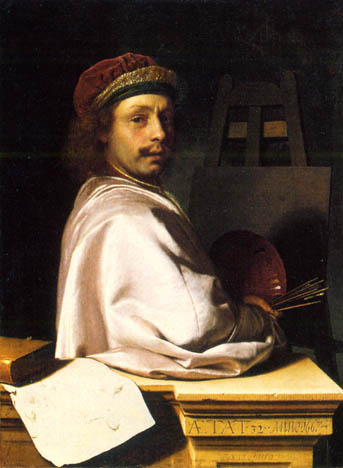
Why Frans van Mieris the Elder matters
Frans van Mieris the Elder was the leading painter of the Leiden fijnschilders, the school of Dutch Golden Age artists prized for extraordinarily fine, small-scale finish. In his own lifetime his paintings were sought by an Archduke and a Grand Duke, and today his work anchors the Dutch collections of major museums from Amsterdam to Washington. For a collector, he represents an established Old Master name with deep institutional standing, paired with a market where verifiable auction data is thin and provenance work matters more than headline price claims.
- Born
- 1635-04-16, Leiden, Dutch Republic
- Nationality
- Dutch
- Media
- Painting
- Movement
- Dutch Golden Age, Leiden fijnschilders
- Education
- Trained under Abraham Toorenvliet's school of design, then in the Leiden workshops of Gerrit Dou and Abraham van den Tempel. Joined the Leiden Guild of Saint Luke in 1658. No university education or academic degrees are documented.
- Signature motifs
- Fijnschilder fine-detail technique, Domestic genre interiors, Rendering of luxurious fabrics
- Representation
- "None documented. A deceased Old Master whose works circulate through auction houses and specialist Old Master dealers rather than gallery or estate representation."
By the numbers
- 1635 to 1681LivedBorn and died in Leiden, Dutch Republic
- Leiden Guild of Saint LukeGuild membershipJoined 1658
- Mauritshuis and National Gallery of ArtMajor retrospective2005 to 2006
- 9+ institutionsMuseum collectionsIncluding the Rijksmuseum, Getty Museum, and Uffizi
Biography
Frans van Mieris was born in Leiden on 16 April 1635, into a family of goldsmiths; his father, Jan Bastiaans van Mieris, was a goldsmith and gem setter, and Frans himself first trained in that trade. He turned to painting under Abraham Toorenvliet, a glazier who kept a school of design in Leiden, before moving into the workshops of the portraitist Abraham van den Tempel and, most consequentially, Gerrit Dou, the founder of the Leiden fijnschilder manner. He became known as the foremost of Dou's pupils and joined the Leiden Guild of Saint Luke in 1658. He married Cunera van der Cock in the spring of 1657; their sons Jan van Mieris (1660 to 1690) and Willem van Mieris (1662 to 1747) both became painters, and a grandson, Frans van Mieris the Younger (1689 to 1763), continued the family's genre-painting tradition as a distinct artist.
Van Mieris worked his entire career in Leiden and became one of the best-paid painters in the Dutch Republic. Archduke Leopold Wilhelm in Vienna tried unsuccessfully to lure him away with a promised allowance, and in 1669 Cosimo III de' Medici, then Grand Duke of Tuscany, paid a studio visit and subsequently acquired several of his paintings. Contemporary critics linked him closely with his teacher: the writer Cornelis de Bie discussed his work in relation to Gerrit Dou as early as 1661, and the French critic Roger de Piles judged that he surpassed his teacher in composition and coloration. He died in Leiden on 12 March 1681 and was buried in the Pieterskerk alongside other prominent Leiden citizens.
Critical reception
Van Mieris was recognized in his own era as standing at or near the top of the Leiden fine-painting tradition, frequently discussed in relation to his teacher Gerrit Dou by contemporaries such as Cornelis de Bie and Roger de Piles. That standing has persisted institutionally: the 2005 to 2006 retrospective organized jointly by the Mauritshuis in The Hague and the National Gallery of Art in Washington drew on his presence in major European and American collections and reaffirmed his place as the central figure of the fijnschilder movement. Museums including the Rijksmuseum, the Getty, and the Uffizi continue to present his genre scenes and portraits as benchmark examples of Dutch small-scale painting.
Market
Van Mieris has no gallery or estate representation in the modern sense; as a deceased seventeenth-century painter, his works pass through Old Master auction houses and specialist dealers rather than a managed program. A widely cited auction-price database lists a figure near USD 4.75 million associated with his name, but the underlying lot, title, auction house, and sale date could not be independently confirmed across other major auction platforms, so it is not treated here as a verified record. Collectors should expect that reliable, sourced price history for this artist is comparatively sparse, and any headline figure should be checked against primary auction-house records before it is relied upon.
Selected exhibitions
| Years | Exhibition | Venues |
|---|---|---|
| 2005 to 2006 | Frans van Mieris (1635 to 1681): Painted Perfection | Mauritshuis, The Hague |
| 2006 | Frans van Mieris the Elder | National Gallery of Art, Washington, D.C. (Dutch Cabinet Galleries) |
Museum collections
- Mauritshuis, The Hague
- Kunsthistorisches Museum, Vienna
- Galleria degli Uffizi, Florence
- National Gallery of Art, Washington, D.C.
- Rijksmuseum, Amsterdam
- National Gallery, London
- Getty Museum, Los Angeles
- Fondation Custodia, Paris
- British Museum, London
Awards and honors
- Admitted to the Leiden Guild of Saint Luke (1658)
- Studio visit and acquisition of several paintings by Cosimo III de' Medici, Grand Duke of Tuscany (1669)
Authentication and provenance
No catalogue raisonne.
No published catalogue raisonne was confirmed. Attribution and authentication for paintings of this kind rest on connoisseurship, technical study, and exhibition history, most notably the 2005 to 2006 Mauritshuis and National Gallery of Art retrospective that consolidated scholarly consensus on his oeuvre.
Primary reference: https://www.nationalgallery.org.uk/artists/frans-van-mieris-the-elder
What collectors should know
There is no confirmed catalogue raisonne for Frans van Mieris the Elder, so attribution depends on connoisseurship, technical examination, and documented exhibition and collection history rather than a single reference catalogue. Buyers should also take care to distinguish him from his son Willem van Mieris and his grandson Frans van Mieris the Younger (1689 to 1763), each of whom has a separate market and body of work; some auction catalogues have even used a different lifespan (1631 to 1685) for the Elder, though the art-historical consensus, drawn from the National Gallery, the Getty, and The Leiden Collection, is 1635 to 1681. Given how limited verifiable auction data is for this artist, provenance documentation and expert authentication should carry more weight than any single reported sale price.
Further reading and resources
Data current as of 2026-07-09.

