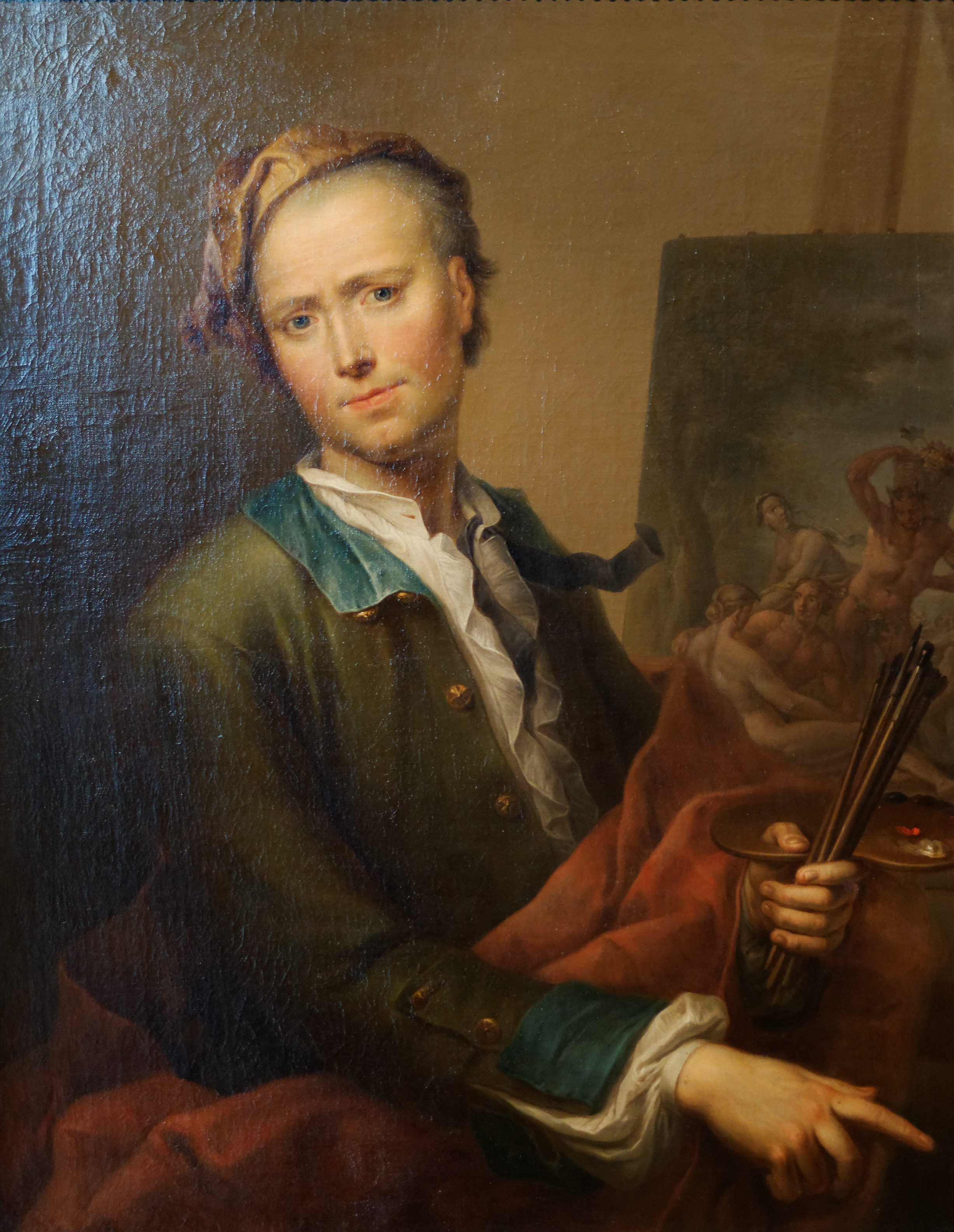
Why Franz Christoph Janneck matters
Franz Christoph Janneck is one of the leading painters of Austrian Rococo cabinet pictures, an artist whose finely worked scenes of aristocratic merrymaking, religious subjects, and landscapes on copper and canvas were prized in his own lifetime and remain a fixture of Old Master sales today. He held teaching and administrative standing at the Vienna Academy alongside Paul Troger and Michelangelo Unterberger, placing him at the center of Vienna's mid-eighteenth-century painting establishment. For collectors, he represents a well-documented, historically significant Old Master name whose market trades in a thin but steady stream at the major continental auction houses.
- Born
- 1703-10-03, Graz, Austria
- Nationality
- Austrian
- Media
- Painting, Cabinet pictures on copper
- Movement
- Austrian Baroque, Rococo
- Education
- Private instruction under the still-life painter Matthias Vangus in Graz; entered the Hofakademie der Maler, Bildhauer und Baukunst in Vienna in 1726 as a student of the court painter Jacob van Schuppen; further study in Frankfurt am Main with Josef Orient. No degree or diploma is documented at any stage.
- Signature motifs
- Cabinet pictures on copper, Fete galante and merrymaking scenes
By the numbers
- 1703 to 1761Life datesGraz to Vienna (Mariahilf)
- Assessor, 1752 to 1758Vienna AcademyAlongside Paul Troger and Michelangelo Unterberger
- ATS 140,000Historical auction highDorotheum, Vienna, 23 March 1965; exact title unconfirmed
- EUR 89,600Notable recent resultim Kinsky, Vienna; Kreuzigung Christi, circa 1750; exact sale date unconfirmed
Selected works
Click any work to view it full screen.
Biography
Franz Christoph Janneck was born on 3 October 1703 in Graz, in the Austrian lands of the Holy Roman Empire. After completing his secondary schooling there, he took private art lessons from the still-life painter Matthias Vangus. Sources agree that he then moved to Vienna, though the exact year is not settled: the most widely repeated encyclopedic account places the move in 1726, tying it to his enrollment as a student of the court painter Jacob van Schuppen at the newly reorganized Hofakademie der Maler, Bildhauer und Baukunst, while some dealer literature gives an earlier move around 1721 or places his Academy enrollment as late as 1740. He later continued his training in Frankfurt am Main under the painter Josef Orient, before returning to Vienna.
Janneck built a career as a painter of highly finished cabinet pictures, most often on copper, depicting fete galante scenes of elegant figures dancing and merrymaking, alongside religious subjects and landscapes. He signed works with the form "F.C. Janneck fe:" or the monogram "FCJ." From 1752 to 1758 he served as Assessor of the Vienna Academy, sharing administrative responsibility for the institution with fellow painters Paul Troger and Michelangelo Unterberger. He died on 13 January 1761 in Mariahilf, then a separate locality just outside Vienna and today part of the city's 6th district, on Mariahilfer Strasse.
Critical reception
Museum and dealer literature consistently treats Janneck as one of the foremost Austrian Baroque and Rococo cabinet painters, often discussed alongside his contemporary Johann Georg Platzer as a benchmark for the genre. No exact, attributable quotation from a named critic in a major outlet could be confirmed in the available sources, so none is reproduced here. The recurring theme across museum notes, auction catalogues, and dealer literature is technical fluency: his small-scale, densely populated scenes on copper are singled out for their finish and for the way they combine genre incident with a Rococo lightness of touch, a reputation that has held steady from his own century into current scholarship and the market.
Market
Janneck's market is that of a historically significant but thinly traded Old Master specialist, concentrated at Dorotheum, im Kinsky, Christie's, and Sotheby's. Dealer records point to two related paintings sold at Dorotheum in Vienna on 23 March 1965 (sale 567, lots 60 to 61), realizing ATS 140,000 and ATS 130,000; the exact titles and which lot achieved which price are not confirmed in the sources reviewed, so these figures should be treated as historical context rather than a reliable current benchmark. In euro-denominated sales, results have generally run in the mid five to low six figures, including a reported EUR 89,600 (including fees) for Kreuzigung Christi, circa 1750, at im Kinsky in Vienna, and a EUR 45,500 result for an Adoration of the Magi subject at the same house; exact sale dates for both are not confirmed. Additional lots appear periodically at Christie's, Sotheby's, and Dorotheum, but this profile could not independently confirm further specific prices and dates, so no further individual results are cited here.
Top auction results
| Work | Price | Sale |
|---|---|---|
| One of two related paintings sold as lots 60 to 61 (Dorotheum sale 567); exact title and lot-price pairing unconfirmed (1965) | ATS 140,000 (paired lot realized ATS 130,000) | Dorotheum, Vienna, 1965-03-23 |
Selected exhibitions
| Years | Exhibition | Venues |
|---|---|---|
| Ongoing | Permanent collection display | Residenzgalerie Salzburg (DomQuartier), Salzburg |
| n.d. | Franz Christoph Janneck's Paintings | National Museum in Krakow, Poland |
| 2020s, exact year unconfirmed | All That Glistens | Nicholas Hall, New York |
Museum collections
- Osterreichische Galerie Belvedere, Vienna
- Kunsthistorisches Museum, Vienna
- Schottenstift, Vienna
- Musee du Louvre, Paris
- Alte Galerie, Universalmuseum Joanneum, Graz
- Residenzgalerie Salzburg (DomQuartier)
Awards and honors
- Assessor, Vienna Academy of Fine Arts, through 1758, an administrative role held alongside Paul Troger and Michelangelo Unterberger (1752)
Authentication and provenance
No catalogue raisonne.
No published catalogue raisonne has been confirmed for Janneck. Works are typically authenticated through the artist's signature, most often 'F.C. Janneck fe:' or the monogram 'FCJ', together with stylistic connoisseurship and documented provenance through the major auction houses that regularly handle his work, including Dorotheum, Christie's, Sotheby's, and im Kinsky.
Primary reference: https://en.wikipedia.org/wiki/Franz_Christoph_Janneck
What collectors should know
There is no published catalogue raisonne for Janneck, so authentication rests on signature, connoisseurship, and traceable auction or collection provenance rather than a single reference catalogue. His market is genuinely thin: sales are infrequent relative to better-known contemporaries, individual results vary considerably by subject and condition, and the one clearly documented record price, from a 1965 Vienna sale in a now-obsolete currency, cannot be read as a reliable indicator of current value. Collectors should weight recent, transparently reported euro-denominated results from Dorotheum, im Kinsky, and comparable houses more heavily than any single historical figure, and should expect provenance research, rather than a catalogue raisonne entry, to carry the weight of verification.
Further reading and resources
Data current as of 2026-07-16.

