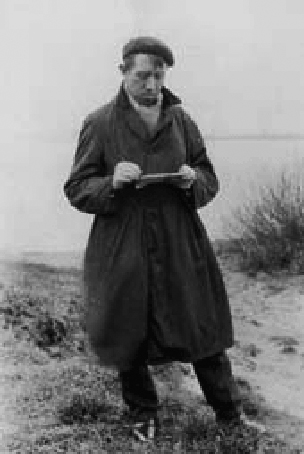
Why Franz Radziwill matters
Franz Radziwill was one of the distinctive voices of German painting between the two world wars, known for landscapes that fold ships, airplanes, and industrial structures into otherwise ordinary village and coastal scenes, giving them an unsettled, dreamlike charge. His work sits inside the broader New Objectivity movement but is usually singled out for its own strain of magic realism. For collectors, he matters as an artist with deep, verified museum standing, including holdings at the National Gallery of Art, the Städel Museum, the Museum of Modern Art, and the British Museum, even though his auction market remains comparatively thin and under-documented in public data.
- Born
- 1895-02-06, Strohausen, near Rodenkirchen, Wesermarsch, Germany
- Nationality
- German
- Media
- Painting, Works on paper
- Movement
- New Objectivity, Magic Realism
- Education
- Bricklayer apprenticeship, Bremen, 1909 to 1913. Admitted to the Technical State School of Bremen to study architecture, from 1913. Evening drawing classes at the Bremen School of Arts and Crafts, 1913 to 1914. No completed degree is documented in available sources.
- Signature motifs
- Ships and aircraft set within pastoral landscapes, Dreamlike, apocalyptic coastal scenes
By the numbers
- 1895 to 1983LifespanBorn Strohausen, Germany; died Wilhelmshaven, Germany
- USD 503,468Auction high (reported)Maximum realized price reported for a painting, per MutualArt; the specific work, auction house, and sale date are not publicly disclosed in accessible sources
- 1963Villa Massimo Prize
- 5Museum collectionsIncluding the National Gallery of Art, the Städel Museum, and the British Museum
Biography
Franz Radziwill was born on 6 February 1895 in Strohausen, near Rodenkirchen, in the Wesermarsch region of Germany, and trained first as a bricklayer in Bremen from 1909 to 1913. He was then admitted to the Technical State School of Bremen to study architecture starting in 1913, while also taking evening drawing and design classes at the Bremen School of Arts and Crafts through 1914. No completed academic degree is documented in available sources; his path into painting grew out of this practical, hands-on training rather than a conventional fine-arts education.
After the First World War, Radziwill developed a style close to Expressionism before moving toward the sober, detail-focused observation associated with New Objectivity, later inflected with surreal and symbolist elements. He had early contact with the Kunsthalle Bremen, exhibiting there as early as 1919, and showed with the Free Secession in Berlin in 1920. His paintings characteristically place ships, airplanes, and industrial forms inside quiet rural or coastal settings, producing landscapes that read as calm and threatening at once. He spent most of his working life in the North Sea town of Dangast, near Varel.
Radziwill's career intersected directly with the politics of the Nazi era, and the record is documented and should not be smoothed over. He was a member of the Nazi Party and, according to the Städel Museum, initially sympathized with the regime. Despite this, his own paintings were declared "degenerate art" beginning as early as 1935, and, per Art Blart and other sources, at least three of his early works were included in the regime's "Entartete Kunst" (Degenerate Art) exhibition. He had assumed a professorship at the Kunstakademie Düsseldorf in 1933, succeeding Paul Klee, and was dismissed from that post around 1935 once his work was outlawed. He continued to paint through the war years; a 1941 exhibition organized for the Weser-Ems Gau in Oldenburg included one of his works addressing submarine warfare.
After 1945, Radziwill's institutional standing recovered steadily. A large traveling exhibition organized by the Oldenburg Kunstverein marked his sixtieth birthday in 1955 and toured sixteen German cities. He maintained a long relationship with the Kunsthalle Bremen, which had exhibited his work as early as 1919. The Landesmuseum Oldenburg mounted a jubilee exhibition in 1975, and a large retrospective followed at the Staatliche Kunsthalle Berlin in 1981, two years before his death. Franz Radziwill died on 12 August 1983 in Wilhelmshaven, Germany.
Critical reception
Radziwill is consistently discussed by museums and historians as a central, if idiosyncratic, figure within German New Objectivity, distinguished from his peers by a magic-realist sensibility that treats ordinary landscapes as sites of latent catastrophe. Institutions including the Städel Museum and the Kunsthalle Bremen frame his recurring motifs, ships, airplanes, and industrial machinery set inside pastoral or coastal scenes, as a sustained meditation on modern anxiety and technological menace rather than straightforward landscape painting. His biography also poses an ongoing interpretive problem for historians: scholarship, including academic work on the artist's politics under National Socialism, treats his Nazi Party membership alongside the regime's own condemnation of his paintings as "degenerate art" as a documented tension rather than a simple story of victimhood or complicity.
Market
Radziwill's auction market is long-running but thinly documented in publicly accessible databases. Artprice records more than 700 auction results for the artist stretching back to at least 1985, and platforms including Artnet, MutualArt, Invaluable, and Barnebys all catalogue his work, sometimes indexing him under the inverted form "Radziwill Franz." The most specific public figure available is a reported maximum realized price of USD 503,468 for a painting, cited by MutualArt, though the underlying work, auction house, sale location, and exact date are not disclosed in accessible listings and could not be independently corroborated. Recent lots at houses such as Lempertz have sold well below that figure, in the range of tens of thousands of euros. No current primary gallery or estate representative could be identified; his work reaches the market primarily through auction houses and secondary dealers rather than a single representing gallery.
Top auction results
| Work | Price | Sale |
|---|---|---|
| Not identified in publicly accessible sources | USD 503,468 |
Selected exhibitions
| Years | Exhibition | Venues |
|---|---|---|
| 2017 | Franz Radziwill and Bremen | Kunsthalle Bremen |
| 1981 | Retrospective | Staatliche Kunsthalle Berlin |
| 1975 | Jubilee exhibition | Landesmuseum Oldenburg |
| 1955 | 60th-birthday traveling exhibition | Organized by the Oldenburg Kunstverein; toured 16 German cities |
| 1941 | Weser-Ems Gau exhibition | Oldenburg |
| 1928 | Deutsche Kunst Düsseldorf (German Art Düsseldorf) | Düsseldorf |
| 1920 | Free Secession exhibition | Berlin |
| 1919 | Early exhibition | Kunsthalle Bremen |
Museum collections
- National Gallery of Art, Washington, D.C.
- Städel Museum, Frankfurt
- Kunsthalle Bremen
- British Museum, London
- Museum of Modern Art, New York
Awards and honors
- Villa Massimo Prize (1963)
Authentication and provenance
No catalogue raisonne.
No published catalogue raisonne and no estate certification program have been identified as of this writing. Works are documented mainly through museum collection records, exhibition history, and auction-house provenance research; there is also no confirmed primary gallery or estate representative to consult for authentication.
Primary reference: https://en.wikipedia.org/wiki/Franz_Radziwill
What collectors should know
There is no published catalogue raisonne and no identified estate or gallery serving as an authentication authority, so provenance research and museum-held comparanda carry unusual weight when evaluating a Radziwill painting or work on paper. Public auction-price data for the artist is fragmented across several databases and, at the very top end, is not fully corroborated with a named work, house, or date, so any single headline price should be treated with caution rather than as a settled benchmark. His institutional presence, spanning the National Gallery of Art, the Städel Museum, the Museum of Modern Art, and the British Museum, is the strongest, most independently verifiable signal of his standing.
Further reading and resources
Data current as of 2026-07-11.

