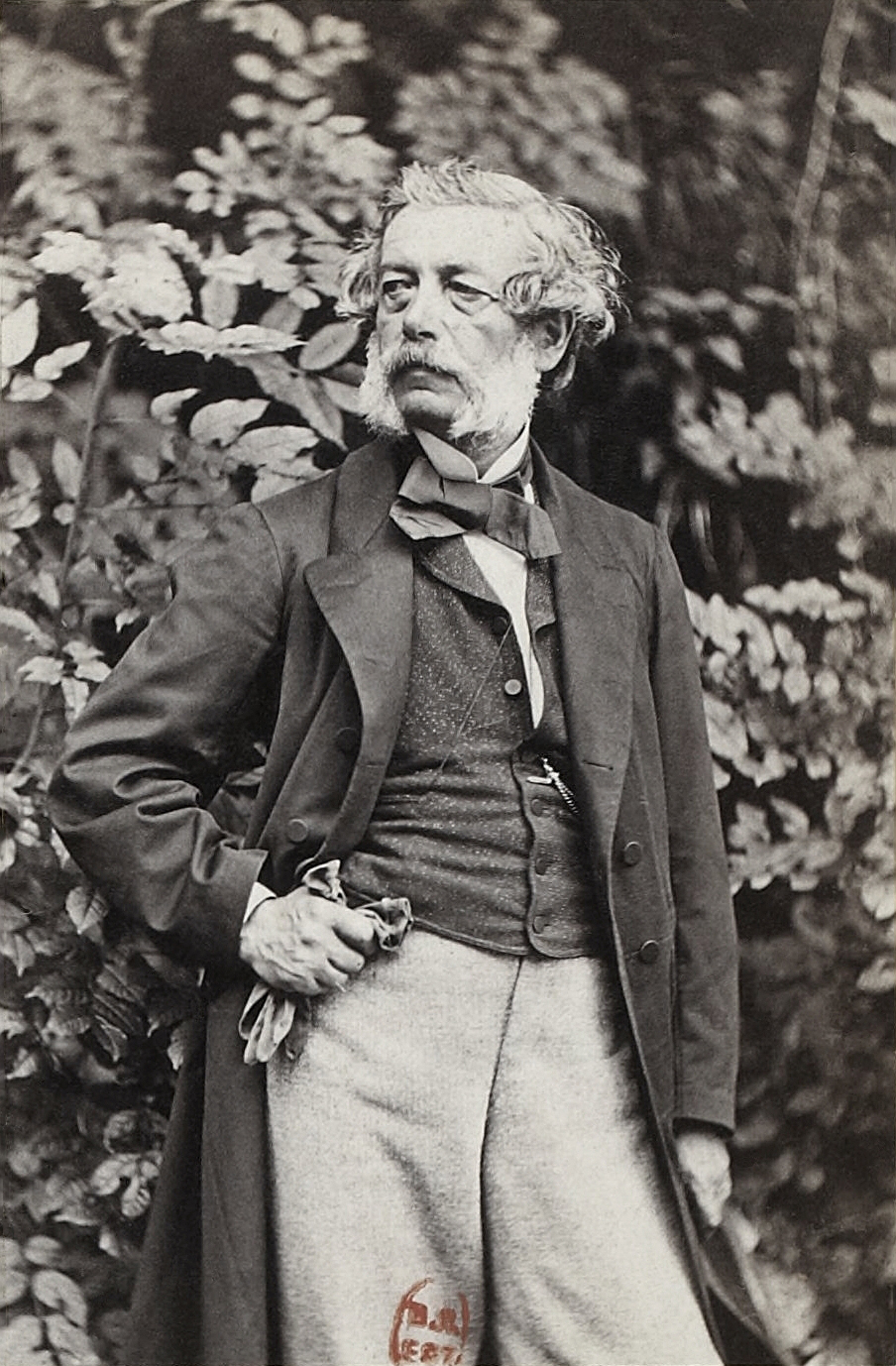
Why Franz Xaver Winterhalter matters
Franz Xaver Winterhalter was the portraitist most European monarchs and aristocrats chose to be remembered by. Across the 1830s to the 1860s he painted Queen Victoria and Prince Albert, King Louis-Philippe of France, Napoleon III and Empress Eugenie, Empress Elisabeth of Austria, and the ruling houses of Mexico, Belgium, and beyond, producing the images that still define how those courts are pictured today. For collectors, he matters less as a market-moving name than as a historically essential one: his paintings sit inside the Royal Collection, the Chateau de Versailles, and major national museums, and the rare examples that reach the auction market are treated as museum-grade material rather than routine supply.
- Born
- 1805-04-20, Menzenschwand, Grand Duchy of Baden (present-day Germany)
- Nationality
- German
- Media
- Painting, Lithography
- Movement
- Academic art, 19th-century court portraiture
- Education
- Studio apprenticeship under Ludwig Schuler, Freiburg im Breisgau, 1818 to 1824; Academy of Fine Arts, Munich, circa 1824 to 1827, studying under Peter von Cornelius and Joseph Karl Stieler.
- Signature motifs
- Idealized royal and aristocratic portraiture, Luminous rendering of skin and fabric, Group portraits of court ladies-in-waiting
By the numbers
- Not conclusively documentedAuction highDatabases report results up to about USD 1.98M for paintings (MutualArt); a fully documented example is EUR 150,000 for Portrait of the Viscountess Esher, Christie's London, 1 December 2022
- 1805 to 1873LifespanGerman court portraitist, died in Frankfurt am Main
- 1987Major retrospectiveNational Portrait Gallery, London, and Petit Palais, Paris
- 2016Recent surveyHigh Society: The Portraits of Franz X. Winterhalter, Museum of Fine Arts, Houston, and J. Paul Getty Museum
Selected works
Click any work to view it full screen.
Biography
Winterhalter was born on 20 April 1805 in Menzenschwand, in the Grand Duchy of Baden. He received basic schooling and early drawing instruction from a local pastor, then attended a Benedictine monastery school in St. Blasien before leaving home at thirteen. From 1818 to 1824 he trained as a draughtsman, engraver, and lithographer in the Freiburg im Breisgau studio of Ludwig Schuler. In 1823 he moved to Munich with the support of the Grand Duke of Baden, and from about 1824 to 1827 he studied at the Academy of Fine Arts in Munich, receiving instruction from Peter von Cornelius and, more decisively for his later career, from the portraitist Joseph Karl Stieler. He completed his academy studies in the summer of 1827 and later spent time studying in Italy, including Rome, between 1832 and 1834.
He began exhibiting at the Paris Salon in the mid-1830s, and critics praised his 1836 Salon debut. A genre painting shown at Karlsruhe in 1834 won public acclaim as well. Success in Paris drew him into the circle of King Louis-Philippe, whose portrait commissions he fulfilled through the 1840s, and he went on to become the favored portrait painter of Napoleon III and Empress Eugenie, of Queen Victoria and Prince Albert, and of royal patrons across Germany, Austria, Belgium, Russia, and Mexico. Queen Victoria is recorded as having called him her "excellent, delightful Winterhalter," and the Royal Collection today holds more than one hundred of his works. He continued to travel and paint for European courts through the 1860s. During a visit to Frankfurt am Main in the summer of 1873 he contracted typhus and died there on 8 July 1873, at the age of sixty-eight.
Critical reception
Winterhalter's critical reputation has moved in an arc. Contemporary critics praised his 1836 Paris Salon debut and, by the mid to late 1830s, regarded him as among the best portrait painters working in Paris. That standing carried him into four decades as the preferred portraitist of European royalty. In the generations after his death, however, critics increasingly dismissed his work as glossy and superficial, valuing it more as a historical record of vanished courts than as serious painting. That view began to reverse with a major 1987 retrospective at the National Portrait Gallery, London, and the Petit Palais, Paris, and was reinforced by the 2016 survey High Society: The Portraits of Franz X. Winterhalter at the Museum of Fine Arts, Houston, and the J. Paul Getty Museum. At the Houston opening, museum director Gary Tinterow and curator Helga Aurisch both spoke to the historical vividness of his court portraits and to his skill in rendering skin, hair, and fabric.
Market
Winterhalter's market is thin and specialized within the Old Master and nineteenth-century painting categories. Public auction-market summaries report results reaching roughly USD 1.98 million for paintings, but full details for that top-level figure, including the specific work, house, and date, are not consistently published in accessible sources. A fully documented example near the upper end of his market is Portrait of the Viscountess Esher, which sold for EUR 150,000 at Christie's London on 1 December 2022. Most of Winterhalter's major works remain in royal collections and museums rather than in private hands, and works of comparable scale and royal sitters rarely come to auction. No current commercial gallery or estate represents Winterhalter; work by him is handled through Old Master and nineteenth-century sales at the major auction houses and through specialist dealers in European portraiture, rather than through gallery representation of the kind associated with living or recently deceased artists.
Top auction results
| Work | Price | Sale |
|---|---|---|
| Portrait of the Viscountess Esher (2022) | EUR 150,000 | Christie's, London, 2022-12-01 |
Selected exhibitions
| Years | Exhibition | Venues |
|---|---|---|
| 1834 | Public exhibition, Karlsruhe | Karlsruhe |
| 1836 | Paris Salon debut | Paris Salon |
| 1987 | Franz Xaver Winterhalter | National Portrait Gallery, London |
| 1987 | Franz Xaver Winterhalter | Petit Palais, Paris |
| 2016 | High Society: The Portraits of Franz X. Winterhalter | Museum of Fine Arts, Houston |
| 2016 | Franz Xaver Winterhalter | J. Paul Getty Museum, Los Angeles |
Museum collections
- Royal Collection Trust, United Kingdom
- Musee Jacquemart-Andre, Paris
- Chateau de Versailles
- National Museum of History, Chapultepec Castle, Mexico City
- Staatliche Kunsthalle Karlsruhe
Authentication and provenance
No catalogue raisonne.
No published catalogue raisonne has been confirmed. Attribution and provenance work rely on museum and Royal Collection records and on auction-house research, since Winterhalter and his studio produced multiple painted versions of his most popular royal portraits.
Primary reference: https://en.wikipedia.org/wiki/Franz_Xaver_Winterhalter
What collectors should know
Winterhalter's market is illiquid and dominated by institutional ownership rather than active private trading, so any single auction result should be read as a data point from a thin field rather than a stable price trend. There is no published catalogue raisonne, and because Winterhalter and his studio produced multiple painted versions of his most sought-after royal portraits, provenance and attribution research through museum, Royal Collection, and auction-house records matter more than usual before a purchase. Collectors should also expect that the strongest examples of his work are simply not for sale, since they remain in the Royal Collection, the Chateau de Versailles, and comparable national institutions.
Further reading and resources
Data current as of 2026-07-10.

