Why Fred Sandback matters
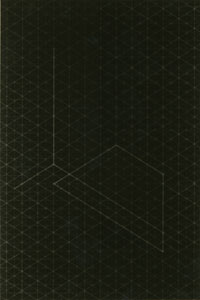
Fred Sandback is one of the defining figures of American Minimalist and postminimalist sculpture, known for defining planes and volumes in a room using nothing more than lengths of colored acrylic yarn strung taut between floor, wall, and ceiling. Rather than building solid mass, he used a single line to suggest an entire sculptural volume, asking viewers to complete the form in their own perception. For a collector, he represents a market built almost entirely on museum validation and archival stewardship rather than auction volume, since much of his work is site-specific and rarely appears for sale as a discrete, fixed object.
- Born
- 1943-08-29, Bronxville, New York, USA
- Nationality
- American
- Media
- Sculpture, Installation, Drawing
- Movement
- Minimalism, Postminimalism
- Education
- Williston Academy, 1957 to 1961; Theodor-Heuss-Gymnasium, Heilbronn, West Germany, 1961 to 1962; Yale University, BA Philosophy 1966; Yale School of Art and Architecture, MFA Sculpture 1969
- Signature motifs
- Acrylic yarn line constructions, Illusory planes and volumes
- Representation
- "David Zwirner (estate)"
By the numbers
- USD 139,700 (best documented, unverified record)Auction highUntitled (LLR of A Series of Eight Sculptures, Open Series), 1969; sale house and exact date not independently confirmed beyond a May 2026 press recap
- David Zwirner (estate)Represented byEstate representation
- Dia:Beacon, Beacon, New YorkLong-term installationOn view since Dia:Beacon's 2003 opening
- 2007Archive establishedFred Sandback Archive
Biography
Fred Sandback was born on August 29, 1943, in Bronxville, New York. He attended Williston Academy from 1957 to 1961, then spent a year at the Theodor-Heuss-Gymnasium in Heilbronn, West Germany, from 1961 to 1962. He returned to the United States to study philosophy at Yale University, earning a BA in 1966, and continued at the Yale School of Art and Architecture, completing an MFA in sculpture in 1969.
While still at Yale, Sandback developed his signature approach: stretching colored acrylic yarn, wire, or cord across a room's corners and open spans to trace the edges of an implied plane or volume. The work sat within the vocabulary of Minimalism but pushed toward something closer to drawing in space, using illusion and perception as material as much as yarn itself. Institutional writing about his practice frequently frames this effect as a deliberate blending of fact and illusion, rather than a simple play of solid form.
His first solo gallery exhibitions came in 1968, at Galerie Konrad Fischer in Dusseldorf and Galerie Heiner Friedrich in Munich, placing him early within the European conceptual and minimal art circuits alongside artists such as Donald Judd and Robert Morris. The Dia Art Foundation became his most important institutional partner, sponsoring the Fred Sandback Museum in Winchendon, Massachusetts, from 1981 to 1996, and later including his sculptures in the long-term collection display at Dia:Beacon from its 2003 opening onward. The Fred Sandback Archive now maintains his documentation and installation records.
Sandback died by suicide on June 23, 2003, in New York City, at age 59, as reported by The New York Times and discussed by Artforum.
Critical reception
Sandback is consistently described in museum and gallery literature as a central figure of Minimalism who pushed the movement's vocabulary toward perception and illusion rather than mass and volume. His obituary in The New York Times framed him plainly as a Minimalist sculptor whose yarn constructions redefined how architecture and empty space could be read as form. Institutions including Dia, the Whitechapel Gallery, the Pulitzer Arts Foundation, and the Chinati Foundation have continued to present his work as foundational to postminimal sculpture. Sotheby's describes his forms as "illusionistic, merely suggesting a form" and requiring the viewer to complete them, a formulation consistent with critical emphasis on perception over solid mass.
Market
Sandback's market is thin and largely institutional. Because his sculptures are frequently realized on site from the artist's own diagrams and instructions rather than sold as fixed physical objects, complete sculptural installations rarely come to auction; most public sales are of drawings, prints, and multiples. Press coverage in 2026 documented a sale of Untitled (LLR of A Series of Eight Sculptures, Open Series), a 1969 work, for USD 139,700, the highest price for a named, dated Sandback lot found in the available record; the auction house and exact sale date were not stated in the accessible recap.
Top auction results
| Work | Price | Sale |
|---|---|---|
| Untitled (LLR of A Series of Eight Sculptures, Open Series) (1969) (2026) | USD 139,700 |
Selected exhibitions
| Years | Exhibition | Venues |
|---|---|---|
| 1968 | First solo gallery exhibitions | Galerie Konrad Fischer, Dusseldorf; Galerie Heiner Friedrich, Munich |
| 1978 | Solo exhibition | P.S.1, New York |
| 1988 | Solo exhibition | Dia Art Foundation, New York |
| 2003 | Solo museum exhibition | Pinakothek der Moderne, Munich |
| 2003 to present | Long-term installation | Dia:Beacon, Beacon, New York |
| 2011 | Solo exhibition | Whitechapel Gallery, London |
| 2015 | Fred Sandback: 64 Three-Part Pieces / Light, Space, Facts | Pulitzer Arts Foundation, St. Louis |
| 2025 to 2026 | Fred Sandback: Sculpture | Chinati Foundation, Marfa (posthumous remounting) |
Museum collections
- Museum of Modern Art, New York
- Solomon R. Guggenheim Museum, New York
- Whitney Museum of American Art, New York
- National Gallery of Art, Washington, D.C.
- Art Institute of Chicago
- Centre Pompidou, Paris
- Dia Art Foundation (Dia:Beacon), Beacon, New York
Awards and honors
- Fred Sandback Museum established and sponsored by Dia Art Foundation, Winchendon, Massachusetts (operated 1981 to 1996) (1981)
- Fred Sandback Archive established (2007)
Authentication and provenance
No catalogue raisonne.
No published catalogue raisonne has been confirmed. The Fred Sandback Archive maintains the artist's documentation and installation records, and the estate is represented by David Zwirner. Because many sculptures are realized on site from the artist's instructions rather than sold as fixed objects, provenance and installation documentation carry particular weight for authentication.
Primary reference: https://www.davidzwirner.com/artists/fred-sandback
What collectors should know
There is no confirmed published catalogue raisonne for Sandback; verification runs through the Fred Sandback Archive and the estate, represented by David Zwirner. Because many works are ephemeral, site-realized constructions rather than fixed objects, documentation of provenance, diagrams, and prior installation is especially important when evaluating a piece. The auction market is small and inconsistent, dominated by works on paper and multiples rather than sculpture, so any single high price, including the figure cited above, should be read as an isolated data point rather than a stable benchmark.
Further reading and resources
Data current as of 2026-07-11.

