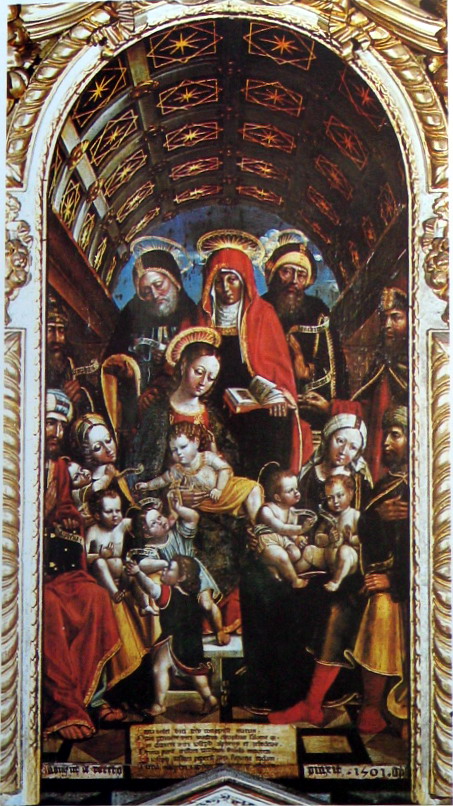
Why Gandolfino da Roreto matters
Gandolfino da Roreto, also documented as Gandolfino d'Asti, is one of the defining painters of the Piedmontese Renaissance, an artist whose signed and dated altarpieces anchor the museum history of Asti, Turin, and Alessandria. For students of the period he matters as a bridge figure: trained in a provincial workshop, he absorbed Ligurian and Provencal models early in his career and later incorporated Lombard and Leonardesque influences, carrying an unusually international visual language into the churches of Piedmont. He also matters as a reminder that not every historically significant painter has an active secondary market; his importance is measured in museum holdings and scholarly attention rather than in auction turnover.
- Nationality
- Italian
- Media
- Panel painting, Fresco
- Movement
- Early Renaissance, Piedmontese Renaissance
- Education
- Apprenticed in the workshop of his father, the painter Giovanni da Roreto, in Asti. No formal schooling or degrees are documented.
- Signature motifs
- Gilt polyptych altarpieces, Sacra Parentela (Holy Kinship) compositions
By the numbers
- 1493First documented workPolyptych of the Assumption of the Virgin, Galleria Sabauda, Turin
- 1493 to 1518Documented activityAsti, Alessandria, and Monferrato, Piedmont
- Not establishedAuction recordNo verified public sale identified as of 2026
- NoneCatalogue raisonneAttribution relies on archival and stylistic scholarship
Selected works
Click any work to view it full screen.
Biography
Gandolfino trained in the workshop of his father, the painter Giovanni da Roreto, in Asti. No formal schooling or academic record survives, which is typical for a provincial workshop painter of the period. Little is documented about him before 1493, when his first known work, a signed and dated polyptych of the Assumption of the Virgin with Saints, was completed for the church of San Francesco in Alba. It later entered the royal collection that became the Galleria Sabauda in Turin.
Over the following two and a half decades he worked across Asti, Alessandria, and Monferrato, producing a series of polyptychs and altarpieces for parish churches and cathedrals. His most important surviving commissions are concentrated in the Duomo di Asti: the Pelletta Polyptych with the Holy Kinship (1501), the Marriage of the Virgin (circa 1510), a Madonna enthroned with saints and a donor (1515), and a Lamentation over the Dead Christ (circa 1516). Related polyptychs survive in the Collegiata di San Secondo and the church of Santa Maria Nuova in Asti, in the parish church of San Pietro in Savigliano, and in the parish church of San Dalmazzo in Quargnento.
Documentary sources place his last securely dated activity around 1518, and Italian cataloguing records extend his documented notices to 1522. One Italian art historical commentary states that he died in that year. No source gives an exact day, month, or place of death, so 1522 should be read as the best documented estimate rather than a certainty.
Critical reception
Scholarship treats Gandolfino as a central figure of the Asti school. The Italian Wikipedia entry on Piedmontese art history describes the late fifteenth and early sixteenth century as a golden period for Asti painting defined by his presence, calling him, in translation, certainly the most important painter of the period in that city. The State Hermitage Museum, which holds his Nativity, describes his work as marked by the narrative quality in the depiction of the earthly world characteristic of the Early Renaissance. The recurring theme across these sources is his role as a synthesizer, absorbing Ligurian, Provencal, and later Lombard and Leonardesque models into a regional Piedmontese idiom.
Market
There is no established secondary market for Gandolfino da Roreto in the modern sense. No verified public auction record, work, price, or sale date could be confirmed for the artist as of this writing; his paintings survive almost entirely in museum and church collections rather than circulating privately. Anyone researching his market should also take care not to conflate him with Gaetano Gandolfi, an unrelated eighteenth century Bolognese painter whose auction results sometimes surface under similar search terms. Auction houses, including Wannenes in Italy, catalogue and discuss his oeuvre for scholarly and attribution purposes, but no confirmed realized price for a work by this artist could be verified in the available record.
Selected exhibitions
| Years | Exhibition | Venues |
|---|---|---|
| 1493 | Polyptych of the Assumption of the Virgin with Saints | San Francesco, Alba, now Galleria Sabauda, Turin |
| 1501 | Pelletta Polyptych with the Holy Kinship | Duomo di Asti |
| circa 1510 | Marriage of the Virgin | Duomo di Asti |
| 1515 | Madonna enthroned with saints and donor | Duomo di Asti |
| circa 1516 | Lamentation over the Dead Christ | Duomo di Asti |
| circa 1510 | San Pietro Polyptych | Chiesa di San Pietro, Savigliano |
| circa 1515 to 1518 | Adoration of the Magi (San Paolo altarpiece) | Collegiata di San Secondo, Asti |
| 2022 to 2023 | Rinascimento privato: da Spanzotti a Defendente Ferrari nelle collezioni piemontesi | Fondazione Accorsi-Ometto, Museo di Arti Decorative, Turin |
Museum collections
- Galleria Sabauda, Turin
- Museo Civico d'Arte Antica, Palazzo Madama, Turin
- Duomo di Asti (Asti Cathedral)
- Collegiata di San Secondo, Asti
- The State Hermitage Museum, Saint Petersburg
Authentication and provenance
No catalogue raisonne.
No catalogue raisonne exists for Gandolfino da Roreto. Attributions rest on archival documentation, signed and dated altarpieces, and the stylistic scholarship of art historians including Giovanni Romano.
Primary reference: https://www.treccani.it/enciclopedia/gandolfino-da-roreto_(Dizionario-Biografico)/
What collectors should know
Gandolfino da Roreto is not a market artist in any contemporary sense: there is no gallery or estate representation, no catalogue raisonne, and no confirmed auction record to benchmark against. Authentication and attribution rest on archival documentation, signed and dated altarpieces, and the stylistic scholarship of art historians including Giovanni Romano. Anyone encountering a work offered under this name should verify it against the documented church and museum holdings in Asti, Turin, and the State Hermitage Museum, and should independently confirm that it is not being confused with the unrelated eighteenth century painter Gaetano Gandolfi.
Further reading and resources
Data current as of 2026-07-18.

