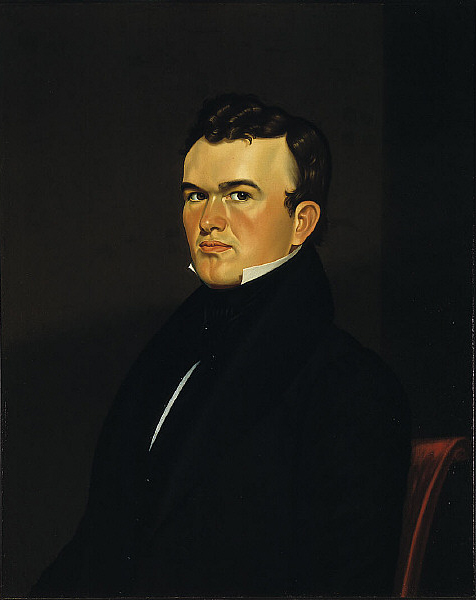
Why George Caleb Bingham matters
George Caleb Bingham is the artist most closely associated with painting the Missouri River frontier: its boatmen, its elections, and the everyday commerce of the antebellum American West. For collectors, he represents a market defined by scarcity rather than speed. His works are held almost entirely in museum collections, a scholarly catalogue raisonne project governs authentication, and the auction pool is thin enough that a single 1978 sale remains, as far as public records show and despite some discrepancy with modern price databases, his highest recorded auction result nearly five decades later.
- Born
- 1811-03-20, Augusta County, Virginia, USA
- Nationality
- American
- Media
- Painting
- Movement
- American genre painting, 19th-century American art
- Education
- Apprenticed to a cabinetmaker in Boonville, Missouri, 1827 to 1828. Briefly trained at the Pennsylvania Academy of the Fine Arts, Philadelphia, circa 1838, and returned there in 1843. Studied the Dusseldorf school in Germany in 1856. Largely self-taught; no degree is documented in the historical record.
- Signature motifs
- River genre scenes of flatboatmen and boatmen, Political and election genre scenes
- Representation
- No living gallery or estate representation confirmed (artist deceased since 1879)
By the numbers
- USD 980,000Auction highThe Jolly Flatboatmen, Sotheby Parke Bernet, Los Angeles, 1978, per contemporaneous press; not corroborated by modern price databases
- 1811 to 1879LifespanAugusta County, Virginia to Kansas City, Missouri
- Online scholarly catalogueCatalogue raisonnebinghamcatalogue.org; ongoing project, not a confirmed published catalogue raisonne
- 8+ major institutionsMuseum collectionsIncluding the National Gallery of Art and the Metropolitan Museum of Art
Selected works
Click any work to view it full screen.
Biography
George Caleb Bingham was born March 20, 1811, in Augusta County, Virginia, and moved with his family to Missouri as a child. He apprenticed to a cabinetmaker in Boonville, Missouri, from 1827 to 1828, and began working as an itinerant portrait painter soon after, largely teaching himself the craft. His only documented formal training came in brief stretches at the Pennsylvania Academy of the Fine Arts in Philadelphia, first around 1838 and again in the summer of 1843, followed by a period of study of the Dusseldorf school in Germany in 1856. No degree is recorded.
Bingham became known in his lifetime as "the Missouri artist" for genre scenes of river commerce and frontier political life, including Fur Traders Descending the Missouri (1845, Metropolitan Museum of Art), The Jolly Flatboatmen (1846), and The County Election (1852). Late in his career he painted Gen. Order No. 11 (1869 to 1870), a large history painting depicting the forced civilian evacuation ordered during the Civil War in Missouri, now held by the State Historical Society of Missouri. Near the end of his life he was appointed the first Professor of Art at the University of Missouri in Columbia, a position his death ended.
Bingham died July 7, 1879, in Kansas City, Missouri, at age 68. Historical and reference sources describe the cause as an acute intestinal illness, recorded in period terminology as cholera morbus; one account notes a preceding bout of pneumonia. He was buried at Union Cemetery in Kansas City. His death was reported in the Jefferson City Peoples Tribune on July 16, 1879.
Critical reception
Bingham's paintings, according to institutional summaries, largely fell out of critical attention for decades after his death before a mid-20th-century rediscovery. The Metropolitan Museum of Art's 1933 acquisition of Fur Traders Descending the Missouri is often cited as a marker of that renewed attention, and a 1961 sesquicentennial exhibition further reinforced his critical standing, though the exhibition's specific venue is not confirmed in available sources. More recently, the 2014 to 2015 traveling exhibition Navigating the West: George Caleb Bingham and the River, organized by the Saint Louis Art Museum and the Amon Carter Museum of American Art and shown at the Metropolitan Museum of Art, reassembled his river paintings for the first time in decades and reaffirmed his standing as a founding figure of American genre painting.
Market
Bingham's public auction record is anchored by a single, long-standing sale: The Jolly Flatboatmen (also cited as The Jolly Flatboatmen No. 2), reported by the New York Times to have sold for USD 980,000 at Sotheby Parke Bernet's Beverly Hills sale on June 6, 1978, at the time described as a record price for an American painting at auction. Modern auction-price aggregators, including Artprice and MutualArt, show a maximum realized price for a Bingham painting of about USD 493,000, well below the reported 1978 figure, and this profile cannot resolve that gap from the public record. Some market observers have suggested the widely cited $980,000 figure may reflect a reporting error rather than a corroborated sale price, though no source confirms this either way. Collectors should treat the 1978 result as a historically reported figure rather than one reconciled against current price databases.
Top auction results
| Work | Price | Sale |
|---|---|---|
| The Jolly Flatboatmen (also cited as The Jolly Flatboatmen No. 2) | USD 980,000 | Sotheby Parke Bernet, Los Angeles, 1978-06-06 |
Selected exhibitions
| Years | Exhibition | Venues |
|---|---|---|
| 2014 to 2015 | Navigating the West: George Caleb Bingham and the River | Saint Louis Art Museum; Amon Carter Museum of American Art, Fort Worth; Metropolitan Museum of Art, New York |
| 2023 to 2050 | Works by George Caleb Bingham | State Historical Society of Missouri, Columbia |
| 1961 | Bingham sesquicentennial exhibition | Missouri (specific venue not confirmed in available sources) |
| 1933 | Acquisition of Fur Traders Descending the Missouri | Metropolitan Museum of Art, New York |
Museum collections
- National Gallery of Art, Washington, D.C.
- Metropolitan Museum of Art, New York
- Saint Louis Art Museum
- Amon Carter Museum of American Art, Fort Worth
- Nelson-Atkins Museum of Art, Kansas City
- State Historical Society of Missouri, Columbia
- National Portrait Gallery, Smithsonian Institution
- Brooklyn Museum
Authentication and provenance
No catalogue raisonne.
No published catalogue raisonne is confirmed. The George Caleb Bingham Catalogue Raisonne (binghamcatalogue.org) is an ongoing online scholarly project that documents the artist's paintings and is described by its organizers as a definitive reference, though its formal publication status is unconfirmed. Attribution is further supported by museum provenance records and documented exhibition history. There is no certificate-of-authenticity program.
Primary reference: https://www.nga.gov/artists/2380-george-caleb-bingham
What collectors should know
Bingham's market is shaped by supply, not demand. Nearly all of his most important paintings sit permanently in museum collections such as the National Gallery of Art, the Metropolitan Museum of Art, the Saint Louis Art Museum, and the State Historical Society of Missouri, which leaves very little material to trade and makes any single auction result an outsized data point. The widely cited 1978 figure for The Jolly Flatboatmen has stood for nearly fifty years, but its precise amount has not been corroborated by modern price databases, so collectors should treat it as a historically reported high water mark rather than a confirmed current trading benchmark. Because there is no certificate-of-authenticity program and no confirmed published catalogue raisonne, the George Caleb Bingham Catalogue Raisonne project and documented provenance are the central tools for verifying a work, and both should be checked closely before any acquisition.
Further reading and resources
Data current as of 2026-07-11.

