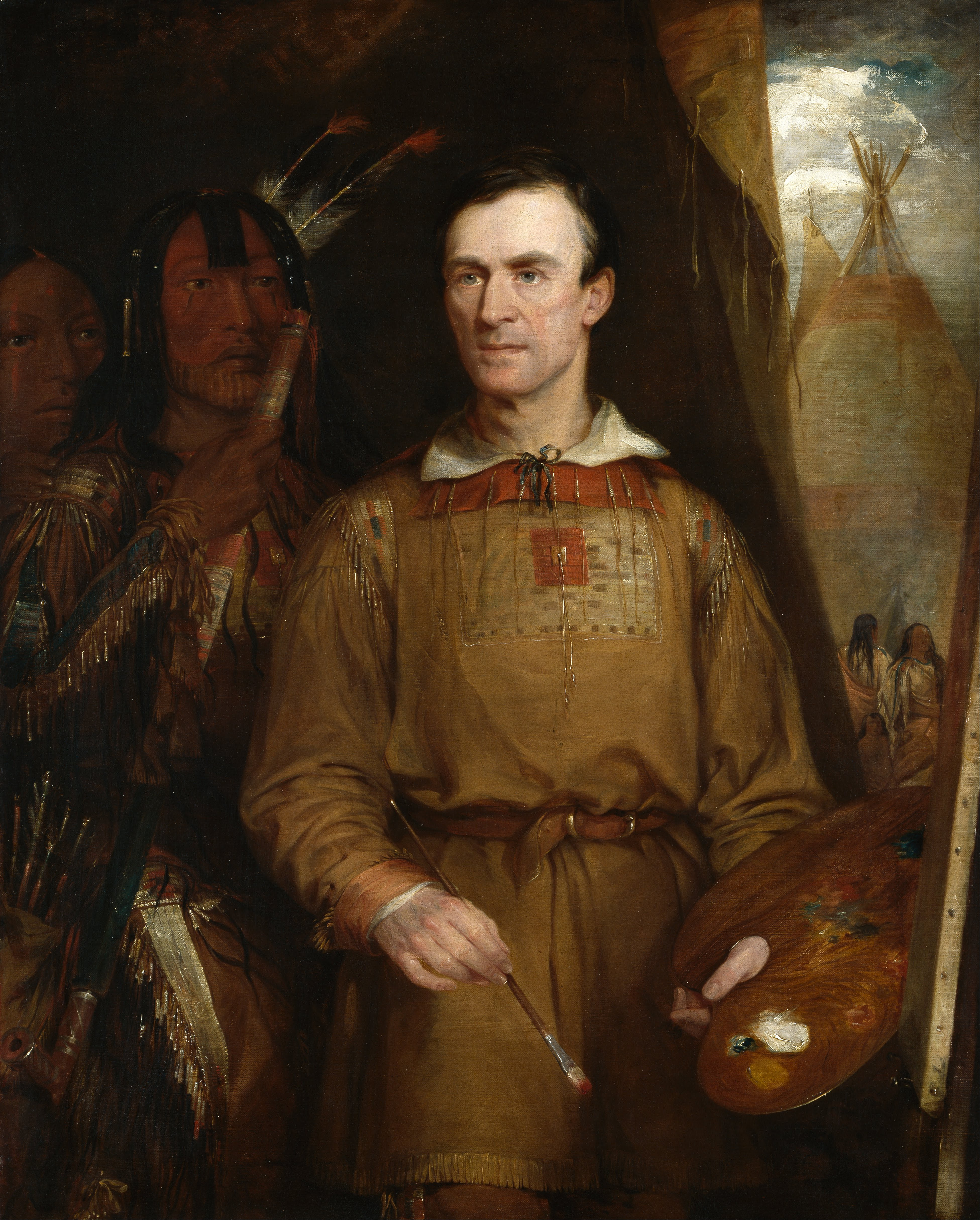
Why George Catlin matters
George Catlin is the foundational visual chronicler of Native American life in the decades before photography. Over repeated expeditions in the 1830s he produced hundreds of portraits and scenes of Plains and other tribal peoples, work that now anchors the collections of the Smithsonian American Art Museum and the National Gallery of Art. For a collector, Catlin is a study in how a historically important body of work can become market-scarce: most of his major paintings were absorbed into museums during or shortly after his lifetime, so the small number that still circulate at auction can command outsized attention when they appear.
- Born
- 1796-07-26, Wilkes-Barre, Pennsylvania, USA
- Nationality
- American
- Media
- Painting, Drawing, Lithography
- Movement
- "19th-century American frontier and ethnographic painting"
- Education
- Litchfield Law School, law studies from about 1817, admitted to the bar in Connecticut and Pennsylvania by about 1818 to 1819. Largely self-taught as a painter; exhibited at the Pennsylvania Academy of the Fine Arts, Philadelphia, from 1821 and elected a member in 1824.
- Signature motifs
- Native American portraiture, "Indian Gallery" ethnographic scenes, Frontier and Western landscapes
By the numbers
- USD 1.54MAuction highInterior of a Mandan Lodge, Sotheby's New York, 2004
- 1796 to 1872Life datesWilkes-Barre, Pennsylvania to Jersey City, New Jersey
- 400 to 600 worksIndian GallerySmithsonian American Art Museum, donated 1879
- 300+ worksNational Gallery of Art holdingsPaintings and works on paper
Selected works
Click any work to view it full screen.
Biography
George Catlin was born on July 26, 1796, in Wilkes-Barre, Pennsylvania. He was sent to a private academy around 1810, then studied law at Litchfield Law School in Connecticut beginning around 1817, spending about two years there before he was admitted to the bar in Connecticut and Pennsylvania around 1818 to 1819. He practiced law briefly but disliked the field, and turned instead to painting, working largely as a self-taught portraitist and miniaturist. By 1821 he had four miniatures accepted into the annual exhibition of the Pennsylvania Academy of the Fine Arts in Philadelphia, and in 1824 the academy elected him a member. He moved to New York in the mid-1820s to continue his art career.
Beginning in 1830, Catlin traveled repeatedly into the American West to paint Native American peoples from life, eventually producing more than 500 paintings that he assembled into what he called his Indian Gallery. He first exhibited the Gallery publicly in New York in 1837, then toured it through other American cities before taking it to Europe, showing it in London and other European venues beginning in 1839. Catlin struggled financially for much of his later career and eventually lost the Indian Gallery to a creditor, the Philadelphia collector Joseph Harrison. He returned to New York in 1870 and exhibited a new, smaller collection of work without commercial success.
Catlin died on December 23, 1872, in Jersey City, New Jersey, at age 76. He is generally reported to be buried at Green-Wood Cemetery in Brooklyn alongside his wife and two of their children. In 1879, Joseph Harrison's widow donated the Indian Gallery to the Smithsonian Institution, where several hundred of the surviving portraits and landscapes remain on view today.
Critical reception
Catlin's contemporaries were divided between fascination with his subject matter and skepticism about his reliability as an ethnographer: one contemporary accused him of "a great deal of humbug" for exaggerating Native customs, a criticism recorded in the Missouri Encyclopedia. Modern institutional assessment echoes that mixed legacy. Cornell University Library's exhibition on Catlin notes his images were "once accepted as exact copies of their subjects" but are now understood as "images of native people veneered with European sensibilities," while the market data provider MutualArt describes him more simply as "the first white artist to travel among and record the customs of native peoples." The recurring critical thread, then and now, is Catlin's status as a documentary pioneer whose ethnographic ambitions and showmanship sit alongside real questions, still debated by historians, about how faithfully his images render the peoples he painted.
Market
Catlin's auction market is thin and dominated by a single benchmark sale. His record is Interior of a Mandan Lodge, which sold for USD 1,538,500 at Sotheby's New York on December 1, 2004, the top lot in a group of four Catlin paintings deaccessioned by the Field Museum, originally from the collection of Benjamin O'Fallon, that together totaled USD 4,576,000. Away from that sale, documented results are far more modest: Coeur d'Alene Art Auction has recorded Catlin lots in the range of roughly USD 15,000 to USD 47,600. A precise, ranked list of second- and third-highest results across all houses could not be confirmed from public sources. No auction result since 2004 has been identified that surpasses the Sotheby's high.
Because so much of Catlin's most important work is already held by the Smithsonian, the National Gallery of Art, and other institutions, the works that reach the market tend to be secondary paintings, drawings, and lithographic prints from series such as the North American Indian Portfolio. No commercial gallery or estate currently represents Catlin; auction houses and specialist dealers in historic Americana and antique prints remain the primary market venues.
Top auction results
| Work | Price | Sale |
|---|---|---|
| Interior of a Mandan Lodge (2004) | USD 1,538,500 | Sotheby's, New York, 2004-12-01 |
Selected exhibitions
| Years | Exhibition | Venues |
|---|---|---|
| 1821 | Annual exhibition | Pennsylvania Academy of the Fine Arts, Philadelphia |
| 1837 | Catlin's Indian Gallery, first exhibition | New York |
| 1839 to 1840 | European tour of the Indian Gallery | London and other European venues |
| 1870 | Exhibition of a new collection | New York |
| 1879 | Donation and permanent installation of the Indian Gallery | Smithsonian Institution, Washington, D.C. |
Museum collections
- Smithsonian American Art Museum, Washington, D.C. (Catlin's Indian Gallery)
- National Gallery of Art, Washington, D.C.
- American Museum of Natural History, New York
- New-York Historical Society, New York
- Gilcrease Museum, Tulsa, Oklahoma
- Cornell University Library, Ithaca, New York
Awards and honors
- Elected Member, Pennsylvania Academy of the Fine Arts (1824)
Authentication and provenance
No catalogue raisonne.
No published catalogue raisonne has been identified for Catlin. Most of his major paintings entered public collections during or shortly after his lifetime, notably the Smithsonian Institution's 1879 acquisition of his Indian Gallery and the National Gallery of Art's holdings, so provenance and institutional records, rather than a raisonne or certification program, are the primary basis for authentication.
Primary reference: https://americanart.si.edu/artist/george-catlin-782
What collectors should know
Catlin has no catalogue raisonne, and the bulk of his most significant paintings are permanently held by museums, which means the population of exhibition-quality works available for private sale is genuinely small. That scarcity is a double-edged fact for buyers: it supports the exceptional price achieved by Interior of a Mandan Lodge in 2004, but it also means the broader market, made up mostly of prints, drawings, and secondary paintings, trades at prices far below that headline figure. Provenance and institutional documentation, rather than a raisonne or certification body, are the main tools for authenticating a Catlin work, so collectors should weight paper trail and prior ownership history heavily when evaluating any piece.
Further reading and resources
Data current as of 2026-07-10.

