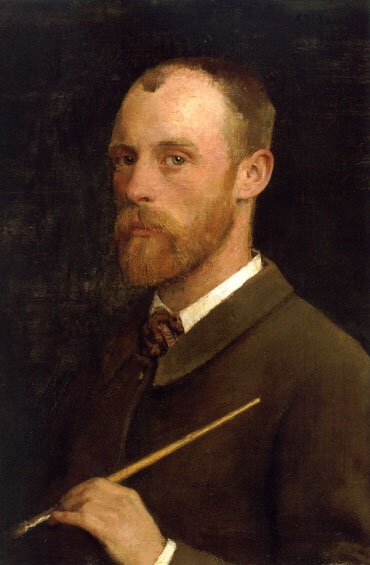
Why George Clausen matters
George Clausen, later Sir George Clausen, was one of the artists who brought French plein-air naturalism into British painting, turning the everyday labor of farmworkers and gleaners into serious subject matter for the Royal Academy. His long institutional career, a Royal Academy professorship, a knighthood, and an official war artist commission, sits alongside a still-active secondary market for his rural scenes. For a collector, he is a case study in a historically significant but thinly documented market, where museum holdings are well established but individual auction results are harder to verify in public sources.
- Born
- 1852-04-18, London, United Kingdom
- Nationality
- British
- Media
- Painting, Watercolor
- Movement
- Naturalism, British Impressionism
- Education
- St Mark's School, Chelsea, to age fourteen; National Art Training School (South Kensington Schools), 1867 to 1873, with a national scholarship in decorative painting from 1873; short-term study at the Antwerp Academy under Joseph van Lerius; Academie Julian, Paris, 1883, under William-Adolphe Bouguereau and Tony Robert-Fleury.
- Signature motifs
- Rural field labor, Gleaners and farm workers, Plein-air naturalism
- Representation
- "No current gallery or estate representation confirmed; secondary-market dealings include Richard Green Gallery, London, and Maas Gallery, London"
By the numbers
- USD 1.37MAuction high (approximate)Aggregate top realized price for a painting, per MutualArt; exact work, house, and sale date not publicly documented
- 1927KnightedFor services to art
- 1889Gold medalExposition Universelle, Paris
- 1904 to 1906RA Professor of PaintingRoyal Academy Schools
Biography
George Clausen was born on 18 April 1852 in London. He attended St Mark's School in Chelsea until about age fourteen, then began a five-year apprenticeship in the drawing office of the decorating firm Trollope, where he was trained by John Cleghorn. From 1867 to 1873 he attended design classes at the National Art Training School at South Kensington, and in 1873 he won a national scholarship in decorative painting that funded two further years of full-time study there. He went on to study briefly at the Antwerp Academy under Joseph van Lerius, and in 1883 spent several months at the Academie Julian in Paris under William-Adolphe Bouguereau and Tony Robert-Fleury. He also worked for a period in the studio of the painter Edwin Long.
Clausen became a founding member of the New English Art Club, the exhibiting society that gave a platform to younger, French-influenced British painters, and his rural subjects, gleaners, harvesters, and farm laborers rendered with an interest in outdoor light, drew comparisons to Jules Bastien-Lepage. He was awarded a gold medal at the 1889 Exposition Universelle in Paris. He was elected a Royal Academician and served as Professor of Painting at the Royal Academy Schools from 1904 to 1906. In 1918, during the First World War, he was appointed an official war artist and worked at Woolwich Arsenal. He was knighted for services to art in 1927.
Clausen moved to the village of Cold Ash, near Newbury in Berkshire, at the outbreak of the Second World War. He died there on 22 November 1944, at the age of 92, and was buried in the parish churchyard next to his wife.
Critical reception
Clausen's Gleaners drew notice from contemporary periodical critics when it appeared in the 1880s, with The Spectator and The Magazine of Art both remarking on its outdoor naturalism and its debt to Bastien-Lepage's rural realism. That critical framing, an English painter absorbing French plein-air method to picture rural labor honestly rather than picturesquely, defined his reputation through the rest of his career. His standing was reaffirmed institutionally well after his death: the Fine Art Society devoted part of its 1979 exhibition The Rustic Image to his rural pictures, the Royal Academy mounted his first major retrospective in 1980 (touring to Bradford, Bristol, and Newcastle), and the Fine Art Society returned to him with a Clausen-only Rustic Image show in 2012.
Market
Clausen's paintings and watercolors continue to trade at auction, but the publicly available record is thin on detail. Aggregated market data from MutualArt puts his highest realized price for a painting at approximately USD 1.37 million, with a separate high of roughly USD 750,000 for a work on paper; the specific work, auction house, sale location, and exact date behind that painting figure are not disclosed in public sources and could not be confirmed. Recent smaller sales, by contrast, have ranged from the low thousands of dollars to the low tens of thousands, indicating a market with a wide spread between routine works and the small number of major exhibition pictures.
Top auction results
| Work | Price | Sale |
|---|---|---|
| Not confirmable from public sources; aggregate high reported at approximately USD 1,366,023 for a painting | USD 1,366,023 |
Selected exhibitions
| Years | Exhibition | Venues |
|---|---|---|
| 1880 to 1889 | Grosvenor Gallery exhibitions, including Gleaners | Grosvenor Gallery, London |
| 1889 | Exposition Universelle | Paris (gold medal) |
| 1918 | Official war artist commission, Woolwich Arsenal | Ministry of Information, London |
| 1979 | The Rustic Image | The Fine Art Society, London |
| 1980 | George Clausen retrospective | Royal Academy of Arts, London, toured to Bradford, Bristol, and Newcastle |
| 2012 | The Rustic Image | The Fine Art Society, London |
Museum collections
- Tate, London
- Art Institute of Chicago
- National Gallery of Australia, Canberra
- Dublin City Gallery, The Hugh Lane
- Nottingham Castle Museum and Art Gallery
- Laing Art Gallery, Newcastle upon Tyne
- Imperial War Museum, London
- Royal Academy of Arts, London
Awards and honors
- Knighted for services to art (1927)
- Official War Artist, Woolwich Arsenal (1918)
- Professor of Painting, Royal Academy Schools (to 1906) (1904)
- Gold medal, Exposition Universelle, Paris (1889)
Authentication and provenance
No catalogue raisonne.
No published catalogue raisonne has been identified for Clausen. Tate's collection records credit copyright to the estate of Sir George Clausen, but no gallery or agent is documented as administering that estate or issuing certificates of authenticity. Attribution in practice relies on institutional exhibition history, dealer provenance, and inclusion in major museum collections.
Primary reference: https://www.tate.org.uk/art/artists/sir-george-clausen-96
What collectors should know
There is no published catalogue raisonne for Clausen, and no gallery or agent is documented as administering his estate, which Tate's own records identify only by a copyright credit. That absence puts real weight on institutional exhibition history and dealer provenance, most visibly through London dealers such as Richard Green Gallery and Maas Gallery, when assessing a given work. The public auction record is also less legible than for many artists of his stature: aggregate price ceilings are reported by market databases, but the underlying sale details for his top result are not openly documented, so collectors should treat any single headline figure with caution and seek the specific lot record before relying on it.
Further reading and resources
Data current as of 2026-07-10.

