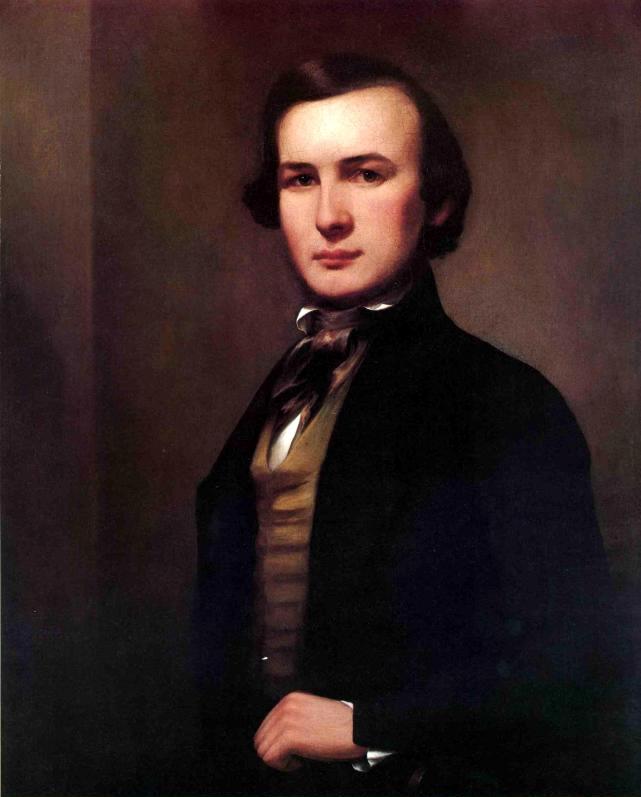
Why George Henry Durrie matters
George Henry Durrie is the painter most responsible for the popular American image of the New England winter, a mid nineteenth century Connecticut artist whose farm and sleighing scenes were reproduced as lithographs by Currier and Ives and became fixtures of American visual culture. For collectors, he is a useful case study in how posthumous print reproduction can carry an artist's imagery far beyond what a short life and a thin lifetime market would suggest, and in how deep museum collecting can validate a career that auction data alone documents only unevenly.
- Born
- 1820-06-06, New Haven, Connecticut, USA
- Nationality
- American
- Media
- Painting
- Movement
- "19th-century American landscape painting", "American genre painting"
- Education
- Hopkins School, New Haven (secondary schooling). Private instruction under Nathaniel Jocelyn, New Haven, beginning 1839, roughly two years of concentrated study with intermittent contact extending to about 1842. No academy degree documented.
- Signature motifs
- "Winter rural landscapes", "Sleighing and farmyard scenes"
- Representation
- "Questroyal Fine Art (secondary market)", "Godel & Co. Fine Art (secondary market)"
By the numbers
- 1839 to 1863Career spanFrom first study with Nathaniel Jocelyn to his death in New Haven
- USD 312,500Auction high (reported)Hunter in a Winter Wood, reported sold in 2018; auction house and exact date not independently confirmed
- 10 printsCurrier and Ives lithographsIssued after 1860; six reproduced posthumously per Wikipedia and Godel & Co.; exact issue years not confirmed
- Questroyal Fine Art; Godel & Co. Fine ArtRepresented bySecondary market dealers in American nineteenth century painting
Biography
Durrie was born on June 6, 1820, in New Haven, Connecticut, and lived nearly his entire life in and around the city. As a boy he attended Hopkins School in New Haven. Before any formal training he worked, largely self-taught, as an itinerant portrait painter in the area around New Haven and Bethany, Connecticut. In 1839 he and his older brother John began lessons with the New Haven portrait painter and engraver Nathaniel Jocelyn; Durrie studied with Jocelyn for roughly two years of concentrated instruction, with contact continuing intermittently to about 1842. No degree or academy training is documented beyond this private study.
According to dealer chronologies, Durrie first exhibited at the National Academy of Design in New York in 1843, though the specific work shown is not confirmed by primary sources. By the mid 1840s his focus shifted from portraiture toward the rural winter landscapes and genre scenes for which he became known, beginning with Sleighing Party at the National Academy of Design in 1845, the same year he won a second place medal at the New Haven State Fair for two winter landscapes. He exhibited annually at the American Art-Union in New York from 1848 until it dissolved in 1852, and continued to show winter scenes at the National Academy of Design in 1857 and 1863.
Durrie died at his home in New Haven on October 15, 1863, at the age of 43. The New York print firm Currier and Ives reproduced his winter scenes as a series of ten lithographs issued after 1860, six of them posthumously, which carried his imagery to a far wider audience than he reached during his own career.
Critical reception
Durrie's reputation rests less on lifetime critical attention, which was modest, than on the durability of his imagery and its adoption by Currier and Ives. Historians have generally read his lack of academic training as a source of strength rather than a limitation: writing on his landscape work, art historian Martha Young Hutson has argued that the absence of formal schooling let him develop an idiomatic, unaffected style. That reading has held up institutionally. A 1947 monographic exhibition at the Wadsworth Atheneum, a 1966 retrospective organized by the New Haven Colony Historical Society, and a 1977 exhibition at the Santa Barbara Museum of Art titled American Winter Landscapist each reinforced his standing as the defining painter of the New England winter, even as he remains a secondary figure relative to Hudson River School contemporaries in most survey histories of American landscape painting.
Market
Durrie's market is small, thinly traded, and not centrally tracked. Reporting tied to 2018 cites a price of USD 312,500 for Hunter in a Winter Wood, the highest figure for the artist that current sources allow us to trace to a specific work and price, though the auction house and exact sale date could not be independently confirmed from available records. Other Durrie paintings surface periodically at auction houses that specialize in Americana and regional American art, including Brunk Auctions, Shannon's, and Scottsdale Art Auction, generally well below that figure. No catalogue raisonne exists, and Durrie has no living estate or primary gallery; two New York dealers in nineteenth century American painting, Questroyal Fine Art and Godel and Co. Fine Art, currently maintain artist pages and offer his work on the secondary market.
Top auction results
| Work | Price | Sale |
|---|---|---|
| Hunter in a Winter Wood (2018) | USD 312,500 |
Selected exhibitions
| Years | Exhibition | Venues |
|---|---|---|
| 1843 | Annual exhibition | National Academy of Design, New York |
| 1845 | Sleighing Party exhibited | National Academy of Design, New York |
| 1848 to 1852 | Annual exhibitions | American Art-Union, New York |
| 1857 | Two winter scenes exhibited | National Academy of Design, New York |
| 1945 | Hudson River School and the Early American Landscape Tradition | Art Institute of Chicago |
| 1947 | George Henry Durrie: Connecticut Painter of American Life | Wadsworth Atheneum, Hartford |
| 1966 | George Henry Durrie: Connecticut Artist, 1820 to 1863 | New Haven Colony Historical Society |
| 1977 | George Henry Durrie (1820 to 1863): American Winter Landscapist | Santa Barbara Museum of Art |
Museum collections
- Metropolitan Museum of Art, New York
- Museum of Fine Arts, Boston
- Wadsworth Atheneum Museum of Art, Hartford
- National Gallery of Art, Washington, D.C.
- Smithsonian American Art Museum, Washington, D.C.
Awards and honors
- Second place medal, New Haven State Fair, for two winter landscapes (1845)
Authentication and provenance
No catalogue raisonne.
No catalogue raisonne has been published for Durrie. The 1966 New Haven Colony Historical Society exhibition catalogue and the 1977 Santa Barbara Museum of Art exhibition catalogue function as the closest scholarly references. Works are typically authenticated through provenance research and the expertise of auction houses experienced with nineteenth century American painting.
Primary reference: https://americanart.si.edu/artist/george-henry-durrie-1365
What collectors should know
There is no catalogue raisonne for Durrie, so provenance research and the expertise of auction houses experienced with nineteenth century American painting carry unusual weight in authentication. His market is thin: reported prices vary widely by venue, and the widely cited high of USD 312,500 for Hunter in a Winter Wood should be treated as provisional until its auction house and date can be verified against primary sale records. Against that market thinness sits a genuinely deep institutional footprint, with holdings at the Metropolitan Museum of Art, the Museum of Fine Arts Boston, the National Gallery of Art, the Smithsonian American Art Museum, and other major collections, which is the strongest available evidence of Durrie's lasting art historical standing.
Further reading and resources
Data current as of 2026-07-11.

