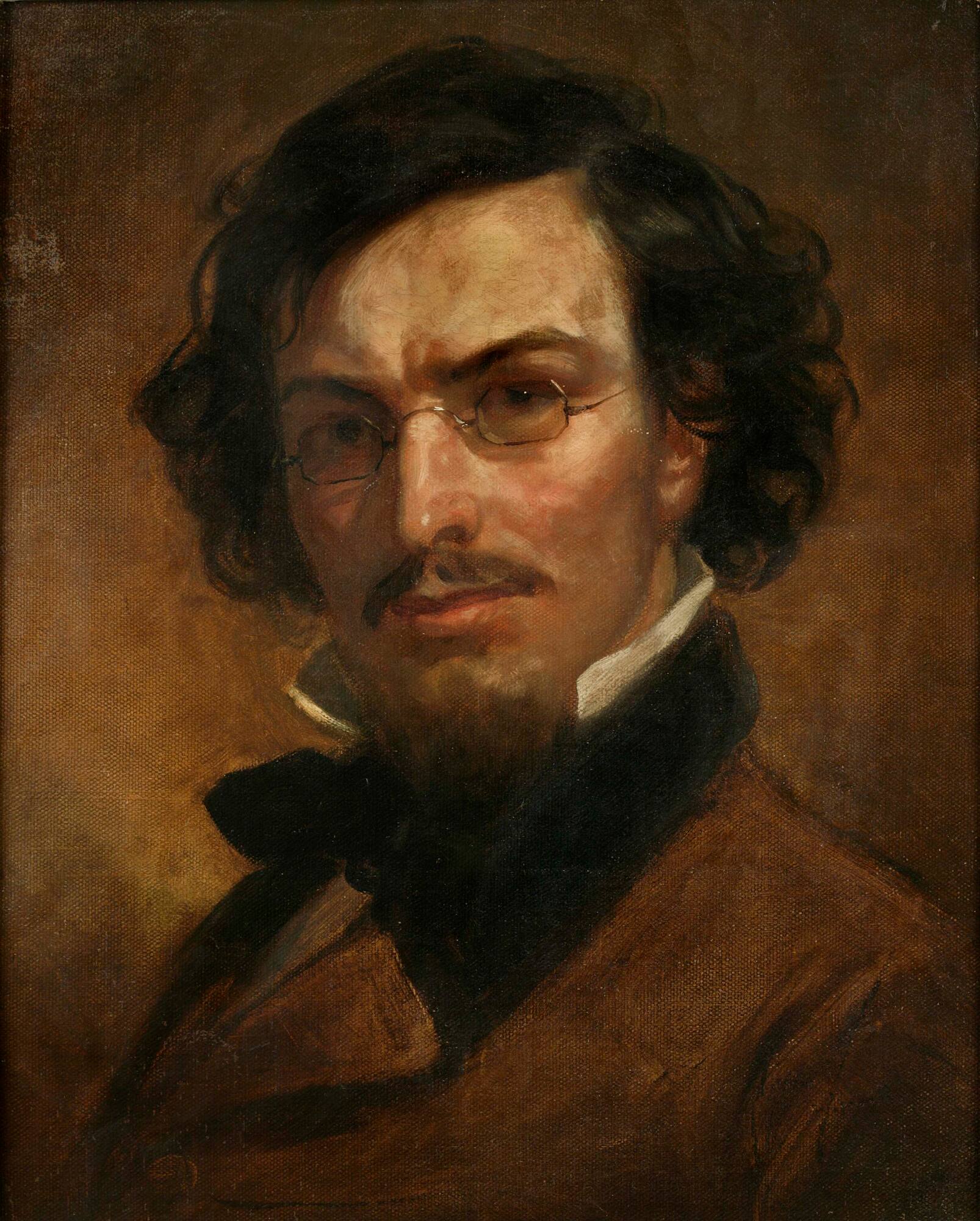
Why George Inness matters
George Inness is one of the foundational figures of American landscape painting, a bridge between the Hudson River School's descriptive realism and the atmospheric, spiritually charged mode that came to be called Tonalism. For a collector, he represents an artist whose reputation is anchored almost entirely in museums and scholarship rather than in a large, liquid secondary market, which makes provenance, attribution, and connoisseurship the central questions in any acquisition.
- Born
- 1825-05-01, Newburgh, New York, USA
- Nationality
- American
- Media
- Painting
- Movement
- Hudson River School, Tonalism, Barbizon-influenced landscape
- Education
- Largely self-taught. Studied several months with itinerant painter John Jesse Barker, 1839. Attended classes at the National Academy of Design, New York, under Regis Francois Gignoux, mid-1840s, first exhibiting there in 1844. Studied in Rome, 1851 to 1852, on a trip funded by patron Ogden Haggerty, then studied Barbizon painters in Paris and Dutch landscapists in London and Amsterdam, early to mid-1850s.
- Signature motifs
- Tonal, atmospheric landscapes, Swedenborgian spiritual symbolism
- Representation
- "Lincoln Glenn (secondary-market gallery; exhibits and handles his work)"
By the numbers
- USD 1,945,000Auction highSunset on the River, Christie's New York, 2008-05-21
- 1844 to 1894Career spanFirst exhibition at the National Academy of Design to death
- DeceasedStatusDied August 3, 1894, Bridge of Allan, Scotland
Selected works
Click any work to view it full screen.
Biography
George Inness was born May 1, 1825, in Newburgh, New York, and grew up largely in Newark, New Jersey, where he received minimal formal schooling. His art education began informally: in 1839, around age fourteen, he studied for several months with the itinerant painter John Jesse Barker. As a teenager he worked as a map engraver in New York City, first at Sherman and Smith and then at N. Currier, and used the time to study the landscapes of Thomas Cole, Asher B. Durand, and Old Masters such as Claude Lorrain and Salvator Rosa.
In the mid-1840s Inness attended classes at the National Academy of Design in New York under the French landscape painter Regis Francois Gignoux, and exhibited there for the first time in 1844. In 1851, the patron Ogden Haggerty funded a European trip; Inness spent about fifteen months in Rome studying Claude Lorrain and Nicolas Poussin, returning to America in May 1852. In Rome he rented a studio above the painter William Page, who is thought to have introduced him to the theology of Emanuel Swedenborg, an influence that shaped the more visionary character of his later work. Further trips to Paris exposed him to the Barbizon school, and visits to London and Amsterdam brought him into contact with Dutch landscape painting, including the work of Meyndert Hobbema. He was elected an Associate of the National Academy of Design in 1853 and a full Academician in 1868. In the fall of 1863 he taught drawing at Eagleswood Military Academy in New Jersey.
Inness continued to paint prolifically through the 1880s and early 1890s, moving toward increasingly abstract, tonal, and spiritually inflected landscapes. He died on August 3, 1894, in Bridge of Allan, Scotland, while traveling, at age sixty-nine. He was widely regarded at the time of his death as the leading American landscape painter of his generation.
Critical reception
Inness has long been treated by critics and historians as one of the pivotal figures in American landscape painting, credited by some with helping to define the country's Tonalist sensibility and, in the words of specialist commentary, regarded by some as the father of American landscape painting. Reviewing the 2003 exhibition George Inness and the Visionary Landscape at the National Academy of Design, critic Mario Naves praised the show in The New York Observer, crediting Inness's debt to Corot and the Barbizon school while arguing that he transformed those influences into a distinctly forceful, concrete American idiom. Museum retrospectives, from a 1974 University of Texas Art Museum exhibition to the Montclair Art Museum's ongoing dedicated Inness gallery, have consistently reinforced his standing as a major figure whose late work anticipated more abstract and spiritually oriented American painting.
Market
George Inness's highest confirmed auction result is Sunset on the River, which sold for USD 1,945,000 at Christie's New York on May 21, 2008. A separate result of USD 262,900 for Near Leeds, New York at Heritage Auctions in Dallas in 2009 is that house's own top price for the artist, well below the overall record. His market is that of a historically significant but comparatively thin nineteenth-century American painting category, with results driven by American art specialists at auction houses and dealers rather than the primary-market mechanics of a living artist. Because he died in 1894, there is no gallery or estate representation in the contemporary sense; works move almost entirely on the secondary market.
Top auction results
| Work | Price | Sale |
|---|---|---|
| Sunset on the River | USD 1,945,000 (USD 1,945,000) | Christie's, New York, 2008-05-21 |
Selected exhibitions
| Years | Exhibition | Venues |
|---|---|---|
| 1844 | First exhibition | National Academy of Design, New York |
| 1884 | Major Inness exhibition | American Art Galleries, New York |
| 1893 | World's Columbian Exposition | Chicago (15 paintings in the American section) |
| 1894 to 1895 | Memorial exhibition of paintings left by Inness | American Fine Arts Society, New York |
| 1917 | Exhibition of twenty paintings | Henry Reinhardt and Son Galleries, New York |
| 1974 | The Paintings of George Inness | University of Texas Art Museum, Austin |
| 2003 | George Inness and the Visionary Landscape | National Academy of Design, New York |
| 2024 | George Inness: Visionary Landscapes, New Works and Native Views | Montclair Art Museum, Montclair, New Jersey |
Museum collections
- Montclair Art Museum, Montclair, New Jersey (largest holding of Inness paintings)
- National Gallery of Art, Washington, D.C.
- Metropolitan Museum of Art, New York
- Milwaukee Art Museum, Milwaukee
- Walters Art Museum, Baltimore
- Krannert Art Museum, Champaign, Illinois
- Brooklyn Museum, Brooklyn, New York
- Buffalo AKG Art Museum, Buffalo, New York
Awards and honors
- Elected full Academician, National Academy of Design (1868)
- Elected Associate, National Academy of Design (1853)
Authentication and provenance
No catalogue raisonne.
No published catalogue raisonne has been confirmed for Inness's work. Attribution and authentication rest on museum curatorial departments, auction house specialists in nineteenth-century American painting, and dealers such as Lincoln Glenn. His widow, Julia Goodrich Smith, compiled a photographic record of his works shortly after his death, now held by the Archives of American Art at the Smithsonian, which remains a key documentary resource. Works are sometimes confused in the market with those of his son, George Inness Jr., who painted under a similar name.
Primary reference: https://www.metmuseum.org/essays/george-inness-1825-1894
What collectors should know
There is no published catalogue raisonne for George Inness, and no formal estate or gallery structure comparable to what exists for living artists; attribution relies on museum curatorial expertise, specialist auction house departments, and dealers such as Lincoln Glenn. Buyers should also be careful to distinguish his work from that of his son, George Inness Jr., since the two names, along with spelling variants such as "Innes," appear closely together in market records. His reputation is strongly institutional, anchored by the dedicated Inness gallery at the Montclair Art Museum and holdings at the National Gallery of Art, the Metropolitan Museum, and other major collections, even though his auction market itself remains comparatively modest and thinly traded relative to that stature.
Further reading and resources
Data current as of 2026-07-10.

