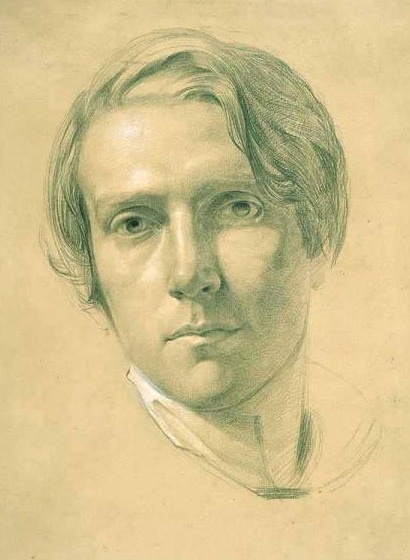
Why George Richmond matters
George Richmond was a leading Victorian portraitist whose long career, from his entry to the Royal Academy Schools in 1824 to his death in 1896, bridged the visionary circle around William Blake and the mainstream of British portrait painting. He is credited with roughly 2,500 to 3,000 portraits of the period's political, religious, and cultural figures. For collectors, he matters less as a blue-chip auction name than as a well documented, institutionally anchored figure in national collections, useful for studying period portraiture, provenance, and the market for nineteenth-century British works on paper.
- Born
- 1809-03-28, Brompton, London, England
- Nationality
- British
- Media
- Painting, Drawing
- Movement
- "The Ancients (Blake circle)", "Victorian portraiture"
- Education
- Royal Academy Schools, London, entered 1824 at age fourteen, studied under Henry Fuseli. Study travel in Paris (art and anatomy, from 1828), then France and Italy. Honorary degrees from the University of Oxford and the University of Cambridge, exact dates undocumented.
- Signature motifs
- "Chalk and crayon portrait drawings", "Early visionary work influenced by William Blake"
By the numbers
- 1809 to 1896LifespanBrompton, London to Portman Square, London
- Entered 1824Royal Academy Schoolsstudied under Henry Fuseli, age fourteen
- Elected RARoyal Academiciansources cite either 1866 or 1868
- About 2,500 to 3,000Documented portraitsper the artist's account books and the George Richmond Portrait Project
Selected works
Click any work to view it full screen.
Biography
George Richmond was born on 28 March 1809 in Brompton, London, the son of the miniature painter Thomas Richmond, from whom he received his first art instruction. After brief attendance at a dame school in Soho, he entered the Royal Academy Schools in December 1824 at age fourteen, one of the youngest students admitted, and studied briefly under Henry Fuseli. There he became close to Samuel Palmer and, through Palmer, to William Blake, joining the informal circle of young artists known as The Ancients. His earliest exhibited works, shown at the Royal Academy in 1830 and 1831, including "On the Eve of Separation," "The Witch," and "The Pilgrim," reflect this visionary, Blake-influenced phase.
In 1828 Richmond traveled to Paris to study art and anatomy, funded by painting miniatures, and went on to spend about three years in France and to visit Italy twice, where he studied Renaissance art intensively. From about 1830, with the encouragement of Sir Robert Harry Inglis, he turned from poetic and religious subjects to portraiture and became a prolific and fashionable success, painting British aristocracy, royalty, and prominent Anglican clergy over six decades.
Richmond also held several institutional roles reflecting his standing in the London art world. In 1846 he was nominated by Gladstone to the Council of the Government Schools of Design, a post he held for three years, and in 1856 he was appointed to the Royal Commission on the site of the National Gallery, where he was alone in voting to move it from Trafalgar Square to South Kensington. He later served as a selector for the Royal Academy's winter loan exhibitions, was elected a Royal Academician (sources cite either 1866 or 1868), and was twice offered, and twice declined, the Directorship of the National Gallery. He held honorary degrees from Oxford and Cambridge, was a Fellow of the Society of Antiquaries, an honorary fellow of University College London and of the Royal Institute of British Architects, and a member of the Painter-Stainers' Company. His son, William Blake Richmond, also became a painter.
Richmond died on 19 March 1896 at his home, 20 York Street, Portman Square, London, where he had lived and worked for fifty-four years. He was buried in the eastern part of Highgate Cemetery, plot 23902, and is commemorated by a tablet in the crypt of St Paul's Cathedral, designed by his sons.
Critical reception
Modern assessments consistently frame Richmond's career as a shift from youthful visionary promise to mature portrait mastery. His biographer Raymond Lister argued that Richmond was "at his greatest as a portrait painter," and that despite his early Blake-influenced ambitions, it is in portraiture that his lasting stature is best seen, a reading echoed by institutions including Tate and the National Portrait Gallery of Australia. Those same institutions emphasize his membership in The Ancients alongside Samuel Palmer and Blake as the formative chapter before his decades-long, highly patronized portrait practice among the British aristocracy and Anglican clergy. His institutional roles, including his vote to relocate the National Gallery and his repeated refusal of its directorship, are cited as further evidence of his standing within the Victorian art establishment, even as his own artistic ambitions reportedly remained tied to the visionary work of his youth.
Market
No auction result rising to the level of a confirmed all-time record could be established for George Richmond from available sale records. Documented public sales are modest: a signed chalk study, "Study of a standing woman with shield," sold for GBP 300 at Dominic Winter Auctioneers on 12 March 2025, and a watercolor, "A Woman with Two Children in a Hilly Landscape," carried a GBP 2,000 to 3,000 estimate at Sotheby's in 2019. One UK regional sale reportedly reached GBP 11,000 for a lot of five nineteenth-century printing plates made after Richmond's designs, but that lot is not a work by the artist's own hand and its exact sale date is not documented. Gallery retail listings for oil portraits by Richmond have appeared in the low thousands of pounds. Taken together, the evidence points to a market defined by institutional and scholarly interest rather than by strong auction competition.
Selected exhibitions
| Years | Exhibition | Venues |
|---|---|---|
| 1830 | Royal Academy Annual Exhibition | Royal Academy, London |
| 1831 | Royal Academy Annual Exhibition | Royal Academy, London |
| 1830 to 1890s | Recurring exhibitor, Royal Academy Annual Exhibitions (portraiture) | Royal Academy, London |
| 1896 | Posthumous bequest and acquisition of portraits and drawings | National Portrait Gallery, London |
Museum collections
- National Portrait Gallery, London
- Tate, London
- Smithsonian American Art Museum, Washington, D.C.
- Ashmolean Museum, Oxford
- Government Art Collection, United Kingdom
- Delaware Art Museum, Wilmington
Awards and honors
- Elected Royal Academician (RA); sources cite 1866 or 1868
- Appointed to the Royal Commission on the site of the National Gallery (1856)
- Nominated by Gladstone to the Council of the Government Schools of Design (served three years) (1846)
- Honorary degrees, University of Oxford and University of Cambridge (dates undocumented)
Authentication and provenance
No catalogue raisonne.
No published catalogue raisonne exists for George Richmond. Scholarship and attribution rely on the artist's own account books, which record roughly 2,500 to 3,000 portraits, the Royal Academy's archive of his personal papers, and the George Richmond Portrait Project's ongoing sitter database.
Primary reference: https://www.tate.org.uk/art/artists/george-richmond-447
What collectors should know
Because no catalogue raisonne exists, attribution and provenance research rest on the artist's own account books, the Royal Academy's archive of his personal papers, and the George Richmond Portrait Project's sitter database, and descendants are known to still hold family works that occasionally reach the market. His auction footprint is thin and modest in value relative to his museum presence, so value for any given work is likely to be driven by the fame of the sitter, the medium (finished oil versus a chalk or watercolor study), and condition, rather than by a well established price benchmark. Buyers should also take care in cataloguing: the Richmond family included other artists, notably his father Thomas Richmond and his son William Blake Richmond, and works are sometimes catalogued surname-first as "Richmond, George," so name variants should be checked against sitter, date, and medium before a work is treated as his.
Further reading and resources
Data current as of 2026-07-16.

