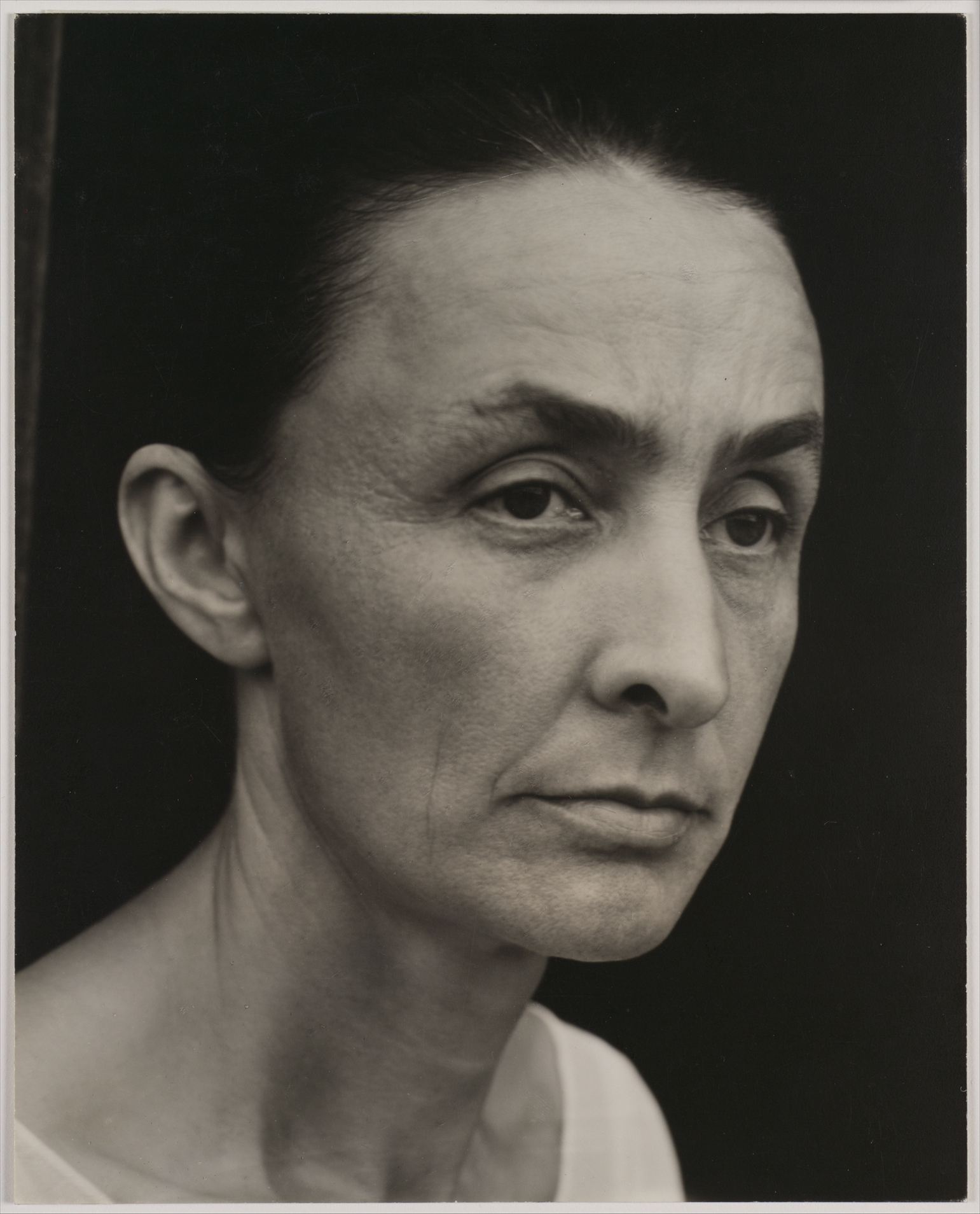
Why Georgia O'Keeffe matters
Georgia O'Keeffe is the central figure of American modernism, the painter who made the magnified flower, the New York skyscraper, and the bleached desert bone into an unmistakable national idiom. For a collector, she carries something rare: a near-universal museum endorsement, a complete published catalogue raisonne, and a single auction result that reset the ceiling for what the market would pay for a woman's work. She is a study in how scarcity, institutional consensus, and a clear body of iconic imagery compound into durable value.
- Born
- 1887-11-15, Sun Prairie, Wisconsin, USA
- Nationality
- American
- Media
- Painting, Works on paper
- Movement
- American Modernism, Precisionism
- Education
- School of the Art Institute of Chicago (1905 to 1906); Art Students League of New York (1907 to 1908); studied under Arthur Wesley Dow at Teachers College, Columbia University (1914)
- Signature motifs
- Magnified flowers, New York skyscrapers, New Mexico landscapes, Bleached bones and skulls
- Representation
- Georgia O'Keeffe Museum
By the numbers
- USD 44.4MAuction highJimson Weed/White Flower No. 1, Sotheby's New York, 2014
- 2014 to 2025Female-artist recordheld the auction record for a work by a woman until Nov 2025
- 2,045 worksCatalogue raisonneLynes, 1999
- Georgia O'Keeffe MuseumEstate
Selected works
Click any work to view it full screen.
Biography
Georgia O'Keeffe was born on 15 November 1887 near Sun Prairie, Wisconsin, and died on 6 March 1986 in Santa Fe, New Mexico, at the age of 98. She trained at the School of the Art Institute of Chicago from 1905 to 1906 and at the Art Students League of New York beginning in 1907, and in 1914 she took a class under Arthur Wesley Dow at Teachers College, Columbia University, whose ideas about composition reshaped her approach to abstraction.
Her career turned on her relationship with the photographer and gallerist Alfred Stieglitz, who gave her a first solo show in 1916, promoted her relentlessly, and married her in 1924. Through the 1920s she produced the work that made her famous: the large-scale, close-cropped flowers and the spare, modern paintings of New York. She first visited New Mexico in 1929 and spent two decades summering there before settling permanently in 1949, after Stieglitz's death, dividing her time between Ghost Ranch and a house at Abiquiu. The desert gave her the cliffs, skies, and animal skulls that defined her late work.
O'Keeffe continued working into her nineties despite the macular degeneration that cost much of her central vision, painting her last unassisted oil in 1972 and then working with assistants. After her death, her estate passed through a contested settlement to the Georgia O'Keeffe Foundation, which dissolved in 2006 and transferred its assets to the Georgia O'Keeffe Museum in Santa Fe, which had opened in 1997 and remains the steward of her legacy.
Critical reception
O'Keeffe was immediately recognised as a trailblazing artist
Tate, Georgia O'Keeffe exhibition, 2016
Critical consensus places O'Keeffe among the founders of American modernism, an artist celebrated from her 1916 debut as a distinctive and independent voice. The most persistent critical debate around her work concerns the sexualized, Freudian readings of her flower paintings, a framing that began with Stieglitz and the critic Paul Rosenfeld in the early 1920s and was later taken up by feminist art historians such as Linda Nochlin, who read works like the Black Iris paintings as morphological metaphors for the female body. O'Keeffe rejected these interpretations throughout her life, insisting that viewers were projecting their own associations onto her flowers. Institutions have steadily elevated her standing rather than reduced it to that debate: the Whitney mounted a major retrospective in 1970, and the 2016 Tate Modern survey, which described her as a trailblazing artist, reassessed her place in the twentieth-century canon. The recurring theme is an artist who built a singular American vocabulary while resisting the meanings others tried to assign to it.
Watch
Market
O'Keeffe's auction high is Jimson Weed/White Flower No. 1 (1932), which sold for USD 44,405,000 at Sotheby's New York on 20 November 2014. The result roughly tripled its high estimate and set the record for any work by a female artist at auction, more than tripling the previous mark of about USD 11.9 million held by Joan Mitchell. The buyer was Alice Walton, acquiring it for the Crystal Bridges Museum of American Art, where it remains. That record stood for eleven years before being surpassed in November 2025, when Frida Kahlo's El sueno (La cama) sold for USD 54.7 million. O'Keeffe's market is supported by genuine scarcity, since most of her finest works sit in museum collections and rarely return to sale.
Top auction results
| Work | Price | Sale |
|---|---|---|
| Jimson Weed/White Flower No. 1 (1932) | USD 44,405,000 (USD 44,405,000) | Sotheby's, New York, 2014-11-20 |
Selected exhibitions
| Years | Exhibition | Venues |
|---|---|---|
| 2023 | Georgia O'Keeffe: To See Takes Time | Museum of Modern Art, New York |
| 2021 | Georgia O'Keeffe | Centre Pompidou, Paris (first O'Keeffe retrospective in France) |
| 2016 | Georgia O'Keeffe | Tate Modern, London |
| 1970 | Georgia O'Keeffe | Whitney Museum of American Art, New York |
Museum collections
- Georgia O'Keeffe Museum, Santa Fe
- Art Institute of Chicago
- Crystal Bridges Museum of American Art, Bentonville
- Museum of Modern Art, New York
- The Metropolitan Museum of Art, New York
- Whitney Museum of American Art, New York
- National Gallery of Art, Washington, D.C.
Awards and honors
- Presidential Medal of Freedom (1977)
- National Medal of Arts (1985)
Authentication and provenance
Catalogue raisonne published.
A complete catalogue raisonne, Georgia O'Keeffe: Catalogue Raisonne by Barbara Buhler Lynes (Yale University Press with the National Gallery of Art, 1999), documents 2,045 works, of which 2,029 were located and examined. The Georgia O'Keeffe Museum does not authenticate or appraise works; verification rests on the catalogue raisonne, provenance, and scholarly analysis.
Primary reference: https://www.okeeffemuseum.org/about-georgia-okeeffe/
What collectors should know
O'Keeffe sits in an unusually clean position for a market of her size. She has a complete catalogue raisonne, compiled by Barbara Buhler Lynes and published in 1999 by Yale University Press with the National Gallery of Art, which documents 2,045 works and serves as the central authentication reference. The Georgia O'Keeffe Museum itself does not authenticate or appraise works, so verification rests on the catalogue, on provenance, and on scholarly and conservation analysis rather than on a certificate from a single body. The defining feature of her market is scarcity at the top: the most iconic flowers, skyscrapers, and New Mexico canvases are concentrated in museums, which means top-tier examples come to auction rarely and can command outsized results when they do. For a collector, the strongest signal of durability is exactly that institutional saturation, and the main caution is that thin supply makes any single price a fragile guide to the next one.
Further reading and resources
Data current as of 2026-06-20.

