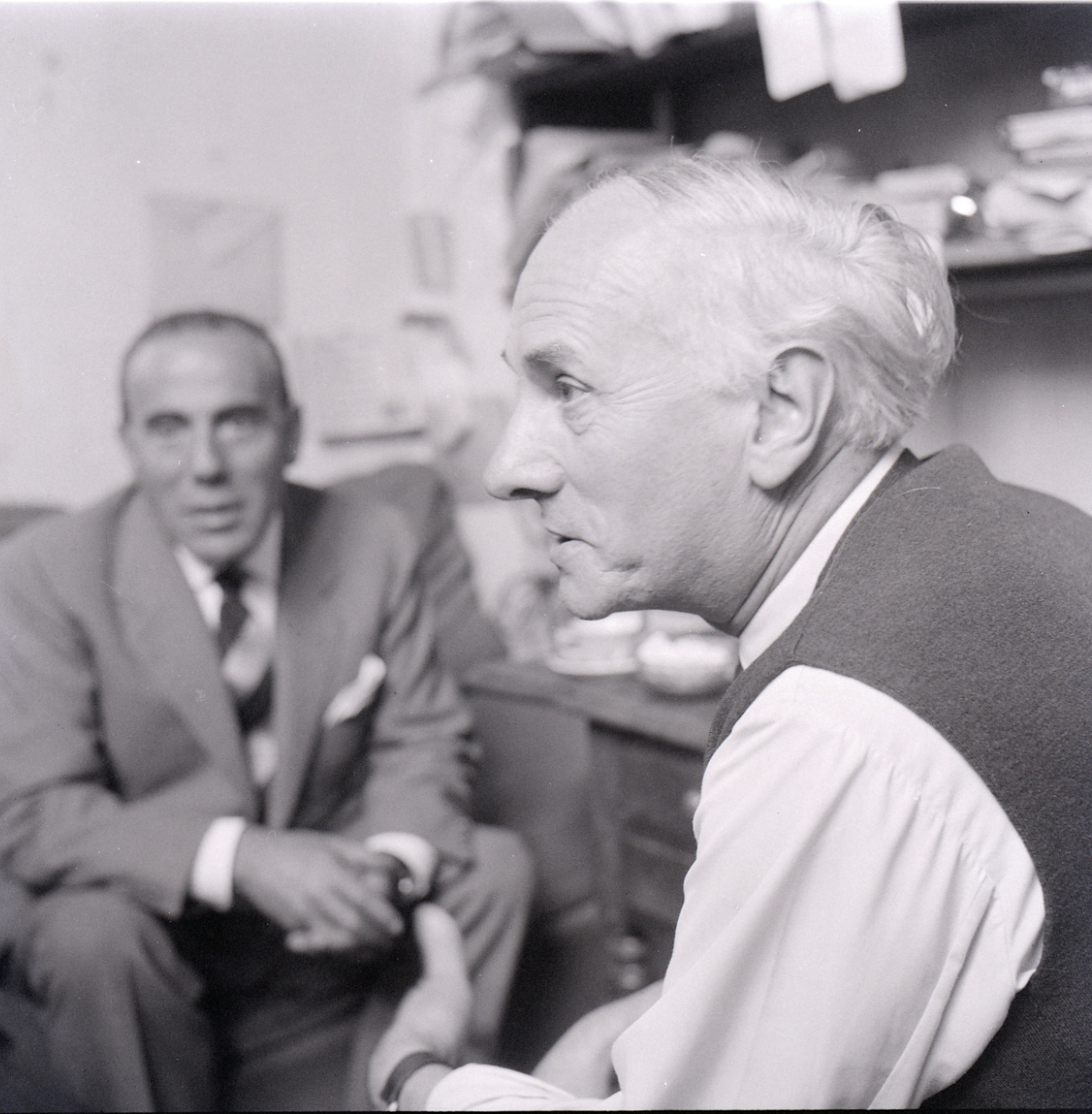
Why Gerard Ernest Schneider matters
Gerard Ernest Schneider was one of the founding figures of lyrical abstraction, the gestural, color-driven strain of postwar abstract painting that took shape in Paris alongside Hans Hartung and Pierre Soulages. He represented France at the Venice Biennale on multiple occasions, including an entire room of the French Pavilion devoted to his work in 1966, and his paintings sit today in the collections of the Centre Pompidou, MoMA, and The Phillips Collection. For collectors, he is a case study in a museum-validated postwar School of Paris painter whose secondary market remains comparatively thin and whose catalogue raisonne is still in preparation.
- Nationality
- Swiss, naturalized French (1948)
- Media
- Painting
- Movement
- Lyrical Abstraction, School of Paris
- Education
- Ecole des Arts Decoratifs, Paris, from c. 1916; enrolled at the Ecole des Beaux-Arts, Paris, 1918, in the studio of Fernand Cormon. No degree or diploma is documented.
- Signature motifs
- Gestural abstraction, Large-scale calligraphic canvases
- Representation
- Applicat-Prazan, Galerie Diane de Polignac
By the numbers
- EUR 342,900Auction highOpus 21B, Sotheby's Paris, 5 June 2023. A 2025 sale reported by MutualArt (Opus 77 C) is cited as a newer record, but its price and date are unconfirmed.
- Lyrical AbstractionMovementSchool of Paris, alongside Hans Hartung and Pierre Soulages
- 6+Museum collectionsCentre Pompidou, MoMA, The Phillips Collection, and others
- Applicat-Prazan; Galerie Diane de PolignacRepresented by
Biography
Gerard Ernest Schneider was born in 1896 in Sainte-Croix, Switzerland. At around age twenty, during the First World War, he moved to Paris and began studying at the Ecole des Arts Decoratifs. In 1918 he enrolled at the Ecole des Beaux-Arts, joining the studio of Fernand Cormon, the same teacher who had previously trained Van Gogh, Toulouse-Lautrec, and Emile Bernard. According to at least one biographical source, he became a French citizen in 1948, having by then settled permanently in the city where he would spend the rest of his career.
Schneider emerged after the Second World War as one of the leading painters of lyrical abstraction, working in large, gestural, calligraphic compositions built from sweeping fields of color. He exhibited at the Venice Biennale in 1948 and again in 1966, when an entire room of the French Pavilion was given over to his paintings. He also took part in the first documenta in Kassel in 1955. His work earned the Prix Lissone in Italy in 1957, the Governor of Tokyo Prize at the International Art Exhibition in Tokyo in 1959, and France's Grand Prix National des Arts in 1975. Major retrospectives followed at the Kunstverein Dusseldorf and the Palais des Beaux-Arts in Brussels in 1962, the Galleria Civica d'Arte Moderna in Turin in 1970, and the Musee d'Art et d'Histoire in Neuchatel in 1983. He died in Paris, France, on 8 July 1986, according to gallery biographical sources; that specific date is not independently corroborated by a contemporaneous newspaper obituary in the sources consulted for this profile.
Critical reception
Schneider is consistently described in museum and gallery literature as one of the pioneers of lyrical abstraction, grouped with Hans Hartung and Pierre Soulages as central to the postwar School of Paris. His inclusion in documenta 1 in 1955 and his dedicated room at the 1966 Venice Biennale French Pavilion are treated as the high points of his international recognition, reinforced by a string of retrospectives in Dusseldorf, Brussels, Turin, and Neuchatel between 1962 and 1983. No verbatim critical quotation from a named critic in a major outlet could be confirmed from the available sources for this profile, so none is reproduced here.
Market
Schneider's best-documented auction result is Opus 21B, which sold for EUR 342,900 (about USD 367,349) at Sotheby's in Paris on 5 June 2023. Market data aggregator MutualArt cites a subsequent 2025 sale, of a work catalogued as Opus 77 C, as the artist's current price record, but the exact hammer price, auction house, and sale date for that lot are not published in the sources available for this profile, so no figure is asserted for it here. His secondary market is handled principally by two Paris galleries, Applicat-Prazan and Galerie Diane de Polignac, both of which work closely with the artist's estate. No catalogue raisonne of his paintings has yet been published. Galerie Diane de Polignac, together with the artist's daughter Laurence Schneider and the art historian Patrick-Gilles Persin, is preparing one covering his works on canvas.
Top auction results
| Work | Price | Sale |
|---|---|---|
| Opus 21B (2023) | USD 367,349 (EUR 342,900) | Sotheby's, Paris, 2023-06-05 |
Selected exhibitions
| Years | Exhibition | Venues |
|---|---|---|
| 1948 | Venice Biennale | Venice Biennale, Venice |
| 1951 to 1952 | Advancing French Art | Traveling exhibition, United States (Louisville, Bloomington, San Francisco, Chicago, Washington) |
| 1955 | documenta 1 | Kassel, Germany |
| 1959 | International Art Exhibition | Tokyo, Japan |
| 1962 | Retrospective | Kunstverein Dusseldorf, traveled to Palais des Beaux-Arts, Brussels |
| 1966 | French Pavilion | 33rd Venice Biennale, Venice (an entire room devoted to his work) |
| 1970 | Retrospective | Galleria Civica d'Arte Moderna, Turin |
| 1983 | Retrospective | Musee d'Art et d'Histoire, Neuchatel |
Museum collections
- Centre Pompidou, Paris
- Museum of Modern Art, New York
- The Phillips Collection, Washington, D.C.
- Montreal Museum of Fine Arts
- Museu de Arte Moderna do Rio de Janeiro
- Fondation Gandur pour l'Art, Geneva
Awards and honors
- Prix Lissone, Italy (1957)
- Governor of Tokyo Prize, International Art Exhibition, Tokyo (1959)
- Grand Prix National des Arts, France (1975)
Authentication and provenance
No catalogue raisonne.
No catalogue raisonne has been published. Galerie Diane de Polignac, working with the artist's daughter Laurence Schneider and art historian Patrick-Gilles Persin, is preparing a catalogue raisonne of Schneider's works on canvas. Until that project is complete, authentication rests with the estate and with the two galleries most active in the market, Applicat-Prazan and Galerie Diane de Polignac.
Primary reference: https://dianedepolignac.com/en/home-gb/artists-en/00-gerard-schneider-gb/
What collectors should know
Schneider's public sales record is real but comparatively limited next to his museum standing, and the absence of a published catalogue raisonne means provenance should be checked against the two galleries most active with his estate, Applicat-Prazan and Galerie Diane de Polignac. The precise day of his birth is not documented in the sources available for this profile and should be treated as open until a primary record surfaces; his death is documented in gallery sources as 8 July 1986, in Paris. Collectors should also expect individual sale results to move with the scarcity of large-format, Biennale-era canvases rather than with a smooth market trend line, and should treat any reported 2025 price record with caution until its underlying auction details are confirmed.
Further reading and resources
Data current as of 2026-07-11.

