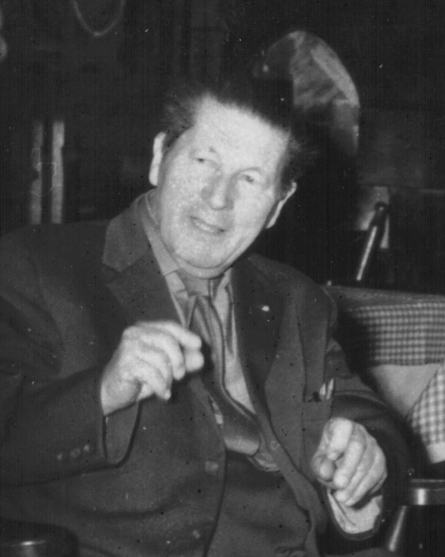
Why Gerrit Rietveld matters
Gerrit Rietveld is one of the foundational figures of twentieth-century modern design, the Dutch cabinetmaker turned architect whose Red and Blue Chair and Rietveld Schröder House became touchstones of the De Stijl movement. For a collector, he represents a different kind of market than a painter: the object of value is as often an architectural monument or a museum-held design icon as it is a piece that trades at auction, and scarcity, edition history, and documentation matter as much as any single sale price.
- Born
- 1888-06-24, Utrecht, Netherlands
- Nationality
- Dutch
- Media
- Furniture design, Architecture
- Movement
- De Stijl
- Education
- No formal degree. Apprenticed in his father's cabinetmaking workshop in Utrecht, took evening drawing courses, worked as a draftsman for jeweler C. J. Begeer (1906 to 1911), and trained in architecture under P. J. Klaarhamer beginning in 1911. Later received an honorary degree from the Technische Hogeschool in Delft.
- Signature motifs
- Primary-color planes, Rectilinear structure, Red and Blue Chair, Modular De Stijl furniture
- Representation
- "Rietveld Originals (furniture production and design rights)"
By the numbers
- USD 403,200Auction highRed Blue Chair, Sotheby's, Michael Maharam collection; exact sale date not independently confirmed
- De StijlMovementNetherlands, early 20th century
- Rietveld Schröder House (1924)Landmark workUNESCO World Heritage Site, Utrecht
- No gallery estate representation confirmedEstate representationRietveld Originals produces and documents his furniture designs
Biography
Gerrit Thomas Rietveld was born on June 24, 1888, in Utrecht, Netherlands. He did not pursue a university education. As a teenager he trained in his father's cabinetmaking workshop in Utrecht, learning joinery and construction firsthand, and supplemented that craft training with evening drawing courses. He worked as a draftsman in a jeweler's studio from 1906 to 1911, then trained in architecture under P. J. Klaarhamer in Utrecht beginning in 1911, building his practice on that combined craft and architectural training rather than on a university degree.
Around 1917 to 1918, Rietveld designed the chair that would become his best-known work, later called the Red and Blue Chair after he repainted it in primary colors; it was published in the De Stijl magazine in 1919 and became closely associated with the De Stijl movement of Theo van Doesburg and Piet Mondrian. In 1924 he designed the Rietveld Schröder House in Utrecht for Truus Schröder-Schräder, a house built almost entirely from planes and lines in primary colors that is now a UNESCO World Heritage Site. He continued to design furniture and buildings, including the Zig-Zag Chair and later architectural commissions, and received an honorary degree from the Technische Hogeschool in Delft along with honors including the Order of Oranje-Nassau, the Crown Order of Belgium, and the Sikkens Prize. He died on June 25, 1964, in Utrecht, the city where he was born. In market and museum catalogs he is sometimes listed under his full name, Gerrit Thomas Rietveld, or in family-name-first form as Rietveld, Gerrit; all refer to the same artist.
Critical reception
Rietveld is treated in design and architectural history as a central figure of De Stijl and of early modernism more broadly. The Red and Blue Chair is held in the permanent collection of the Museum of Modern Art in New York and has been featured repeatedly in the museum's design exhibitions as an early demonstration of how abstract, Mondrian-like composition could be built into a functional object. The Rietveld Schröder House is treated as a landmark of modern architecture and was designated a UNESCO World Heritage Site. Recent institutional attention has continued: the Center for Architecture in New York mounted "Gerrit Rietveld: Wealth of Sobriety" in 2026, built around photographer Arjan Bronkhorst's documentation of Rietveld's lesser-known houses.
Market
Rietveld's market runs through the design and decorative arts auction categories rather than the fine-art painting market, and it is comparatively thin. The best-documented results come from the sale of the Michael Maharam collection at Sotheby's, where the Red Blue Chair sold for USD 403,200 and a rare Danish chair sold for USD 378,000; the exact sale date for that sale could not be confirmed from available sources. A previously unrecorded early armchair sold for USD 266,500 at Phillips in December 2015. Some market databases cite a higher aggregate record near USD 459,000 for the artist, but the underlying work, auction house, and date for that figure could not be independently verified, so it is not treated as the confirmed record here. Rietveld furniture also circulates through licensed production by Rietveld Originals, which distinguishes vintage and original pieces from later authorized editions, a distinction that matters directly for value.
Top auction results
| Work | Price | Sale |
|---|---|---|
| Red Blue Chair (Rood Blauwe Stoel) | USD 403,200 (USD 403,200) | Sotheby's, Not confirmed |
| Danish chair | USD 378,000 (USD 378,000) | Sotheby's, Not confirmed |
| Early armchair (previously unrecorded example) (2015) | USD 266,500 (USD 266,500) | Phillips, Not confirmed |
Selected exhibitions
| Years | Exhibition | Venues |
|---|---|---|
| 1988 | Gerrit Rietveld: A Centenary Exhibition | Barry Friedman Gallery, New York |
| 2026 | Exhibition on the life and work of Gerrit Rietveld | Almedalsbiblioteket, Gotland, Sweden (16 to 27 February 2026) |
| 2026 | Gerrit Rietveld: Wealth of Sobriety | Center for Architecture, New York (7 May to 2 September 2026) |
Museum collections
- Museum of Modern Art, New York
- Centraal Museum, Utrecht
- Rietveld Schröder House, Utrecht (UNESCO World Heritage Site)
Awards and honors
- Order of Oranje-Nassau
- Crown Order of Belgium
- Sikkens Prize
- Honorary degree, Technische Hogeschool Delft
- Honorary membership, Bond van Nederlandse Architecten
Authentication and provenance
No catalogue raisonne.
No published catalogue raisonne is confirmed for Rietveld. Furniture editions and design rights are documented and produced through Rietveld Originals, and architectural works such as the Rietveld Schröder House are documented through Dutch museum and heritage records including the Centraal Museum, Utrecht.
Primary reference: https://www.moma.org/collection/artists/4922
What collectors should know
Rietveld is a design-market artist first, which changes how collectors should read his numbers: there is no catalogue raisonne, and authentication runs through Rietveld Originals for furniture and through Dutch museum and heritage records, such as the Centraal Museum in Utrecht, for architecture. No gallery currently represents his estate in the way a living artist would be represented, so provenance research and edition history carry unusual weight, particularly given the long history of licensed and unlicensed reproductions of his most famous chairs. Auction activity is real but comparatively rare and price levels vary widely between an original historic piece and a later authorized edition, so the specific object and its documentation matter more than any single benchmark price.
Further reading and resources
Data current as of 2026-07-11.

