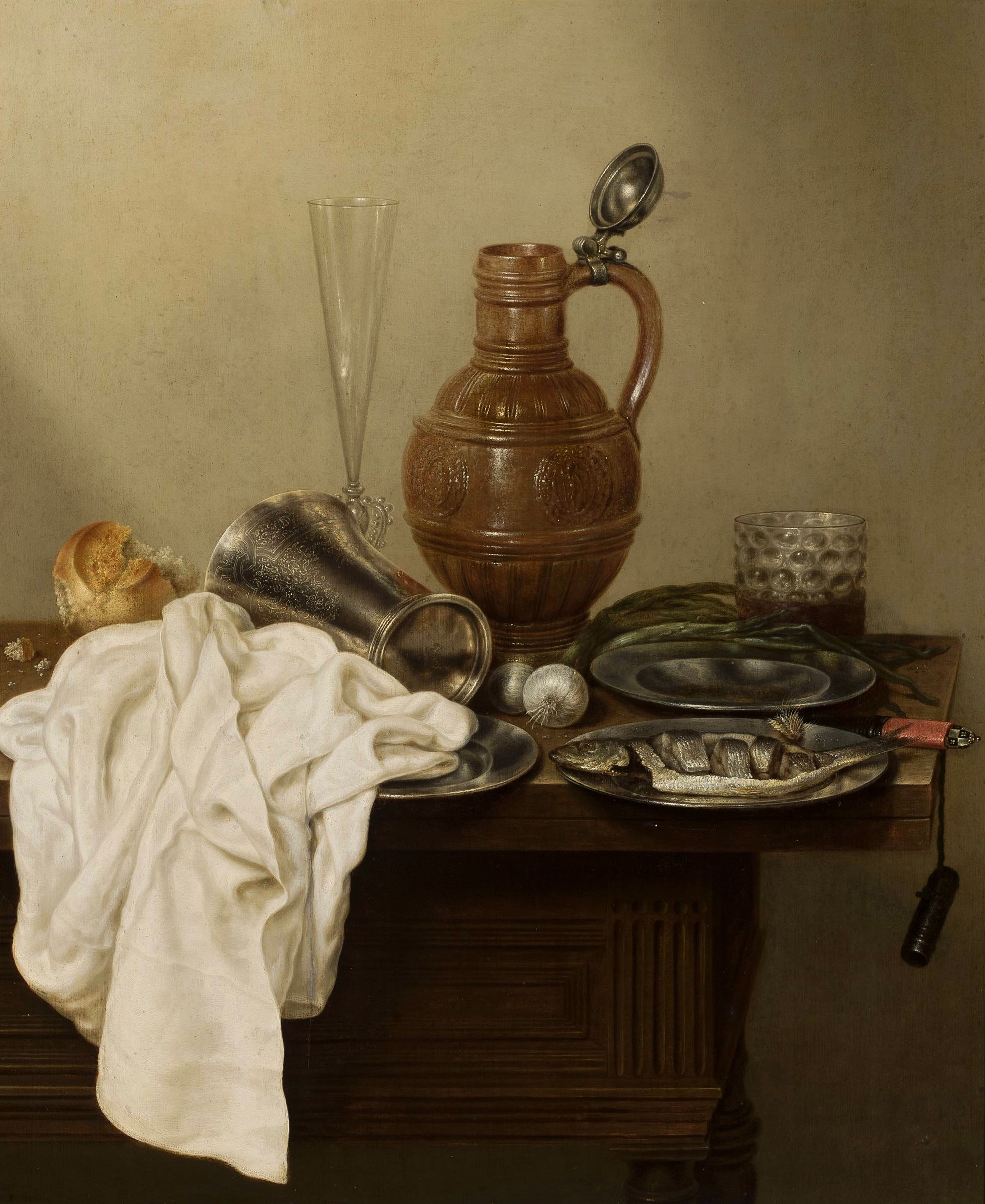
Why Gerrit Willemsz. Heda matters
Gerrit Willemsz. Heda is a secondary but genuine figure in the Dutch Golden Age still-life tradition, valued today for continuing and extending the refined monochrome banquet still life pioneered by his father and teacher, Willem Claesz. Heda. He is not a market blue chip, and his auction footprint is thin, but his paintings hang in several major public collections, including the National Gallery in London and the National Gallery of Art in Washington, and he offers collectors a useful case study in how attribution and connoisseurship, rather than brand-name demand, drive value for minor Old Masters.
- Nationality
- Dutch
- Media
- Painting
- Movement
- Dutch Golden Age, Haarlem still-life school
- Education
- Apprenticed under his father, Willem Claesz. Heda, in Haarlem; registered as his pupil in the Haarlem Guild of Saint Luke, 1642
- Signature motifs
- Monochrome banquet still life (banketje), Roemer glasses and nautilus cups, Oysters and pewter tableware
By the numbers
- Haarlem, active circa 1642 to 1649CareerSon and pupil of Willem Claesz. Heda
- USD 320,000Auction highReported Sotheby's sale, 1996; the same work later resold for USD 120,600 at Christie's New York, 2026
- National Gallery, London; National Gallery of Art, Washington; Rijksmuseum, AmsterdamMuseum collectionsAlso Worcester Art Museum
- NoneCatalogue raisonneAttribution relies on connoisseurship and RKD records
Selected works
Click any work to view it full screen.
Biography
Gerrit Willemsz. Heda was born in Haarlem, in the Dutch Republic, with most reference sources placing his birth somewhere between about 1620 and 1625. He was the son and pupil of Willem Claesz. Heda, one of the leading still-life painters of Haarlem, and in July 1642 his father registered him, along with two other pupils, in the city's Guild of Saint Luke. Working alongside and under his father, Gerrit adopted the elder Heda's restrained, near-monochrome style of laid tables set with roemer glasses, nautilus cups, oysters, and pewter, and developed it further in his own signed and dated works, several of which survive from the 1640s, including pieces now dated to 1641, 1644, 1645, and 1646.
Documentation of his life is sparse. The National Gallery in London, which holds a work probably by his hand, notes that comparatively little is documented about his life. What is agreed across major sources, including the National Gallery and Wikimedia Commons, is that he died in Haarlem, with his burial recorded at the city's Grote Kerk in July 1649. A minority of reference sources, including the Dutch Wikipedia entry citing the RKD Netherlands Institute for Art History, give an earlier burial date of 31 July 1647, and at least one museum record gives an unsupported later date; the weight of the evidence favors 1649. A signed and dated still life of 1650, now in the National Gallery of Art in Washington, is generally treated as either a posthumous date or evidence that the 1649 date is not fully settled, and it is catalogued there under his name after having originally been attributed to his father.
Critical reception
Because Gerrit Willemsz. Heda worked so closely within his father's idiom, auction houses and museums that discuss him almost always do so in relation to Willem Claesz. Heda. Sotheby's, Christie's, Dorotheum, and Lempertz catalogue notes each describe him as his father's son and pupil; Sotheby's, for one, notes that his paintings "have frequently been confused with those of his father." Christie's similarly describes how he adopted his father's style and made copies of his father's compositions, a practice that has caused ongoing confusion between the two men's works. No named critic's review in a major outlet could be confirmed for this artist, and no major awards, honors, or dedicated retrospective exhibitions are documented in current reference sources; his profile rests instead on inclusion in permanent museum collections and periodic reattribution research, such as the National Gallery's identification of a work in its Dutch collection as probably his.
Market
Gerrit Willemsz. Heda's market is small, infrequent, and hard to summarize with a single clean number. Market reporting tied to a 2026 Christie's New York sale states that the same painting, A Pewter Flagon, a Salt Cellar, a Roemer with Silver-Gilt Stem, an Upturned Glass Roemer, Oysters, and a Dish on a Partly Draped Table (1647), sold for USD 320,000 at Sotheby's in New York on 16 May 1996 and then realized only USD 120,600 at Christie's in New York on 4 February 2026, a decline in nominal terms across three decades. Separately, a different still life, Still Life with a Herring, Rummer, Wanli Dish, and Bread, realized EUR 148,800 at Lempertz in Cologne, though the exact sale date is not published in the available record. Other recorded results, including sales at Dorotheum, have cleared in the tens of thousands of euros. Taken together, these results suggest a market that moves in a wide band from roughly USD 100,000 to over USD 300,000 depending on the specific work, its condition, and its attribution certainty, rather than a market with a clear upward trend line.
Top auction results
| Work | Price | Sale |
|---|---|---|
| A Pewter Flagon, a Salt Cellar, a Roemer with Silver-Gilt Stem, an Upturned Glass Roemer, Oysters, and a Dish on a Partly Draped Table (1647) (1996) | USD 320,000 | Sotheby's, New York, 1996-05-16 |
| Still Life with a Herring, Rummer, Wanli Dish, and Bread | EUR 148,800 | Lempertz, Cologne |
| A Pewter Flagon, a Salt Cellar, a Roemer with Silver-Gilt Stem, an Upturned Glass Roemer, Oysters, and a Dish on a Partly Draped Table (1647), resale (2026) | USD 120,600 | Christie's, New York, 2026-02-04 |
Museum collections
- National Gallery of Art, Washington, D.C.
- National Gallery, London
- Rijksmuseum, Amsterdam
- Worcester Art Museum, Worcester, Massachusetts
Authentication and provenance
No catalogue raisonne.
No catalogue raisonne exists for this artist. Because he trained in and closely followed the style of his father, Willem Claesz. Heda, attribution between father and son is a recurring issue, and works are authenticated through connoisseurship, signature analysis, and consultation of the RKD Netherlands Institute for Art History.
Primary reference: https://www.nationalgallery.org.uk/artists/gerrit-willemsz-heda
What collectors should know
Anyone considering a work by Gerrit Willemsz. Heda should treat attribution as the central question, since his output is small, closely intertwined with his father's, and still being sorted out by scholars and museums. There is no catalogue raisonne and no gallery or estate representation; paintings surface irregularly at major auction houses, including Sotheby's, Christie's, Dorotheum, and Lempertz, rather than through a continuous market. Given the wide spread between recorded sale prices for works attributed to him, and the documented case of a single painting selling for markedly different sums thirty years apart, provenance research and independent verification, ideally including consultation of the RKD, matter more here than for almost any market with steadier trading volume.
Further reading and resources
Data current as of 2026-07-18.

