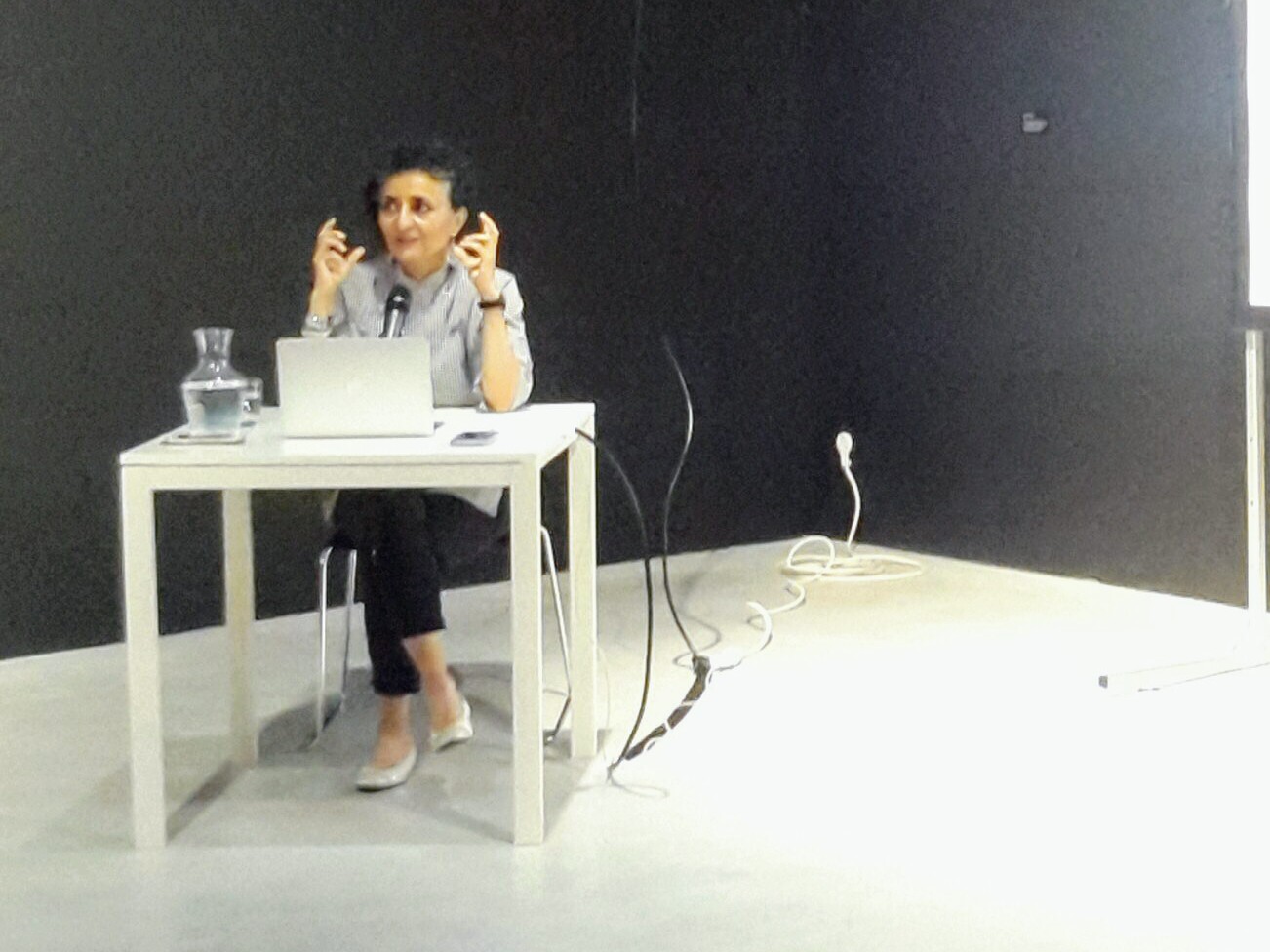
Why Ghada Amer matters
Ghada Amer is among the most prominent Arab and Egyptian-born artists working today, known for reclaiming embroidery, a craft historically coded as domestic and feminine, as a medium for direct engagement with female sexuality, desire, and the erasure of women's voices from art history. Her paintings, built from stitched and dripped thread over gessoed canvas, place explicit source imagery within compositions that read as gestural abstraction from a distance, a strategy that has kept her work in dialogue with both feminist art history and post-war American painting. For collectors, she represents a case of an artist whose auction market remains modest while her exhibition history places her firmly inside major museums and biennials worldwide.
- Born
- 1963-05-22, Cairo, Egypt
- Nationality
- Egyptian
- Media
- Painting, Embroidery and thread work, Sculpture
- Movement
- Contemporary, Feminist art
- Education
- Villa Arson, Nice, BFA 1986, MFA 1989; School of the Museum of Fine Arts, Boston, study abroad 1987; Institut des Hautes Etudes en Arts Plastiques, Paris, postgraduate study circa 1991
- Signature motifs
- Embroidered erotic imagery, Dripped and stitched thread paintings, Garden installations
- Representation
- Marianne Boesky Gallery, Goodman Gallery, Kewenig, Tina Kim Gallery
By the numbers
- GBP 146,500Auction highSotheby's, London; exact work and sale date not confirmed in available sources
- 1999UNESCO Prize48th Venice Biennale
- Officer, Order of Arts and LettersHonorFrench Ministry of Culture, 2024
- Marianne Boesky Gallery; Goodman GalleryRepresented by
Biography
Ghada Amer was born on May 22, 1963, in Cairo, Egypt, and moved to France with her family in 1974. She trained at Villa Arson in Nice, earning a Bachelor of Fine Arts in painting in 1986 and a Master of Fine Arts in painting in 1989, and spent a year of study abroad at the School of the Museum of Fine Arts in Boston in 1987. She later undertook postgraduate study at the Institut des Hautes Etudes en Arts Plastiques in Paris, a period most sources date to 1991.
Amer developed her signature technique in the early 1990s: hand-embroidering and gluing colored thread onto canvas in patterns drawn from pornographic source imagery, then letting loose thread hang and drip down the surface. The device let her raise questions about censorship, female pleasure, and the conventions of abstract painting at once. She gained wider international recognition through the 1990s, receiving the UNESCO Prize at the 48th Venice Biennale in 1999. Her 2000 exhibition Intimate Confessions, first at Deitch Projects in New York, traveled to the Tel Aviv Museum of Art and to Kunst-Werke in Berlin.
Her work has since expanded into sculpture, ceramics, and garden installations. She was given a mid-career retrospective at the Brooklyn Museum in 2008 and a larger retrospective spanning venues in Marseille, including MUCEM, in 2022. In 2024 the French Ministry of Culture named her an Officer in the Order of Arts and Letters. She lives and works in New York, with some biographies noting time divided between New York and Paris.
Critical reception
Amer's work is consistently discussed in terms of its collision between craft and abstraction, and between explicit content and the polite distance of gestural painting. Critics and curators have repeatedly framed her practice around the reclamation of embroidery as a feminist medium and around her direct engagement with female sexuality, censorship, and the marginalization of women within both Islamic and Western cultural narratives. Her placement in major surveys, including the Venice Biennale in 1999, 2005, and 2007, and the Whitney Biennial in 2000, reflects sustained institutional interest across two decades.
Market
The highest publicly documented auction price for Amer's work is GBP 146,500 at Sotheby's in London, described by Artsy as a record for the artist. The specific work and exact sale date are not confirmed in available sources. Available auction records suggest her secondary market remains comparatively thin and modest relative to her museum standing, a pattern common among artists whose primary market activity runs through gallery sales rather than the auction room. She is currently represented by Marianne Boesky Gallery, Goodman Gallery, Kewenig, and Tina Kim Gallery.
Selected exhibitions
| Years | Exhibition | Venues |
|---|---|---|
| 1999 | 48th Venice Biennale (UNESCO Prize) | Venice Biennale, Venice, Italy |
| 2000 | Whitney Biennial | Whitney Museum of American Art, New York |
| 2000 | Intimate Confessions | Deitch Projects, New York; Tel Aviv Museum of Art; Kunst-Werke, Berlin |
| 2004 | Group exhibition | Centre Georges Pompidou, Paris |
| 2008 | Mid-career retrospective | Brooklyn Museum, New York |
| 2022 | My Body, My Choice | Goodman Gallery, London |
| 2022 | Mid-career retrospective | MUCEM and other venues, Marseille, France |
| 2026 | Sculpture retrospective (forthcoming) | Es Baluard Museu d'Art Contemporani, Palma de Mallorca, Spain |
Museum collections
- Centre Georges Pompidou, Paris
- Art Institute of Chicago
- Brooklyn Museum, New York
- Guggenheim Abu Dhabi
- Israel Museum, Jerusalem
- Crystal Bridges Museum of American Art
- Mathaf: Arab Museum of Modern Art, Doha
- Leeum, Samsung Museum of Art, Seoul
Awards and honors
- Pollock-Krasner Foundation Grant (1997)
- UNESCO Prize, 48th Venice Biennale (1999)
- Officer, Order of Arts and Letters, French Ministry of Culture (2024)
Authentication and provenance
No catalogue raisonne.
No published catalogue raisonne has been identified for the artist. Works are represented and verified through her current galleries, including Marianne Boesky Gallery and Goodman Gallery.
Primary reference: https://marianneboeskygallery.com/artists/33-ghada-amer/biography/
What collectors should know
Amer's market history includes only a small number of publicly documented auction results, and the highest known price, GBP 146,500, is modest next to the depth of her museum exposure, from the Pompidou to the Brooklyn Museum to the Guggenheim Abu Dhabi. No catalogue raisonne has been identified, so buyers should rely on documentation and support from her representing galleries. Because her secondary market is thin, prices for individual works can vary widely depending on medium, scale, and period, and any single sale should be treated as an imperfect guide to value across her broader body of work.
Further reading and resources
Data current as of 2026-07-13.

