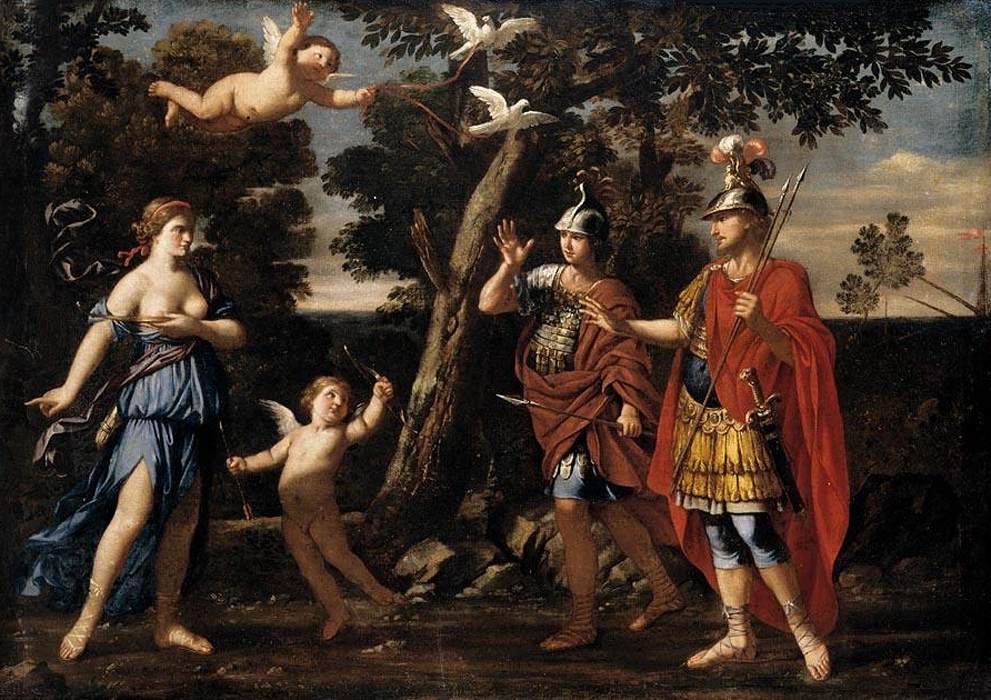
Why Giacinto Gimignani matters
Giacinto Gimignani is remembered as a link between two of the founding poles of Roman Baroque painting: art-historical tradition holds that he trained first under Nicolas Poussin and then under Pietro da Cortona, and his career shows how a talented provincial painter could move to Rome, absorb the era's two dominant idioms, and build a durable practice across churches, palaces, and courtly patrons. For today's collector, he matters less as a market star than as a representative Old Master name: a real, well-documented seventeenth-century Roman painter whose works surface periodically at auction and sit, sometimes without firm attribution, in major museum collections.
- Nationality
- Italian
- Media
- Painting, Etching
- Movement
- Baroque
- Education
- Art-historical tradition holds that he trained in Rome under Nicolas Poussin (design, from about 1630) and then Pietro da Cortona (color, from about 1632); elected to the Accademia di San Luca, Rome, in 1650. No formal degree is documented.
- Signature motifs
- Classicizing figure compositions, Mythological and biblical narrative scenes, Idyllic landscape passages
By the numbers
- EUR 35,300 (about USD 43,000)Auction highDorotheum, Vienna, 8 June 2021
- Rome, c. 1630 to 1681Active
- Elected 1650Accademia di San Luca
- Metropolitan Museum, British Museum, and Palazzo BarberiniMuseum collections
Selected works
Click any work to view it full screen.
Biography
Giacinto Gimignani was born in Pistoia, in present-day Tuscany, and baptized there on 23 January 1606, the son of the painter Alessio Gimignani. By 1630, his father had arranged for him to travel to Rome, where he is said to have begun training under Nicolas Poussin, learning design; by 1632 he had transferred to the studio of Pietro da Cortona, from whom he learned color. The patronage of Cardinal Guido Rospigliosi, part of the prominent Pistoiese family, is credited with easing his early path in Rome.
Gimignani built a career on major Roman commissions. He painted the lunette fresco Rest on the Flight to Egypt in Palazzo Barberini around 1631 while working under Pietro da Cortona, contributed to the decoration of the Palazzo Pamphilj on Piazza Navona around 1648, and later worked under Bernini's direction for Pope Alexander VII Chigi, painting altarpieces at Castel Gandolfo and Santa Maria dei Monti. In 1650 he was elected a member of the Accademia di San Luca, the city's principal painters' academy, a mark of professional standing rather than a formal degree. He died in Rome on 9 December 1681. Some secondary sources give a death date of February 1680, but the more authoritative Dizionario Biografico degli Italiani, the Metropolitan Museum of Art, and the Getty Research Institute's ULAN record all confirm 1681 in Rome.
Critical reception
Scholarly assessment of Gimignani places him firmly within Pietro da Cortona's circle while noting a distinct, more restrained temperament. Writing in Baroque Painting in Rome, the art historian Hermann Voss judged Gimignani closer in style to Romanelli than to Cortona, the teacher traditionally credited to him, and praised his gift for gentle, idyllic landscape passages and medium-scale figured scenes, while finding monumental compositions outside his range. The consistent critical picture, corroborated by his documented training under Poussin and Cortona and his major Roman commissions, is of a capable, well-trained second-tier Roman master best suited to intimate rather than grand-scale work.
Market
Gimignani's market is a small, steady Old Master trade rather than a headline-driven one. The highest publicly documented price is EUR 35,300 (about USD 43,000) for a painting sold at Dorotheum in Vienna on 8 June 2021, in the house's Old Master Paintings sale; the accessible catalogue text confirms the price, house, location, and date, but not the lot's title. Other recorded results are more modest: Chiswick Auctions in London sold a work catalogued as "Giacinto Gimignani (Pistoia 1606 to 1681 Rome)" for GBP 9,375 including premium on 17 March 2020, and a 2025 sale at Ponte realized EUR 15,360 for a work described only as "attributed to the circle of Giacinto Gimignani," not as an autograph painting. Auction houses consistently use the given-name-first form "Giacinto Gimignani," and the birth and death years cited across Dorotheum, Christie's, Chiswick, and the Metropolitan Museum all align on Pistoia 1606 to Rome 1681; a small number of listings, including Bertolami Fine Art and MutualArt, give 1611 as his birth year, which appears to be a recurring cataloguing variant rather than evidence of a second artist.
Top auction results
| Work | Price | Sale |
|---|---|---|
| Old Master painting (lot title not published in the accessible catalogue record) (2021) | USD 43,000 (EUR 35,300) | Dorotheum, Vienna, 2021-06-08 |
Selected exhibitions
| Years | Exhibition | Venues |
|---|---|---|
| c. 1631 | Rest on the Flight to Egypt (lunette fresco) | Palazzo Barberini (Gallerie Nazionali di Arte Antica), Rome |
| 1648 | Decorations for the Palazzo Pamphilj | Piazza Navona, Rome |
| 1650 | Elected member | Accademia di San Luca, Rome |
| c. 1655 to 1660s | Altarpieces for Pope Alexander VII, under Bernini's direction | Castel Gandolfo and Santa Maria dei Monti, Rome |
Museum collections
- Metropolitan Museum of Art, New York
- British Museum, London
- Palazzo Barberini (Gallerie Nazionali di Arte Antica), Rome
Awards and honors
- Elected member, Accademia di San Luca, Rome (1650)
Authentication and provenance
No catalogue raisonne.
No published catalogue raisonne has been identified for Gimignani. His paintings and drawings are documented individually across museum catalogues, the Dizionario Biografico degli Italiani, and auction house records, and a number of works still circulate under attributions such as attributed to or circle of, reflecting ordinary Old Master attribution uncertainty rather than a settled connoisseurship record.
Primary reference: https://www.treccani.it/enciclopedia/giacinto-gimignani_(Dizionario-Biografico)/
What collectors should know
There is no catalogue raisonne for Gimignani, and a meaningful share of the works that reach the market are catalogued as attributed to or circle of rather than as firm autograph paintings, which is typical for a painter of his rank and period but still worth weighing before any purchase. His auction history is thin: a small number of documented sales, led by the EUR 35,300 result at Dorotheum in 2021, with most other results well below that figure. Because so few sales exist, provenance, condition, and a clear attribution history matter more than any single price point, and collectors should expect institutional and archival research, principally through the Dizionario Biografico degli Italiani and museum collection records, to carry more weight than market data alone.
Further reading and resources
Data current as of 2026-07-16.

