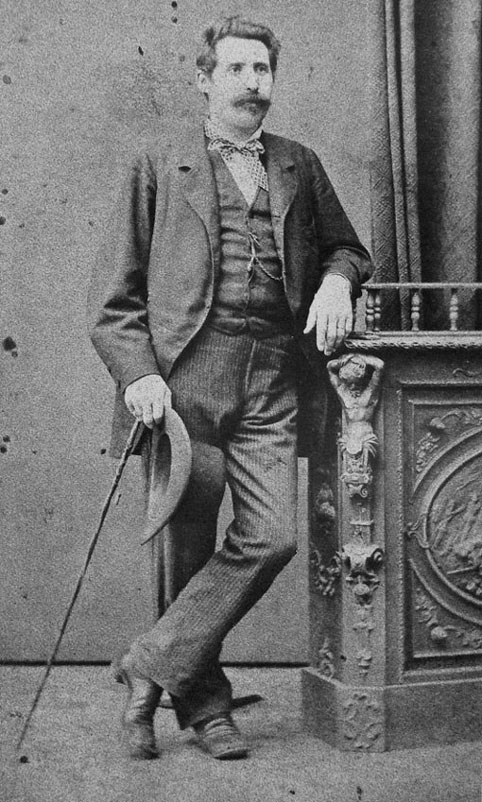
Why Giovanni Battista Lombardi matters
Giovanni Battista Lombardi was a nineteenth-century Italian sculptor known for finely carved marble, especially veiled female figures and funerary monuments, whose surviving work sits mainly in museum collections, church and cemetery monuments, and the secondary auction market rather than in any active gallery or estate program. For a collector, he is a useful case study in what a historical, single-artist market looks like once the artist has been dead for well over a century: no living representation, no catalogue raisonne, and a valuation built almost entirely on provenance, museum comparables, and connoisseurship.
- Born
- 1822-11-24, Rezzato, Italy
- Nationality
- Italian
- Media
- Sculpture
- Movement
- Neoclassicism, Naturalism
- Education
- Scuola di Ornato e Architettura, Rezzato, from 1839. Accademia di Belle Arti di Brera, Milan, and the studio of Lorenzo Vela, from 1845. Accademia di San Luca, Rome, and the studio of Pietro Tenerani, from 1852. No degree or diploma is documented for any of these periods of study.
- Signature motifs
- Veiled marble female figures, Funerary monuments
By the numbers
- USD 133,000Auction highRuth, Sotheby's New York, 18 April 2008; highest price documented, not confirmed as an absolute record
- 1822 to 1880LifespanRezzato to Brescia, Italy
- Metropolitan Museum of ArtMuseum collections
- None identifiedCatalogue raisonne
Selected works
Click any work to view it full screen.
Biography
Giovanni Battista Lombardi was born in Rezzato, near Brescia, in the Lombardy region of Italy, on 24 November 1822, though several art-market references round this to 1823. He began his training locally, entering the Scuola di Ornato e Architettura in Rezzato in 1839 with the encouragement of the architect Rodolfo Vantini. In 1845 he moved to Milan, where he attended the Accademia di Belle Arti di Brera and trained in the studio of the sculptor Lorenzo Vela. In 1852, with the support of Countess Marietta Mazzuchelli Longo, he moved to Rome to continue his studies at the Accademia di San Luca and in the studio of Pietro Tenerani, one of the leading Neoclassical sculptors of the period. He later opened a studio in Rome with his brother, the animal sculptor Giovita Lombardi; the two are sometimes confused in market listings, as is Giovanni Battista Lombardi with the unrelated sixteenth-century painter Giovanni Battista Lombardelli.
Lombardi became known chiefly for idealized female subjects, including virtuoso veiled marble busts and figures, and for funerary sculpture. His monuments can be found in the Cimitero Monumentale di Brescia, the Certosa di Bologna, and the Cimitero del Verano in Rome. His best-known civic commission is the Monumento alle Dieci Giornate, honoring the 1849 uprising in Brescia, installed in the city's Piazza della Loggia and, according to Italian biographical sources, given to the city by King Vittorio Emanuele II. Lombardi died in his home in Brescia on 9 March 1880, a date given by Italian and Russian reference sources, though at least one aggregator lists an alternate death date of 8 March 1880.
Critical reception
No verbatim, attributable critical commentary on Lombardi from named critics in major outlets could be confirmed as of this writing. Encyclopedic and museum-adjacent sources place him within late Italian Neoclassicism, with naturalist tendencies, and describe him as a salon-academic sculptor and a master of the sculptural portrait and the monumental tomb. His veiled marble women, worked in the long Italian tradition of virtuoso veil carving, are the works for which he remains best known internationally, and examples are held today by the Metropolitan Museum of Art and other public collections.
Market
Lombardi's auction market is thin and almost entirely secondary. The highest price documented in the sources reviewed is USD 133,000, paid for the marble figure Ruth at Sotheby's New York on 18 April 2008, per a later Christie's lot note; a separate retail listing gives USD 114,136 for what appears to be the same Ruth sale, so the exact realized price is not fully reconciled. Other tracked results sit well below that level, including a marble bust of a veiled woman that sold at Lempertz in Cologne for approximately EUR 27,280 including premium. A 2017 Sotheby's sale carried an estimate of GBP 60,000 to 80,000 for a Lombardi lot titled Naiad or Nymph, but no confirmed hammer price or sale location could be located. Artnet's database also lists a further sale dated 14 June 2024 for which the realized price could not be confirmed, so it is not certain that the 2008 Ruth result remains the highest price ever paid for the artist.
Top auction results
| Work | Price | Sale |
|---|---|---|
| Ruth (2008) | USD 133,000 (USD 133,000) | Sotheby's, New York, 2008-04-18 |
Selected exhibitions
| Years | Exhibition | Venues |
|---|---|---|
| 1865 | International Exhibition of Arts and Manufactures | Dublin |
| 1872 | Dublin Exhibition of Arts, Industries and Manufactures, with Loan Museum of Works of Art | Dublin |
Museum collections
- Metropolitan Museum of Art, New York
Authentication and provenance
No catalogue raisonne.
No catalogue raisonne has been identified for Giovanni Battista Lombardi. Attribution relies on museum provenance records, historical exhibition catalogues, and standard references such as Benezit. No artist estate or currently active gallery representation has been confirmed.
Primary reference: https://it.wikipedia.org/wiki/Giovanni_Battista_Lombardi
What collectors should know
There is no catalogue raisonne for Lombardi, and no gallery or estate currently represents him; Galerie Tourbillon in Paris has offered individual Lombardi works for sale, but this reflects ordinary dealer inventory rather than exclusive representation. Attribution and condition should be checked against museum provenance records and standard references such as Benezit, since documentation for nineteenth-century Italian marble sculpture of this kind often depends on dealer notes and family history as much as institutional paper trails. The public auction record is small, with results ranging from the mid five figures in euros to the low six figures in US dollars, so any single sale price should be treated as one data point rather than a trend.
Further reading and resources
Data current as of 2026-07-16.

