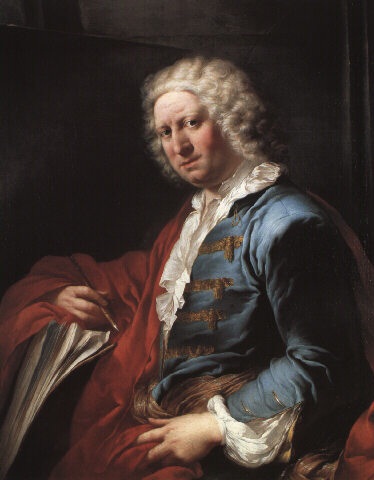
Why Giovanni Paolo Panini matters
Giovanni Paolo Panini is the artist most closely identified with the eighteenth-century image of Rome. As the foremost vedutista of his era, he set the visual template, ancient ruins bathed in golden light, church interiors rendered with theatrical precision, gallery-style capricci gathering monuments that never stood together, that shaped how generations of Grand Tour travelers and, later, museum visitors have pictured the city. For a collector, he matters as a foundational figure in the market for Roman view painting, with work anchored in the permanent collections of the Louvre, the Metropolitan Museum, and the National Gallery of Art, and with a market built entirely on documented auction history rather than gallery representation, since no living estate or dealer speaks for him today.
- Born
- 1691-06-17, Piacenza, Duchy of Parma and Piacenza (now Italy)
- Nationality
- Italian
- Media
- Painting, Architectural drawing
- Movement
- Italian Baroque, Vedutismo
- Education
- Trained in Piacenza under Giuseppe Natali, Andrea Galluzzi, and stage designer Francesco Galli-Bibiena. Moved to Rome in 1711 and studied with the figure painter Benedetto Luti. Admitted to the Accademia di San Luca, Rome, in 1719 (elected Principe, 1754), and to the Academie Royale de Peinture et de Sculpture, Paris, in 1732.
- Signature motifs
- Roman vedute, Architectural capriccio
By the numbers
- ~USD 5.3MAuction highAggregate market-data ceiling reported by MutualArt for paintings; the specific work, auction house, and sale date behind this figure could not be independently confirmed.
- 1711 to 1765Career spanActive as a painter and architect in Rome
- Principe, 1754Academy honorElected director of the Accademia di San Luca, Rome
- 6+Museum collectionsIncludes the Louvre, the Met, and the National Gallery of Art
Selected works
Click any work to view it full screen.
Biography
Giovanni Paolo Panini was born in Piacenza on 17 June 1691. He trained there under the painters Giuseppe Natali and Andrea Galluzzi and with the stage designer Francesco Galli-Bibiena, absorbing the theatrical sense of perspective and architecture that would define his mature style. In 1711 he moved to Rome, where he studied drawing and figure painting with Benedetto Luti and, by some accounts, landscape painting with Andrea Locatelli.
Panini rose quickly within Rome's artistic institutions. He was admitted to the Congregazione dei Virtuosi al Pantheon in 1718 and, in 1719, to the Accademia di San Luca, presenting Alexander Visiting the Tomb of Achilles as his entry piece. He taught perspective drawing there and was elected Principe, or director, of the academy in 1754. In 1732 he was made a member of the Academie Royale de Peinture et de Sculpture in Paris, a distinction rarely extended to a Roman painter, and he later served as professor of perspective and optics at the French Academy in Rome. His documented commissions include a fresco cycle, now lost, for the Villa Patrizi in Rome, executed between about 1719 and 1725. He worked prolifically for Roman patrons and Grand Tour visitors.
Panini died in Rome on 21 October 1765.
Critical reception
Museums and reference sources consistently describe Panini as the leading painter of Roman topography in the eighteenth century and the artist most responsible for defining the visual genre of the veduta and the architectural capriccio. His interiors of Saint Peter's and the Pantheon, and his gallery views assembling the monuments of ancient and modern Rome, are treated as the period's benchmark for combining topographical accuracy with theatrical staging, a skill traced directly to his early training in stage design under the Galli-Bibiena workshop. The National Gallery of Art continues to build interpretive programming around his work, framing him as central to understanding how the Grand Tour shaped Western ideas of Rome. No exact, attributed critical quotation from a named critic in a major outlet could be confirmed for this profile, so none is reproduced here.
Market
Panini's market rests on more than two centuries of documented auction activity rather than on any living representation. The market-data aggregator MutualArt reports realized prices up to USD 5.3 million for Panini paintings, the highest figure found in available market sources, but the specific work, auction house, and sale date behind that figure could not be independently verified and are not asserted here. Confirmed comparables include a Circle of Panini attribution, Philosophers and Soldiers Among Ancient Ruins, Including the Pyramid of Gaius Cestius, which sold for USD 11,950 at Heritage Auctions on 27 May 2010, and a painting that Artsy's auction-result data lists at about USD 284,000 with a sale date of 19 June 2024, though full lot and house details for the latter were not available. Because Panini and his workshop produced multiple versions of his most popular subjects, and because circle and follower attributions circulate alongside autograph works, prices vary considerably by autograph status, subject, condition, and documented provenance.
Selected exhibitions
| Years | Exhibition | Venues |
|---|---|---|
| 1719 | Alexander Visiting the Tomb of Achilles (admission piece) | Accademia di San Luca, Rome |
| 1719 to 1725 | Fresco decoration cycle (now lost) | Villa Patrizi, Rome |
| 1732 | Elected member | Academie Royale de Peinture et de Sculpture, Paris |
| 1754 | Elected Principe (director) | Accademia di San Luca, Rome |
| 1757 | Ancient Rome (pendant to Modern Rome) | On view, The Metropolitan Museum of Art, New York, Gallery 627 |
| Permanent collection | Gallery of Views of Ancient Rome; Gallery of Views of Modern Rome | Musee du Louvre, Paris |
| Ongoing | Finding Awe: Giovanni Paolo Panini's Rome | National Gallery of Art, Washington, D.C. |
Museum collections
- The Metropolitan Museum of Art, New York
- Musee du Louvre, Paris
- National Gallery of Art, Washington, D.C.
- The J. Paul Getty Museum, Los Angeles
- Museum of Fine Arts, Boston
- Detroit Institute of Arts
Awards and honors
- Member, Congregazione dei Virtuosi al Pantheon, Rome (1718)
- Member, Accademia di San Luca, Rome (1719)
- Member, Academie Royale de Peinture et de Sculpture, Paris (1732)
- Principe (Director), Accademia di San Luca, Rome (1754)
Authentication and provenance
No catalogue raisonne.
No catalogue raisonne has been confirmed for Panini. His Roman views and architectural capricci are known to survive in multiple painted versions, so works entering the market are generally authenticated through Old Master specialists at major auction houses and through museum-held provenance records rather than through a single certifying body or estate.
Primary reference: https://www.christies.com/en/artists/giovanni-paolo-pannini
What collectors should know
There is no catalogue raisonne for Panini and no gallery or estate to consult, since he died in 1765; verification depends on auction house Old Master departments, museum-documented provenance, and comparison against known versions of his most repeated compositions. Because Panini and his workshop produced multiple versions of popular subjects, most notably his Roman interiors and gallery views, attribution and condition matter as much as subject when assessing value. Collectors should also treat any single "record price" figure with caution: available market sources point to an aggregate high near USD 5.3 million for paintings, but the underlying sale, work, house, and date have not been independently confirmed, and works attributed to Panini's circle or workshop trade at a small fraction of that figure.
Further reading and resources
Data current as of 2026-07-10.

