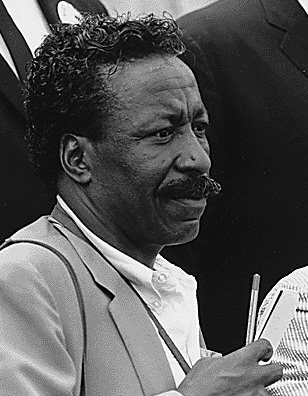
Why Gordon Parks matters
Gordon Parks used a camera, and later a movie set and a typewriter, to document American life from the inside of the communities most often left out of it. He was the first Black staff photographer at Life magazine and, with The Learning Tree in 1969, the first Black director of a major Hollywood studio film. For collectors, he represents a rare case of an artist whose images (American Gothic, Washington, D.C. among them) became part of the historical record itself, backed by deep, decades-long museum collecting and, more recently, a fast-growing gallery and auction presence managed through his foundation.
- Born
- 1912-11-30, Fort Scott, Kansas, USA
- Nationality
- American
- Media
- Photography, Film
- Movement
- Documentary photography, Photojournalism
- Education
- No completed degree. Attended segregated schools in Fort Scott, Kansas, then Mechanic Arts High School and Central High School in St. Paul, Minnesota, leaving before graduation during the Great Depression. Self-taught in photography; received more than fifty honorary doctorates, including the University of Connecticut (1969) and Kansas State University (1970).
- Signature motifs
- American Gothic, Washington, D.C., Farm Security Administration documentary photography, Harlem photo-essays for Life magazine
- Representation
- Alison Jacques, London (represents The Gordon Parks Foundation), Jack Shainman Gallery, New York, Pace Gallery
By the numbers
- USD 140,000Auction high (benefit sale)Department Store, Mobile, Alabama, 1956, Gordon Parks Foundation Awards Dinner and Auction, 2025
- USD 38,100Auction house recordAmerican Gothic, Washington, D.C., 1942, Christie's New York, 2025
- 56 worksMoMA acquisitionAcquired 2019
- Alison Jacques (Gordon Parks Foundation)Represented by
Selected works
Click any work to view it full screen.
Biography
Gordon Roger Alexander Buchanan Parks was born on November 30, 1912, in Fort Scott, Kansas, the youngest of fifteen children. He attended segregated schools in Fort Scott, and after his mother's death in 1928 moved at age sixteen to St. Paul, Minnesota, to live with a sister. He enrolled at Mechanic Arts High School and then Central High School, but left school within months of the 1929 stock market crash to support himself. He never completed high school and never attended college; by his own and his biographers' accounts, he was self-taught, learning photography by studying other photographers' work and visiting museums.
In 1941 Parks received a Julius Rosenwald Fellowship that brought him to Washington, D.C., where he worked for the Farm Security Administration under Roy Stryker. There, in 1942, he made American Gothic, Washington, D.C., his portrait of government cleaning woman Ella Watson posed with a mop and broom in front of an American flag, now among the most reproduced images of American documentary photography. He joined Life magazine as its first Black staff photographer in 1948 and worked there for roughly two decades, covering segregation, poverty, crime, and the civil rights movement, as well as fashion and celebrity portraiture.
Parks expanded into film and letters in parallel with his photography. He wrote the semi-autobiographical novel The Learning Tree and in 1969 directed its film adaptation, becoming the first Black director of a major Hollywood studio production. He went on to direct Shaft in 1971. He also published poetry, memoirs, and composed music across his career. He continued working, publishing, and exhibiting into his nineties. Gordon Parks died of cancer on March 7, 2006, in New York City, at age 93, and was buried in Evergreen Cemetery in his hometown of Fort Scott, Kansas.
Critical reception
Institutional recognition of Parks has been sustained and wide-ranging rather than episodic. He received the NAACP Spingarn Medal in 1972 and the National Medal of Arts in 1988, along with an Emmy Award for the documentary Diary of a Harlem Family in 1968 and lifetime achievement honors from the International Center of Photography (1990), the Jackie Robinson Foundation (2002), and the Lucie Awards (2004). His 1997 retrospective Half Past Autumn: The Art of Gordon Parks, organized by the Corcoran Gallery of Art, toured to roughly ten U.S. cities over several years, cementing his standing as a museum-scale figure rather than a photojournalist of a single era. That standing has continued after his death, with recent solo exhibitions at the National Gallery of Art, Jack Shainman Gallery, Pace Gallery, and, in London, Alison Jacques, all organized in collaboration with The Gordon Parks Foundation. No single, fully verifiable critic quotation about Parks in a major outlet could be confirmed for this profile; his reputation is better read through this dense, continuous record of museum acquisition, retrospective, and award recognition than through any one review.
Market
Gordon Parks's secondary market has strengthened markedly in the past few years, driven largely by museum programming and gallery exhibitions organized in partnership with The Gordon Parks Foundation, which manages his archive and estate. At a conventional auction house, the documented high is USD 38,100, paid for American Gothic, Washington, D.C., 1942 at Christie's New York on October 10, 2025, described by Christie's as a record price for that specific work. A separate, non-competitive sale drew a higher price: in May 2025, ahead of the Christie's sale, the photograph Department Store, Mobile, Alabama (1956) brought USD 140,000 at the Gordon Parks Foundation's own Awards Dinner and Auction, a benefit event rather than a competitive open-market auction. Both results point to the same underlying dynamic, rising institutional and collector demand for vintage civil rights era prints, but collectors should treat a charity benefit sale and a house auction as different kinds of price signals. Institutional demand has been substantial: the Museum of Modern Art acquired 56 Parks photographs in 2019, and the National Gallery of Art holds roughly 200 of his photographs through the Corcoran Collection.
Top auction results
| Work | Price | Sale |
|---|---|---|
| Department Store, Mobile, Alabama (1956) | USD 140,000 | Gordon Parks Foundation Awards Dinner and Auction (benefit sale), New York, 2025-05-20 |
| American Gothic, Washington, D.C., 1942 (1942) | USD 38,100 | Christie's, New York, 2025-10-10 |
Selected exhibitions
| Years | Exhibition | Venues |
|---|---|---|
| 2026 | Gordon Parks: We Shall Not Be Moved | Alison Jacques, London |
| 2026 | Gordon Parks: The South in Color | Jackson Fine Art, Atlanta |
| 2024 to 2025 | Gordon Parks: Camera Portraits from the Corcoran Collection | National Gallery of Art, Washington, D.C. |
| 2024 | Gordon Parks: Born Black | Jack Shainman Gallery, New York |
| 2024 | Gordon Parks | Pace Gallery, Los Angeles |
| 2019 | Gordon Parks and 'The Atmosphere of Crime' | Museum of Modern Art, New York (permanent collection galleries; MoMA acquired 56 works in 2019) |
| 1997 to 2000 | Half Past Autumn: The Art of Gordon Parks | Corcoran Gallery of Art, Washington, D.C., traveling to St. Paul, New York, Detroit, Memphis, West Palm Beach, Atlanta, New Orleans, Los Angeles, Cincinnati, and Chicago |
| 1996 | Moments Without Proper Names | Afro-American Historical and Cultural Museum, Philadelphia |
Museum collections
- Museum of Modern Art, New York
- The Metropolitan Museum of Art, New York
- National Gallery of Art, Washington, D.C. (Corcoran Collection)
- Art Institute of Chicago
- Smithsonian Institution, National Museum of American History, Washington, D.C.
- Nelson-Atkins Museum of Art, Kansas City
- Minneapolis Institute of Art
- Beinecke Rare Book and Manuscript Library, Yale University
Awards and honors
- National Medal of Arts (1988)
- NAACP Spingarn Medal (1972)
- Infinity Award for Lifetime Achievement, International Center of Photography (1990)
- Lucie Award for Lifetime Achievement in Photography (2004)
- Jackie Robinson Foundation Lifetime Achievement Award (2002)
- Emmy Award, Diary of a Harlem Family (1968)
- American Society of Magazine Photographers, Photographer of the Year (1960)
- Julius Rosenwald Fellowship (1941)
Authentication and provenance
No catalogue raisonne.
No published catalogue raisonne has been identified. The Gordon Parks Foundation holds the artist's archive and negatives and functions as the primary authenticating body for prints in the market.
Primary reference: https://www.gordonparksfoundation.org/gordon-parks/biography
What collectors should know
There is no published catalogue raisonne for Gordon Parks; verification of prints runs through The Gordon Parks Foundation, which holds his archive and negatives, so provenance and print-date documentation carry significant weight. His market includes a mix of vintage prints and later Foundation-authorized editions, and recent headline prices have come from two different sources, a competitive auction house and the Foundation's own benefit sale, which are not directly comparable as market signals. Collectors should also expect a market still being built out in real time: gallery representation for the estate (Alison Jacques) was only recently made explicit, and major museum exhibitions and acquisitions (MoMA in 2019, the National Gallery of Art in 2024 to 2025) are recent enough that broad, liquid trading history is still thin.
Further reading and resources
Data current as of 2026-07-18.

