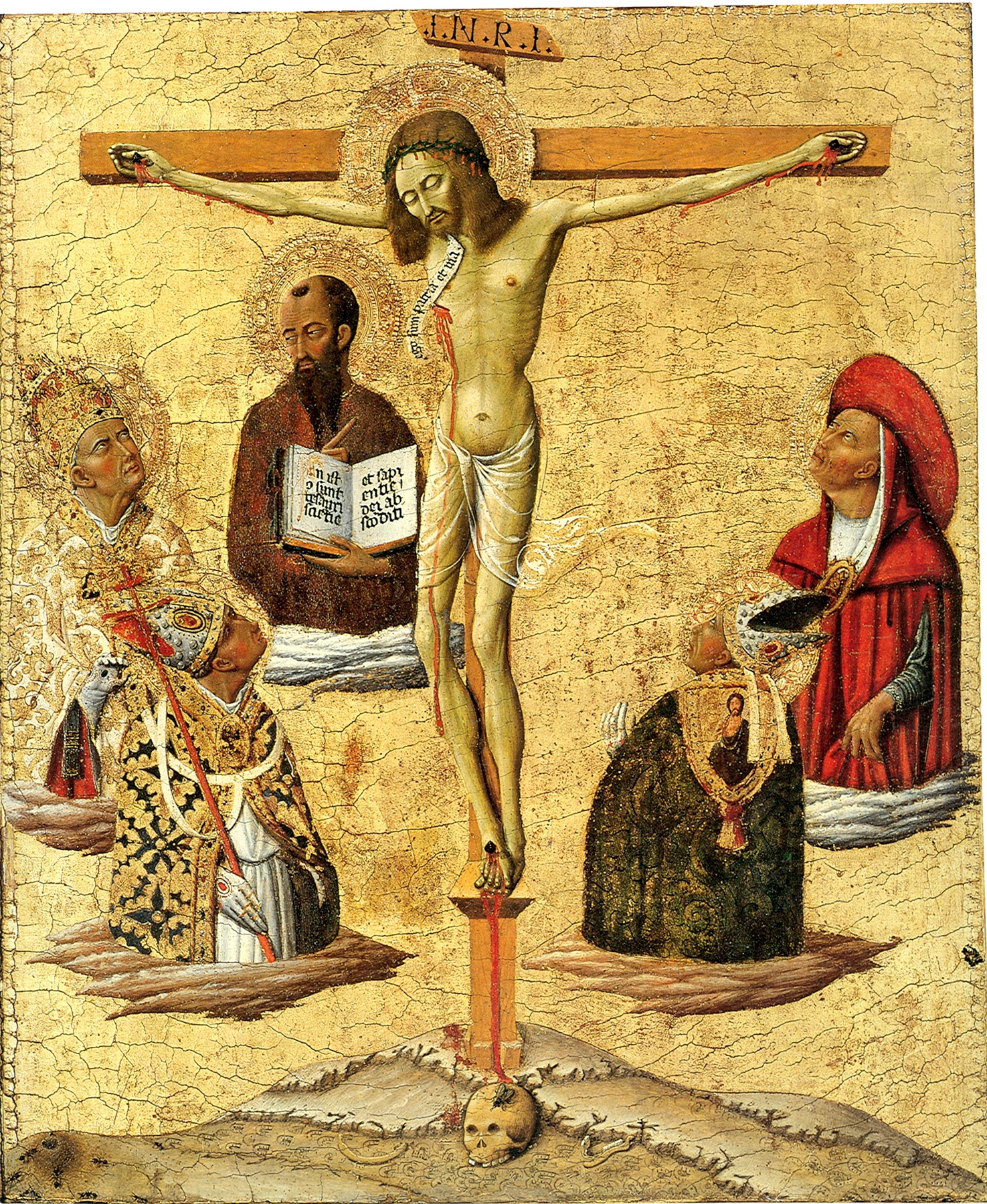
Why Guidoccio di Giovanni Cozzarelli matters
Guidoccio di Giovanni Cozzarelli is a documented figure of the late Sienese Quattrocento, trained in the workshop of Matteo di Giovanni and active across panel painting and manuscript illumination in and around Siena. He matters to collectors less as a market name and more as a case study in Old Master connoisseurship: his work sits in public collections from the Metropolitan Museum of Art to Siena Cathedral, yet it rarely appears at auction, and his stylistic closeness to his teacher has long complicated attribution.
- Nationality
- Italian
- Media
- Panel painting, Manuscript illumination
- Movement
- Italian Renaissance, Sienese School
- Education
- Trained in the workshop of Matteo di Giovanni, Siena, circa 1470 to 1483. No formal school, academy, or degree is documented; his training was a workshop apprenticeship, the standard artistic education of the period.
- Signature motifs
- Madonna and Child devotional panels, Choir-book manuscript illumination
By the numbers
- Siena, circa 1470 to 1516/17Active periodTrained under Matteo di Giovanni
- USD 242,500Auction recordMadonna and Child with Saints, Sotheby's New York, 31 Jan 2013
- 3 confirmed institutionsMuseum holdingsMetropolitan Museum of Art, Walters Art Museum, and Siena Cathedral
- No gallery or estate representation documentedRepresented by
Selected works
Click any work to view it full screen.
Biography
Guidoccio Cozzarelli, also recorded as Guidoccio di Giovanni Cozzarelli or Guidoccio di Giovanni di Marco Cozzarelli, was born in Siena in 1450, the son of Giovanni di Marco di Nanni di Cozzarello, a woodworker. He trained in the workshop of the Sienese painter Matteo di Giovanni, with documented association running from about 1470 to 1483, and his mature style remained close enough to his master's that individual paintings have at times been attributed to one artist or the other.
Cozzarelli's documented activity centers on Siena. He is recorded working for the Santa Maria della Scala hospital around 1470, and around 1480 to 1482 he contributed illuminations to Siena Cathedral's antiphonals. He is also credited with altarpieces for San Bernardino in Sinalunga, generally placed around 1483 and 1486, and with a polyptych, now fragmentary, in Rosia. Later in his career his style shifted under the influence of the painter Pietro Orioli, to the point that works by the two have at times been confused.
Sources place his death in Siena in 1516 or 1517. The Kress Foundation, the Web Gallery of Art, and the Metropolitan Museum give 1516 or 1516/17, while German and Portuguese Wikipedia entries give 1517. The exact year is not fully settled in the available scholarship.
Critical reception
Modern references discuss Cozzarelli chiefly in terms of technique and attribution rather than critical interpretation. Multiple sources note that his paintings have at times been confused with those of his teacher, Matteo di Giovanni, and later with those of Pietro Orioli, because of how closely his mature style tracked theirs. The Metropolitan Museum's scholarly catalogue text notes that Cozzarelli was traditionally dismissed as an uninspired imitator of Matteo di Giovanni, a view it argues is undercut by his altarpieces at San Bernardino in Sinalunga and the polyptych in Rosia. No verbatim quotations from named critics in major outlets could be verified for this profile, so none are reproduced here.
Market
Cozzarelli's market is thin and largely historical rather than active. His best-documented result is USD 242,500, including premium, for The Madonna and Child with Saints Julian the Hospitaler, Roch and Sebastian, Below the Dead Christ Set in a Landscape, Flanked by Saints Cosmas, Damian and Two Other Male Saints, sold at Sotheby's New York on 31 January 2013, a figure market databases cite as his auction record. A smaller, more recent sale, a Visitazione at Pandolfini in Florence, realized EUR 26,460 including fees, reported in November 2023. Public data does not support a ranked list of his second and third highest results, so the 2013 sale should be treated as the best-documented ceiling rather than as evidence of a broad price history. The bulk of his known output resides in museum and church collections rather than in private hands, which further limits the frequency and comparability of public sales.
Top auction results
| Work | Price | Sale |
|---|---|---|
| The Madonna and Child with Saints Julian the Hospitaler, Roch and Sebastian, Below the Dead Christ Set in a Landscape, Flanked by Saints Cosmas, Damian and Two Other Male Saints (2013) | USD 242,500 | Sotheby's, New York, 2013-01-31 |
| Visitazione (Visitation) (2023) | EUR 26,460, including fees | Pandolfini Casa d'Aste, Florence |
Selected exhibitions
| Years | Exhibition | Venues |
|---|---|---|
| circa 1470 to 1483 | Apprenticeship and collaboration with Matteo di Giovanni | Workshop of Matteo di Giovanni, Siena |
| circa 1470 | Hospital commission | Santa Maria della Scala, Siena |
| circa 1480 to 1482 | Choir-book illuminations | Siena Cathedral |
| circa 1483 to 1486 | Altarpieces at San Bernardino, Sinalunga, and a polyptych in Rosia | San Bernardino, Sinalunga, and Rosia |
| ongoing | The Legend of Cloelia, cassone panel | Metropolitan Museum of Art, New York |
| ongoing | Museum holdings | Walters Art Museum, Baltimore |
Museum collections
- Duomo di Siena (Siena Cathedral), Siena
- Metropolitan Museum of Art, New York
- Walters Art Museum, Baltimore
Authentication and provenance
No catalogue raisonne.
No catalogue raisonne exists for Cozzarelli. Attribution rests on archival documentation and scholarly connoisseurship, and because his style closely followed that of his teacher Matteo di Giovanni, a number of his paintings have historically been misattributed between the two artists.
Primary reference: https://www.kressfoundation.org/kress-collection/artist/guidoccio-cozzarelli
What collectors should know
Cozzarelli is a documented, museum-collected Sienese painter and illuminator with no catalogue raisonne and no gallery or estate representation; his works reach the market only occasionally, through the Old Master auction and dealer trade. The scarcity of confirmed realized prices, combined with a documented history of misattribution with Matteo di Giovanni, means that provenance research and direct scholarly attribution matter more here than for artists with an established price history. Collectors should treat the 2013 result as the best-documented ceiling for his market and the far smaller 2023 sale as a reminder of how thin and variable outcomes can be, rather than as proof of a stable trend.
Further reading and resources
Data current as of 2026-07-16.

