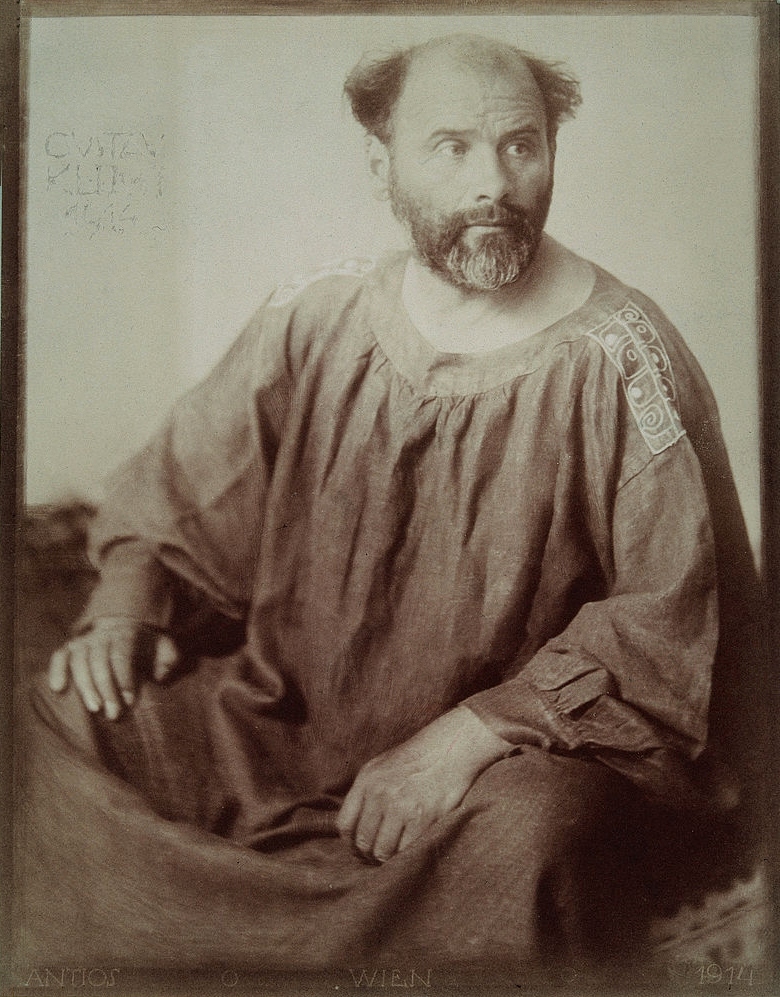
Why Gustav Klimt matters
Gustav Klimt is one of the most valuable names in the entire art market, an artist whose gold-ground portraits and allegories now sit at the very top of the auction record. For a collector, he is the clearest study in scarcity pricing at the trophy tier: a finished body of work that cannot grow, museum-level demand, and a provenance history shaped by restitution, all of which concentrate value into the handful of important pictures that ever reach the open market.
- Born
- 1862-07-14, Baumgarten, Vienna, Austria
- Nationality
- Austrian
- Media
- Painting, Drawing
- Movement
- Vienna Secession, Symbolism, Art Nouveau
- Education
- Vienna Kunstgewerbeschule (School of Applied Arts), 1876 to 1883
- Signature motifs
- Gold leaf, Decorative pattern, Allegorical portraiture, The female figure
- Representation
- Estate; no living gallery representation
By the numbers
- USD 236.4MAuction highPortrait of Elisabeth Lederer, Sotheby's New York, 2025
- Highest for modern artRecord contextHighest price for any work of modern art at auction; second most expensive artwork ever auctioned
- Vienna SecessionMovementCo-founder and first president, 1897
- EstablishedCatalogue raisonne
Selected works
Click any work to view it full screen.
Biography
Gustav Klimt was born on 14 July 1862 in Baumgarten, then a suburb of Vienna, the son of a gold engraver. From 1876 to 1883 he trained at the Vienna Kunstgewerbeschule, the city's School of Applied Arts, and began his career as a decorative painter producing murals for public buildings, including the Burgtheater and the Kunsthistorisches Museum. His ceiling paintings for the University of Vienna, commissioned in the 1890s, were attacked as obscene and pessimistic, a controversy that pushed him decisively away from official commissions and toward independent work.
In 1897 Klimt and a circle of fellow artists broke from the conservative Vienna Artists' Association to form the Vienna Secession, and Klimt was elected its first president. The years that followed produced his celebrated golden phase, in which gold leaf, dense ornament, and the female figure combined in works such as Portrait of Adele Bloch-Bauer I (1907) and The Kiss (1908). He never married and lived much of his life with his mother and sisters, while maintaining a long association with the fashion designer Emilie Floge.
Klimt suffered a stroke in early 1918 that left him partially paralyzed, then contracted pneumonia amid the influenza pandemic. He died in Vienna on 6 February 1918, at the age of 55, leaving several works unfinished. His estate and reputation are now stewarded primarily through museums and scholarship rather than a commercial gallery.
Critical reception
Klimt's standing has moved across two centuries from official scandal to near-universal canonization. The decisive early episode was the rejection of his University of Vienna ceiling paintings, Philosophy, Medicine, and Jurisprudence, around 1900 to 1907, which faculty members and critics condemned as obscene and unintelligible, prompting Klimt to return his fee and withdraw the commission. That break reframed him, in the eyes of later scholars such as art historian Carl Schorske, as a central figure of fin-de-siecle Vienna and its turn toward the psychological and the erotic. Twentieth-century criticism increasingly read the golden portraits not as mere decoration but as a fusion of Byzantine ornament, symbolism, and modern subjectivity. The recurring critical theme is the tension between surface and depth: the gold and pattern that once read as decadent are now treated as a deliberate language for desire, mortality, and identity. Today institutional consensus places him among the defining painters of European modernism.
Watch
Market
Klimt sits at the apex of the auction market. His record is Portrait of Elisabeth Lederer (Bildnis Elisabeth Lederer), painted around 1914 to 1916, which sold for USD 236.4 million at Sotheby's New York on 18 November 2025, from the collection of Leonard A. Lauder. The result was the highest price ever paid at auction for a work of modern art and, at the time, the second most expensive artwork ever sold at auction. His prior high was Dame mit Facher (Lady with a Fan), which made GBP 85.3 million (about USD 108.7 million) at Sotheby's London in June 2023, then a record for any work of art sold at auction in Europe.
Top auction results
| Work | Price | Sale |
|---|---|---|
| Portrait of Elisabeth Lederer (Bildnis Elisabeth Lederer) (1916) | USD 236,400,000 (USD 236,400,000) | Sotheby's, New York, 2025-11-18 |
| Dame mit Facher (Lady with a Fan) (1918) | USD 108,700,000 (GBP 85,305,800) | Sotheby's, London, 2023-06-27 |
Selected exhibitions
| Years | Exhibition | Venues |
|---|---|---|
| 1897 | Founding of the Vienna Secession | Vienna (Klimt elected first president) |
| 1902 | Beethoven Frieze, 14th Secession Exhibition | Secession Building, Vienna |
| 1908 | Kunstschau Wien | Vienna (The Kiss first shown) |
Museum collections
- Osterreichische Galerie Belvedere, Vienna
- Neue Galerie New York
- Museum of Modern Art, New York
- Leopold Museum, Vienna
- Wien Museum, Vienna
- Museum of Fine Arts, Vienna (Kunsthistorisches Museum)
Awards and honors
- Golden Order of Merit, from Emperor Franz Joseph I (1888)
- Honorary member, Academy of Fine Arts Vienna and Munich (1917)
Authentication and provenance
Catalogue raisonne published.
Works are authenticated through scholarship and the established catalogue raisonne, provenance research, and recognized expertise. As a historical artist with no living studio, attribution rests on documentary and connoisseurship evidence rather than a certificate program.
Primary reference: https://www.belvedere.at/en/gustav-klimt
What collectors should know
Klimt's supply is fixed and extraordinarily thin. He produced relatively few finished oil paintings, the majority are in museums, and many of the most important were dispersed or seized during the Nazi era, which means restitution and provenance dominate any serious transaction. The practical effect is a market defined by rare, individually negotiated trophy sales rather than a steady stream of comparable lots, so a single result can reset the record without describing a smooth trend. The established catalogue raisonne and a deep scholarly record support authentication, but for any work the provenance chain, especially across the 1930s and 1940s, is the central diligence question. For a collector, Klimt is the definition of a blue-chip historical name: durable demand, museum-level prestige, and almost no liquidity.
Further reading and resources
Data current as of 2026-06-19.

