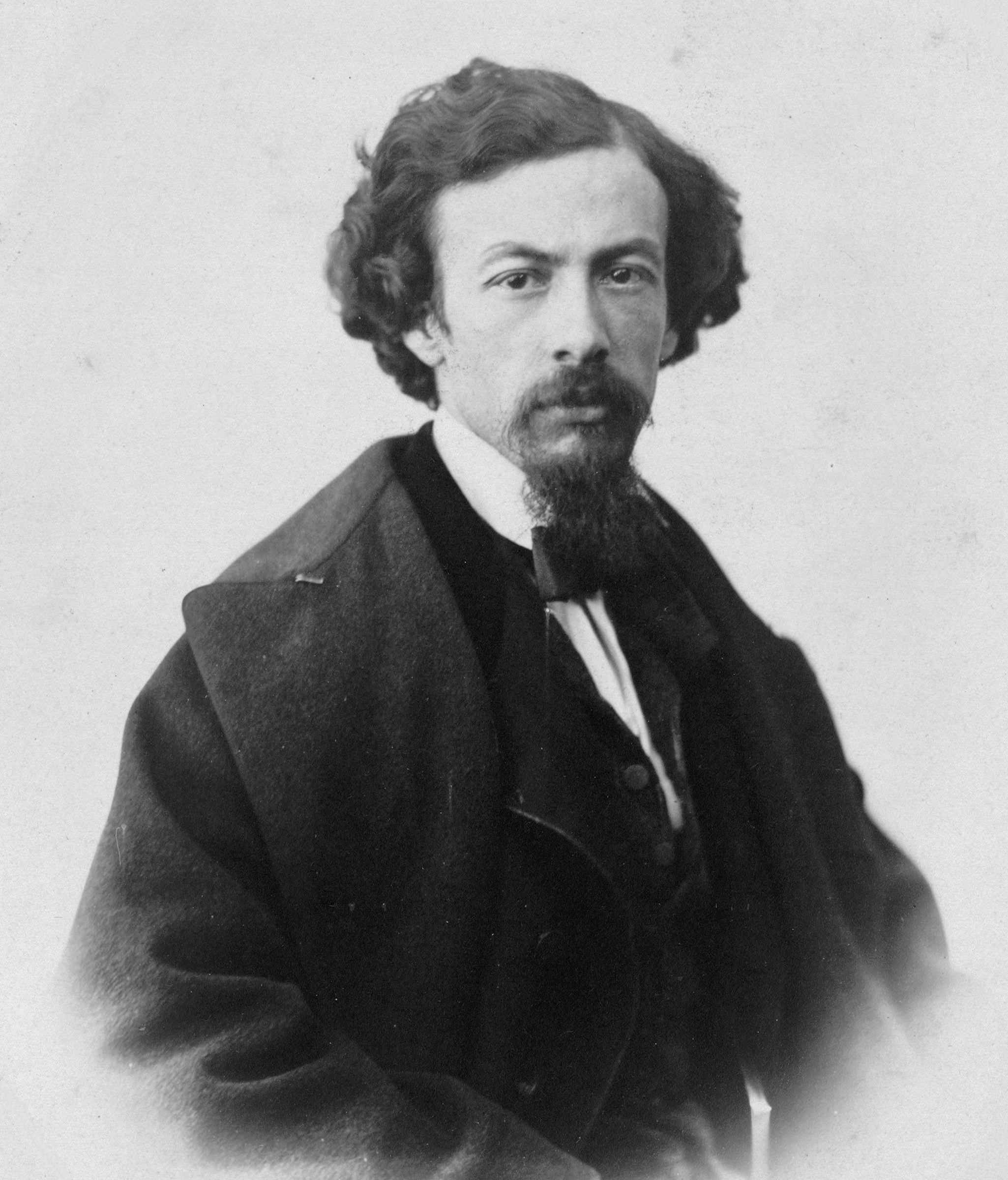
Why Gustave Le Gray matters
Gustave Le Gray is one of the foundational figures of nineteenth-century photography, the artist most credited with turning the paper negative from a rough scientific tool into an aesthetic instrument. His seascapes of the late 1850s, printed from waxed paper negatives of his own devising, are still cited as the moment photography claimed the ambitions of painting. For collectors, he represents an entry point into the earliest, thinnest, and most historically important layer of the photography market, where a single print, The Great Wave, Sete, once set a world record price for any photograph sold at auction.
- Born
- 1820-08-30, Villiers-le-Bel, France
- Nationality
- French
- Media
- Photography, Painting
- Movement
- Early French photography, Mission Heliographique circle
- Education
- Studied painting under Paul Delaroche at the Ecole des Beaux-Arts, Paris, from 1842; copyist at the Louvre; travel to Rome, 1843, to study Old Masters.
- Signature motifs
- Seascapes, Waxed paper negative process, Cloud and wave studies
- Representation
- "No surviving estate. Secondary-market photographs are handled by specialist dealers, including Robert Koch Gallery, San Francisco."
By the numbers
- GBP 507,500Auction highThe Great Wave, Sete, Sotheby's London, 14 October 1999
- 1848 to 1884ActiveParis Salon debut to death in Cairo
- 1851Mission Heliographiqueone of five photographers commissioned by the French government
- 6 major institutionsMuseum collectionsincluding the Met, Getty, Musee d'Orsay, and National Gallery of Art
Selected works
Click any work to view it full screen.
Biography
Jean-Baptiste Gustave Le Gray was born on 30 August 1820 in Villiers-le-Bel, on the outskirts of Paris, the only child of a haberdasher. He trained first as a painter, becoming a student of Paul Delaroche at the Ecole des Beaux-Arts in Paris from 1842 and working as a copyist at the Louvre, and in 1843 he traveled to Rome to study the Old Masters. He exhibited paintings at the Paris Salon in 1848 and again in 1853.
By 1847 Le Gray had turned to photography, and he became the leading technical innovator of the medium's first decade in France. He developed and published a waxed paper negative process that improved on earlier calotype methods, and he opened an influential studio and teaching practice at 35 boulevard des Capucines in Paris, where he trained photographers including Henri Le Secq and Maxime Du Camp. In 1851 the French government named him one of five photographers commissioned for the Mission Heliographique, a survey of the nation's historic monuments, and the same year he was a founding member of the Societe Heliographique. Between roughly 1856 and 1858 he produced his celebrated seascape and cloud studies at Sete and along the Normandy coast, combining two negatives, one for sea and one for sky, to achieve dramatic tonal range.
Le Gray's finances declined through the late 1850s despite his critical standing, and around 1860 he left France for the eastern Mediterranean, traveling first to Lebanon and then settling in Egypt. He spent the last two decades of his life in Cairo, working as a photographer and as a drawing tutor, and according to the dealer Hans P. Kraus Jr. Fine Photographs he died there in poverty. He never returned to France. He died in Cairo, Egypt, on 30 July 1884, at the age of 63.
Critical reception
The photography historian Eugenia Parry Janis, whose 1987 monograph accompanied his retrospective at the Metropolitan Museum of Art and the Art Institute of Chicago, helped establish the now-standard reading of Le Gray as the figure who gave the young medium both a technical grounding and an aesthetic program. Further retrospectives at the Musee d'Orsay in 1988 and at the Bibliotheque nationale de France in 2002 reinforced his position as a central figure of the 1850s, and his prints continue to anchor the nineteenth-century photography holdings of institutions including the Getty, the National Gallery of Art, and the Museum of Fine Arts, Boston.
Market
Le Gray's auction market is small, historic, and concentrated in a handful of headline sales rather than a continuous trading history. His all-time high remains The Great Wave, Sete, an albumen print made around 1857, which sold for GBP 507,500 (about USD 840,370 at the time) at Sotheby's London on 14 October 1999. In the same sale, another print, Beech Tree, Fontainebleau, sold for GBP 419,500, briefly holding its own record before being overtaken by The Great Wave in the same session. The 1999 result for The Great Wave was described at the time as a world record price for a single photograph at auction. No sale of a Le Gray print exceeding GBP 507,500 has been identified in the sources checked for this profile, including recent Phillips, Artprice, Gazette Drouot, and Invaluable listings, though access to a complete paid auction database was not available.
Top auction results
| Work | Price | Sale |
|---|---|---|
| The Great Wave, Sete (1857) | USD 840,370 (GBP 507,500) | Sotheby's, London, 1999-10-14 |
Selected exhibitions
| Years | Exhibition | Venues |
|---|---|---|
| 1848 | Paris Salon | Paris Salon, Paris |
| 1853 | Paris Salon | Paris Salon, Paris |
| 1851 | Mission Heliographique | French government photographic survey commission |
| 1987 | The Photography of Gustave Le Gray | The Metropolitan Museum of Art, New York; Art Institute of Chicago |
| 1988 | Gustave Le Gray, photographe, 1820 to 1882 | Musee d'Orsay, Paris |
| 2002 | Gustave Le Gray, 1820 to 1884 | Bibliotheque nationale de France, Paris |
| 2015 | In Light of the Past: Celebrating 25 Years of Photography at the National Gallery of Art | National Gallery of Art, Washington, D.C. |
| undated | Gustave Le Gray, Photographer | J. Paul Getty Museum, Los Angeles |
Museum collections
- National Gallery of Art, Washington, D.C.
- Metropolitan Museum of Art, New York
- J. Paul Getty Museum, Los Angeles
- Musee d'Orsay, Paris
- Museum of Fine Arts, Boston
- Clark Art Institute, Williamstown
Awards and honors
- Mission Heliographique, government photographic survey commission, France (1851)
- Founding member, Societe Heliographique (1851)
Authentication and provenance
No catalogue raisonne.
No catalogue raisonne of Le Gray's photographs has been identified in current sources. Attribution and dating rely on museum provenance research and specialist photography dealers, since his waxed paper negative process allowed multiple prints of varying quality from a single negative.
Primary reference: https://www.metmuseum.org/essays/gustave-le-gray-1820-1884
What collectors should know
There is no catalogue raisonne of Le Gray's photographs, so attribution and dating depend on museum provenance research and the expertise of specialist photography dealers such as Robert Koch Gallery. His waxed paper negative process allowed multiple prints from a single negative, and print quality and condition vary considerably, which makes connoisseurship of the individual object, not just the image, essential to value. Public auction data for Le Gray is thin: the 1999 Sotheby's sale that produced his record price is still the clearest benchmark available, and collectors should treat any claim about his current market ranking with caution given how few results exist to compare it against. Older reference sources occasionally give his death year as 1882 rather than 1884; the later date is the one supported by current major museum and encyclopedia sources.
Further reading and resources
Data current as of 2026-07-10.

