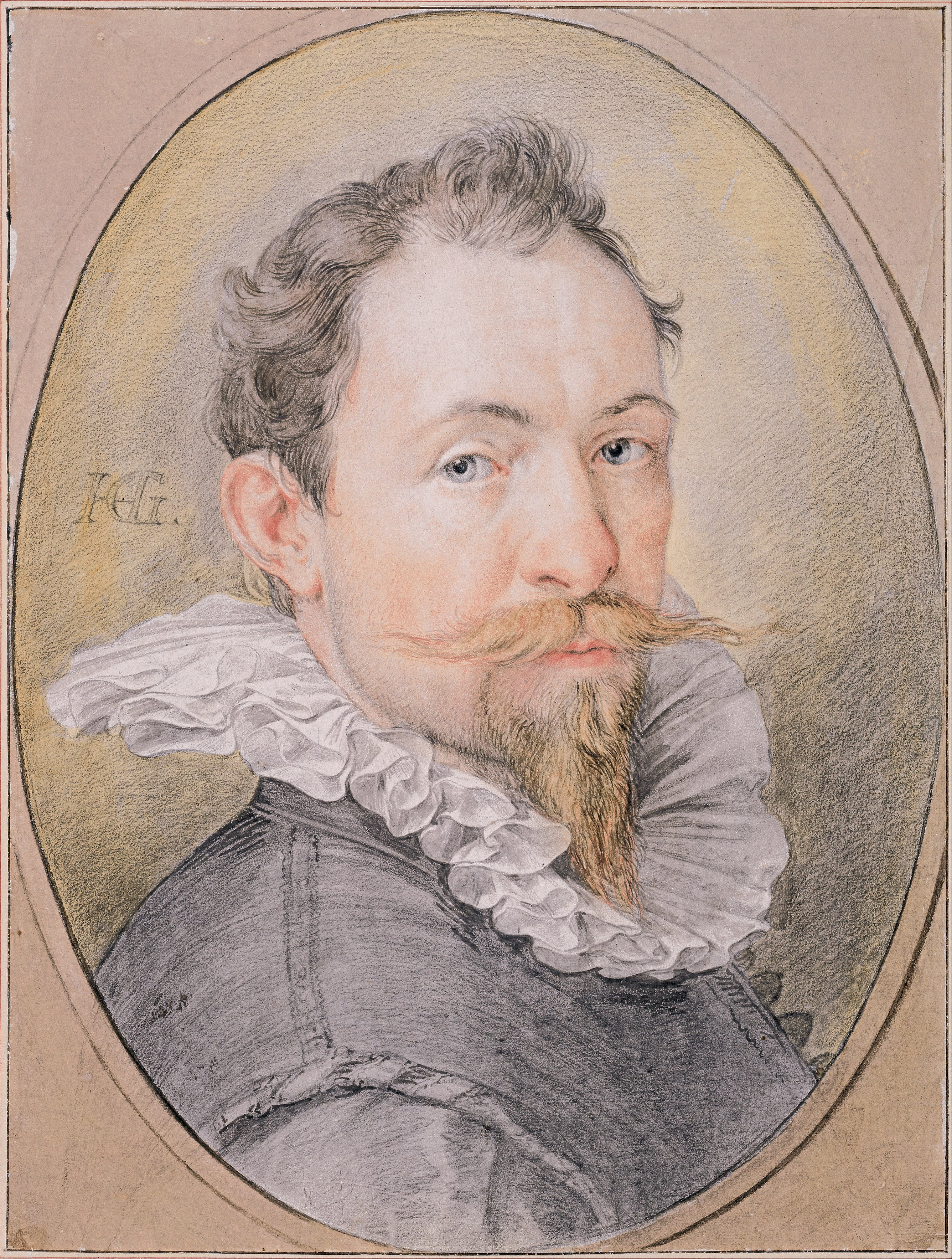
Why Hendrick Goltzius matters
Hendrick Goltzius is one of the defining figures of Northern European Mannerism and, by wide art-historical consensus, one of the greatest engravers in the history of printmaking. He stands at a hinge point in Netherlandish art, carrying the extravagant figural virtuosity of Mannerism into the more naturalistic, classicizing sensibility that would define the seventeenth-century Dutch Golden Age. For a collector, he is a study in how a market for a long-deceased Old Master actually works: there is no gallery or estate to manage supply, no living artist to set a narrative, and value instead rests on museum scholarship, published reference catalogues, and provenance.
- Nationality
- Dutch
- Media
- Engraving, Drawing, Painting
- Movement
- Netherlandish Mannerism, Haarlem Mannerism
- Education
- No formal schooling documented. Trained in glass painting under his father, Jan Goltz; apprenticed in engraving under Dirck Volckertszoon Coornhert; self-directed study of antique sculpture and Italian Renaissance masters in Rome, Florence, Venice, and Bologna, 1590 to 1591.
- Signature motifs
- Elaborate swelling-and-tapering engraved line, Muscular Mannerist figures in extreme foreshortening, Silverpoint and metalpoint self-portraits
By the numbers
- 1558 to 1617LifespanBorn Duchy of Julich, died Haarlem, Dutch Republic
- USD 4.5M (GBP 2.6M)Auction highThe Artist's Right Hand (1588), Sotheby's London, 9 July 2014
- 59 known paintingsPaintings catalogue raisonneNichols, 2013 monograph and catalogue raisonne
- 2003 to 2004Major retrospectiveRijksmuseum, Metropolitan Museum of Art, Toledo Museum of Art
Selected works
Click any work to view it full screen.
Biography
Hendrick Goltzius was born in January or February 1558 in Bracht (also recorded as Mühlbracht), a village in the Duchy of Julich, in what is now Germany close to the Dutch border. His father, Jan Goltz, was a glass painter, and Goltzius received his earliest training in that craft in his father's workshop. As an infant he sustained burns that left his right hand permanently disfigured, a detail recorded in later biographical accounts of his life; he nonetheless went on to become one of the most technically demanding engravers of his era, and his own hand later became a recurring subject in his self-portraits and drawings.
He subsequently studied engraving and humanist culture under the Dutch polymath Dirck Volckertszoon Coornhert, and in 1577, at about nineteen, moved with Coornhert to Haarlem, where he lived for the rest of his life. In Haarlem he built a career as an engraver and print publisher, and in the 1580s he worked closely with the painter Karel van Mander and Cornelis van Haarlem, the three together running an informal drawing academy centered on the study of the human figure from life. Van Mander nicknamed him "the Netherlandish Proteus" for his ability to work convincingly in the styles of older Italian and German masters. His Life of the Virgin engraving series so pleased its dedicatee, Duke Wilhelm V of Bavaria, that the duke sent him a gold chain and portrait medallion, a courtly mark of high esteem rather than a competitive award.
In 1590, Goltzius traveled through Germany to Italy, studying antique sculpture and the paintings of Michelangelo and other High Renaissance masters in Rome, Florence, Venice, and Bologna before returning to Haarlem in 1591. In the later part of his career he increasingly turned from engraving to drawing, in silverpoint, metalpoint, and colored chalk, and eventually to painting, producing a smaller body of mythological and religious pictures. He died in Haarlem, in the Dutch Republic, on 1 January 1617, and was buried in the Grote Kerk there; at least one auction-house source records an alternate death date of 29 December 1616, a minor discrepancy in the historical record.
Critical reception
Major museums treat Goltzius as a pivotal figure whose full importance was only widely recognized in the last half-century. The Metropolitan Museum, organizer of his first major retrospective, described him as internationally acclaimed in his own day as the leading artistic personality of the Netherlands, noting that his reputation was later eclipsed by the achievements of the seventeenth-century Dutch Golden Age painters who followed him, and crediting him as a pioneer of Dutch realism and classicism as well as the supreme exponent of Netherlandish Mannerism. His contemporary Karel van Mander's nickname for him, "the Netherlandish Proteus," captures the critical view of Goltzius as a virtuoso able to absorb and reproduce the styles of other masters at will. Later twentieth-century scholarship has been more mixed, at times reading his psychological character in less flattering terms, but the consensus on his technical and historical importance as a printmaker and draftsman has held.
Market
Goltzius has no gallery or estate representation in any contemporary sense; as a four-centuries-deceased Old Master, his work moves through Old Master auction houses and specialist dealers on a work-by-work basis rather than through managed representation. His confirmed auction high is The Artist's Right Hand, a 1588 work that sold at Sotheby's in London on 9 July 2014 for GBP 2.6 million (about USD 4.5 million). Most Goltzius material that reaches auction consists of engravings and drawings at far lower price points; paintings by his hand are rare, since only 59 are currently documented, which is why an exceptional example can command a price of this scale.
Top auction results
| Work | Price | Sale |
|---|---|---|
| The Artist's Right Hand (1588) | USD 4,500,000 (GBP 2,600,000) | Sotheby's, London, 2014-07-09 |
Selected exhibitions
| Years | Exhibition | Venues |
|---|---|---|
| 2003 to 2004 | Hendrick Goltzius: Prints, Drawings, Paintings | Rijksmuseum, Amsterdam; Metropolitan Museum of Art, New York; Toledo Museum of Art, Ohio |
| 2014 | Passion and Virtuosity: Hendrick Goltzius and the Art of Engraving | Crocker Art Museum, Sacramento |
| 1958 | Rotterdam exhibition (exact title and venue not documented in available sources) | Rotterdam |
Museum collections
- Rijksmuseum, Amsterdam
- Mauritshuis, The Hague
- Metropolitan Museum of Art, New York
- National Gallery of Art, Washington, D.C.
- British Museum, London
- Toledo Museum of Art, Ohio
- Museum Boijmans Van Beuningen, Rotterdam
- Frans Hals Museum, Haarlem
Authentication and provenance
No catalogue raisonne.
No single catalogue raisonne covers Goltzius's full output across media. Lawrence Nichols published a monograph and catalogue raisonne of the 59 known paintings in 2013; the engravings and drawings are catalogued separately in the Hollstein and Illustrated Bartsch reference series. Attribution is verified through museum curatorial departments, provenance research, and these standard reference catalogues rather than through a single unified authority or a certificate-of-authenticity program.
Primary reference: https://www.nga.gov/artists/2534-hendrick-goltzius
What collectors should know
There is no single catalogue raisonne covering Goltzius's entire output. His paintings, a small corpus of 59 known works, were catalogued by Lawrence Nichols in a 2013 monograph and catalogue raisonne, while his much larger body of engravings and drawings is documented instead through the standard Hollstein and Illustrated Bartsch reference series. Attribution and authenticity for any work therefore depend on matching it against these separate reference catalogues and on museum curatorial review, not on a single certifying body. Because he worked across engraving, drawing, and painting, and because supply at the top of the market (his paintings) is extremely thin, collectors should expect that price is driven heavily by medium, rarity, and documented provenance rather than by a smooth, broad-based market curve.
Further reading and resources
Data current as of 2026-07-11.

