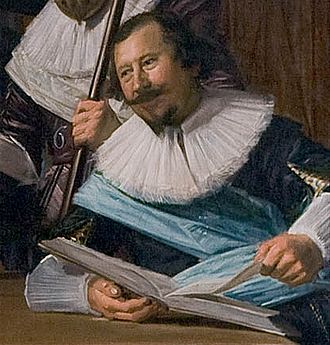
Why Hendrik Gerritsz Pot matters
Hendrik Gerritsz Pot, also recorded as Hendrick Gerritsz. Pot, was a leading genre and portrait painter of the Dutch Golden Age, active in Haarlem and Amsterdam through the first half of the seventeenth century. He served multiple terms as dean of the Haarlem Guild of St. Luke alongside contemporaries such as Frans Hals, and in 1632 traveled to London to paint members of the English royal court. His work is held today in museums including the Rijksmuseum in Amsterdam and the National Gallery in London, making him a well-documented but market-thin figure whose value for collectors lies chiefly in historical and institutional standing rather than a deep auction record.
- Nationality
- Dutch
- Media
- Painting
- Movement
- Dutch Golden Age
- Education
- Probably a pupil of Karel van Mander, before 1603. No formal academy or degree is documented.
- Signature motifs
- Portraiture, Genre scenes, Vanitas still life
By the numbers
- Dutch Golden AgeEraActive in Amsterdam and Haarlem, c. 1600 to 1657
- Dean, Haarlem Guild of St. LukeGuild office1626, 1630, 1635
- Rijksmuseum; National Gallery, LondonMuseum holdingsBroader museum count not independently confirmed in current sources
- None publishedCatalogue raisonneAttribution via museum research and RKD archives
Selected works
Click any work to view it full screen.
Biography
Hendrik Gerritsz Pot was born in the Netherlands, most likely around 1580 to 1585. Sources disagree on both the exact year and the city: most general references favor Amsterdam, while the National Gallery in London favors Haarlem. He is thought, though not firmly documented, to have trained under Karel van Mander before 1603, a connection noted by van Mander's anonymous early biographer.
By the 1620s Pot was established in Haarlem, where he was elected dean of the Guild of St. Luke in 1626, 1630, and 1635, and served as hoofdman, or headman, of the guild in 1634 and 1648, working alongside Frans Hals and other members of the Haarlem school. In 1632 he traveled to London, where he painted portraits of members of the English royal family. He remained based in Haarlem until 1648, then returned to Amsterdam, becoming a citizen there in 1650. He died in Amsterdam in 1657 and was buried on 15 October 1657 in the Oudezijds Kapel. The precise calendar date of his death, as distinct from his burial, is not recorded in surviving sources.
Critical reception
Pot is consistently placed within the Haarlem school of the Dutch Golden Age, in the professional and social circle of Frans Hals, and is recognized for genre scenes, vanitas still lifes, and portraits of the upper middle class and, briefly, the English court. His work has appeared in numerous museum survey exhibitions of Dutch seventeenth-century painting, including Judith Leyster: A Dutch Master and Her World (1993) and Frans Hals: Eye to Eye with Rembrandt, Rubens and Titian (2013), which situate him among the notable second-tier painters of the period. No verbatim critical quotations from named critics in major outlets could be confirmed in current sources.
Market
Public auction data for Pot is sparse and, as of this writing, does not support a single fully documented all-time record with title, price, house, and exact date all confirmed together. The highest figure identified in available market listings is a reported USD 257,000 for Loth und seine Töchter (Lot and his Daughters) at Van Ham, but sources disagree on the year of that sale and the exact date could not be confirmed, so it is presented here as unverified rather than as a confirmed record. A later offering of the same title at Van Ham in 2024 did not sell. A workshop-attributed version of an Elegante Gesellschaft composition realized EUR 7,400 at Auktionshaus Stahl, a result that reflects a studio attribution rather than a fully autograph work and is not comparable to a confirmed artist record. Collectors should expect thin, infrequent sales activity typical of a well-documented but auction-scarce Old Master.
Selected exhibitions
| Years | Exhibition | Venues |
|---|---|---|
| 2015 | Masters of Everyday: Dutch Artists in the Age of Vermeer | Not specified in available sources |
| 2013 | Frans Hals: Eye to Eye with Rembrandt, Rubens and Titian | Not specified in available sources |
| 2008 | De Gouden Eeuw begint in Haarlem | Not specified in available sources |
| 2003 | Satire en vermaak: het genrestuk van Frans Hals en zijn tijdgenoten, 1610 to 1635 | Not specified in available sources |
| 1996 | Die sichtbare Welt: Niederlandische Bilder des 16. und 17. Jahrhunderts | Not specified in available sources |
| 1993 | Judith Leyster: A Dutch Master and Her World | Not specified in available sources |
| 1976 | Art in 17th-century Holland | Not specified in available sources |
Museum collections
- Rijksmuseum, Amsterdam
- National Gallery, London
Awards and honors
- Dean, Guild of St. Luke, Haarlem (1626)
- Dean, Guild of St. Luke, Haarlem (1630)
- Dean, Guild of St. Luke, Haarlem (1635)
- Hoofdman (headman), Guild of St. Luke, Haarlem (1634)
- Hoofdman (headman), Guild of St. Luke, Haarlem (1648)
Authentication and provenance
No catalogue raisonne.
No catalogue raisonne has been identified for Pot. Attribution rests on museum curatorial research and the archives of the RKD, Netherlands Institute for Art History, as is typical for Dutch Golden Age painters. Workshop versions of his compositions are documented alongside autograph works, which makes expert opinion important.
Primary reference: https://www.nationalgallery.org.uk/artists/hendrick-pot
What collectors should know
There is no catalogue raisonne for Pot, and attribution questions are real: at least one documented sale distinguishes an autograph work from a Werkstatt, or workshop, version of the same composition, underscoring the importance of provenance and expert opinion, typically anchored in RKD, Netherlands Institute for Art History, research, before purchase. His birth year and birthplace are contested in the standard references, and no fully specified auction record, meaning work, price, house, and date together, could be verified as of this writing. His market strength lies in museum representation rather than a deep or liquid auction history, so collectors should weigh institutional presence and documented provenance more heavily than any single sale price.
Further reading and resources
Data current as of 2026-07-18.

