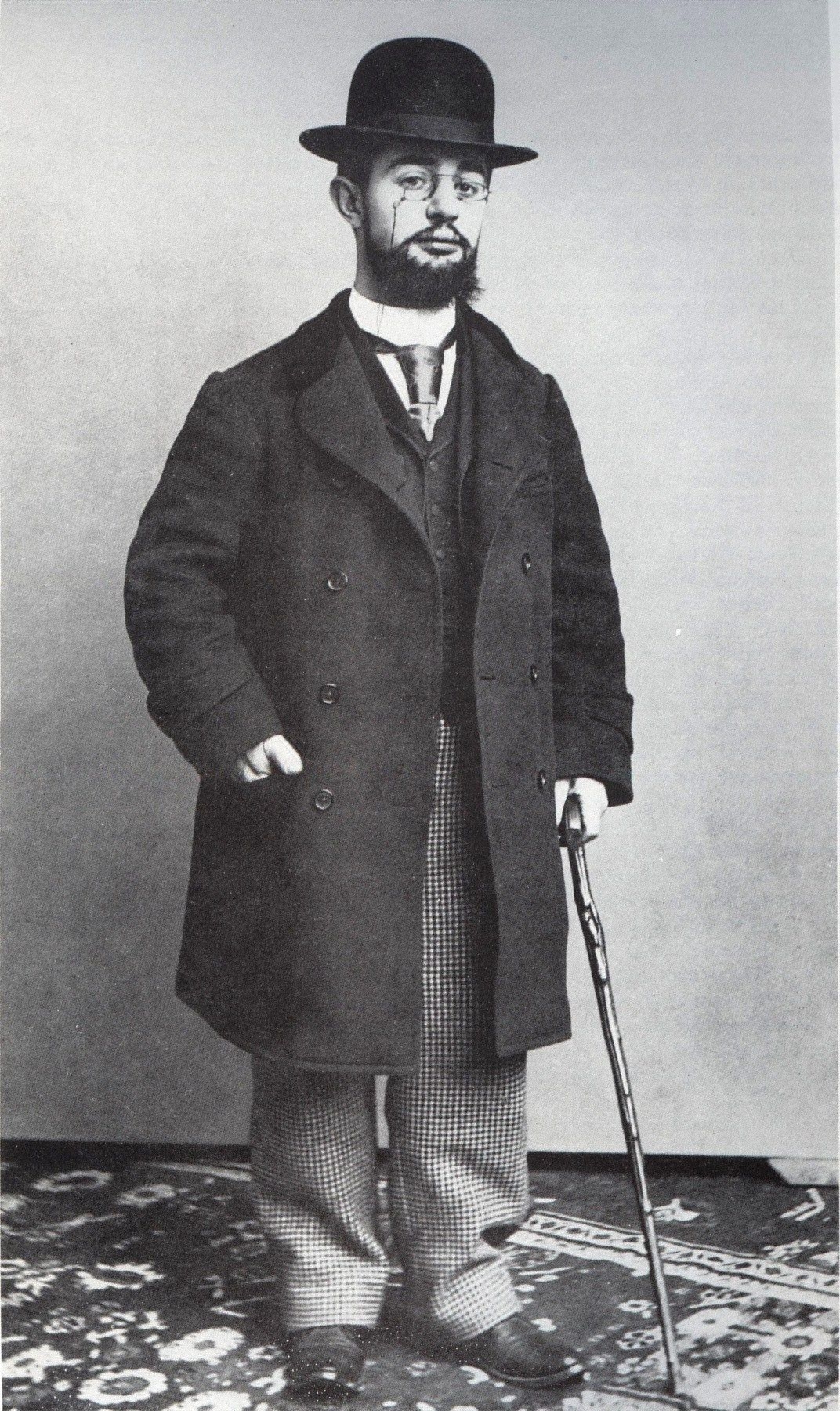
Why Henri de Toulouse-Lautrec matters
Henri de Toulouse-Lautrec is one of the defining chroniclers of Belle Epoque Paris, an artist whose paintings, drawings, and above all his lithographic posters turned the cafes, cabarets, and dance halls of Montmartre into a lasting visual language. He is credited as a pioneer of the modern poster as an art form, and his images, from the Moulin Rouge to the performers he painted around it, remain among the most recognizable in French art. For a collector, his market is a study in an artist with deep, permanent museum standing and genuine scarcity at the top end, set against an active parallel market in prints and posters that trades far more frequently.
- Born
- 1864-11-24, Albi, France
- Nationality
- French
- Media
- Painting, Drawing, Printmaking, Poster design
- Movement
- Post-Impressionism, Belle Époque poster art
- Education
- Lycee Fontanes (now Lycee Condorcet), Paris, to baccalaureate, 1881; private study under Rene Princeteau; ateliers of Leon Bonnat, 1882, and Fernand Cormon, 1883 to about 1887, Paris
- Signature motifs
- Montmartre nightlife, Cafe-concert and cabaret scenes, Lithographic poster design, Can-can dancers
By the numbers
- USD 22.4MAuction highLa blanchisseuse, Christie's New York, 2005
- 1864 to 1901Life datesAlbi to Chateau Malrome, France
- Post-ImpressionismMovementPioneer of the modern Belle Epoque lithographic poster
- Louvre, Met, MoMA, TateMuseum presenceamong many other institutions
Selected works
Click any work to view it full screen.
Biography
Henri Marie Raymond de Toulouse-Lautrec-Monfa was born on 24 November 1864 in Albi, France, into an aristocratic family. He attended the Lycee Fontanes in Paris, now the Lycee Condorcet, and completed his baccalaureate in 1881 after a period of private tutoring. He first studied informally under the painter Rene Princeteau, a family friend, before entering the Paris studio of Leon Bonnat in 1882 and then the studio of Fernand Cormon in 1883, where he trained for several years alongside the emerging avant-garde.
By the mid-1880s he had settled in Montmartre and begun the body of work for which he is best known: paintings, drawings, and lithographic posters of the district's cafe-concerts, cabarets, brothels, and dance halls, including the Moulin Rouge. He exhibited at the Salon des Arts Incoherents in Paris in 1886 and 1889 and was invited to show with the Belgian avant-garde group Les XX in Brussels in 1888, exhibitions that placed him within the wider Post-Impressionist and Symbolist circles of the period.
Toulouse-Lautrec's health declined through the 1890s amid heavy drinking, and he died on 9 September 1901 at the age of 36, at his mother's estate, the Chateau Malrome, in Saint-Andre-du-Bois, Gironde, France. Major reference sources, including Wikipedia and the Musee Toulouse-Lautrec in Albi, attribute his death to complications of alcoholism and syphilis. He is buried in the nearby cemetery at Verdelais.
Critical reception
Toulouse-Lautrec's contemporaries recognized him early as a defining figure of the new Parisian avant-garde: his invitation to exhibit with Les XX in Brussels in 1888 placed him alongside the leading Symbolist and Post-Impressionist artists of his generation, and by the late 1890s the critic Andre Mellerio was already describing him as foremost among artists working in his vein. Later scholarship and museum programming, from the Nationalmuseum's 2008 monographic exhibition in Stockholm to the Phillips Collection's 2017 survey of his prints and posters, have consistently framed him as central to the emergence of the modern poster and to the visual record of Belle Epoque nightlife. Recent exhibitions in Florence, Aix-en-Provence, and San Diego continue to present him primarily through this lens: an artist whose commercial graphic work carries the same critical weight as his paintings and drawings.
Market
Toulouse-Lautrec's auction record is La blanchisseuse (1886-87), which sold for USD 22,416,000 at Christie's New York in 2005, then a landmark price for the artist and still his standing high as of this writing. Records in the low eight figures for individual paintings have appeared at Sotheby's as well, underscoring that seven and eight figure results are concentrated in a small number of major paintings rather than spread across a large body of work.
Alongside the painting market, Toulouse-Lautrec's lithographic posters and prints, including the Elles portfolio and images such as Moulin Rouge: La Goulue, trade in an active and separate secondary market, with results ranging from the low tens of thousands to well over a million dollars depending on edition, condition, and rarity. There is no gallery or estate that currently represents the artist in the way a living artist is represented; sales are handled through major auction houses and secondary-market dealers, and museum loans for current exhibitions are arranged directly with institutions such as the Musee Toulouse-Lautrec in Albi.
Top auction results
| Work | Price | Sale |
|---|---|---|
| La blanchisseuse (1886-87) (2005) | USD 22,416,000 (USD 22,416,000) | Christie's, New York, 2005 |
Selected exhibitions
| Years | Exhibition | Venues |
|---|---|---|
| 1886 | Salon des Arts Incoherents | Paris |
| 1888 | Les XX | Brussels |
| 1889 | Salon des Arts Incoherents | Paris |
| 2008 | Toulouse-Lautrec | Nationalmuseum, Stockholm |
| 2017 | Toulouse-Lautrec Illustrates the Belle Epoque | The Phillips Collection, Washington, D.C. |
| 2025 to 2026 | Toulouse-Lautrec. A Journey through the Paris of the Belle Epoque | Museo degli Innocenti, Florence |
| 2026 | Toulouse-Lautrec | Caumont Centre d'Art, Aix-en-Provence, in collaboration with the Musee Toulouse-Lautrec, Albi |
| 2026 | Cafes and Cabarets: The Spectacular Art of Toulouse-Lautrec | San Diego Museum of Art |
Museum collections
- Musee Toulouse-Lautrec, Albi
- Musee d'Orsay, Paris
- Musee Carnavalet, Paris
- Musee du Louvre, Paris
- Metropolitan Museum of Art, New York
- Museum of Modern Art, New York
- Tate, London
- National Gallery of Art, Washington, D.C.
- Fine Arts Museums of San Francisco (Achenbach Foundation for Graphic Arts)
Authentication and provenance
No catalogue raisonne.
No single published catalogue raisonne could be confirmed as current and authoritative in the sources reviewed for this profile. Authentication of paintings and prints is handled case by case through provenance research, specialist auction-house departments, and comparison with the holdings of the Musee Toulouse-Lautrec in Albi and other major institutions.
Primary reference: https://en.wikipedia.org/wiki/Henri_de_Toulouse-Lautrec
What collectors should know
Because no single, confirmed catalogue raisonne could be verified as current for this profile, provenance research and specialist review at the point of sale carry unusual weight for both paintings and prints. The two segments of his market behave differently: paintings are scarce and command seven and eight figure prices at the rare moments they appear, while his posters and lithographs, given as multiples, trade more frequently and at a much wider range of price points, with edition and condition driving value. Given the long history and popularity of his best-known poster images, collectors should also expect close scrutiny of edition, printing, and paper when buying in the print market.
Further reading and resources
Data current as of 2026-07-09.

