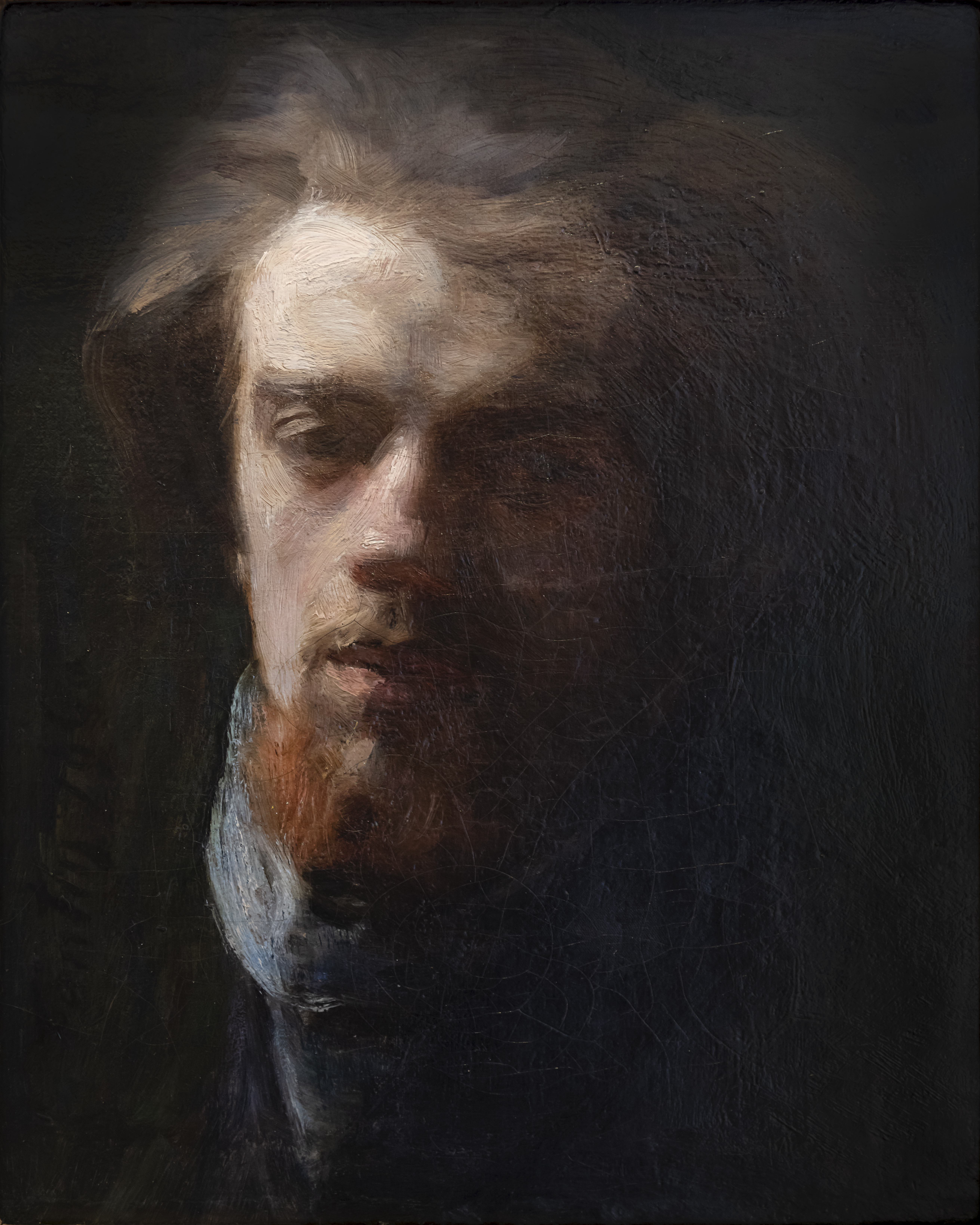
Why Henri Fantin-Latour matters
Henri Fantin-Latour occupies a distinctive place between Realism and the emerging modern movements of nineteenth-century Paris. He is best known for two bodies of work that still anchor his market and his museum presence today: intimate, closely observed flower still lifes, and large group portraits that document the circle of painters and writers around him, including contemporaries such as Manet and Whistler. For collectors, he offers a rare combination of deep, long-standing institutional presence in museums such as the Musee d'Orsay, the Metropolitan Museum, and the Tate, and a market built almost entirely on secondary sales rather than a single controlling gallery or estate.
- Born
- 1836-01-14, Grenoble, France
- Nationality
- French
- Media
- Painting, Lithography
- Movement
- Realism, Symbolism
- Education
- Petite Ecole (school of Lecoq de Boisbaudran), Paris, from 1850; brief, probationary attendance at the Ecole des Beaux-Arts, Paris, from 1854 (no permanent place awarded); briefly studied in Gustave Courbet's studio
- Signature motifs
- Flower still lifes, Group portraits of Parisian artists and writers
- Representation
- No confirmed primary gallery or estate representation as of 2026, Secondary market: Richard Green, London
By the numbers
- GBP 2.0MAuction highSotheby's, 2022; exact work, date, and sale location not independently confirmed
- 1857 to 1904Career spanLouvre copyist years to death
Selected works
Click any work to view it full screen.
Biography
Henri Fantin-Latour was born on 14 January 1836 in Grenoble, France, the son of the painter Theodore Fantin-Latour, who gave him his first drawing lessons. The family moved to Paris around 1850, where he enrolled at the Petite Ecole under Horace Lecoq de Boisbaudran and Louis-Alexandre Peron. In 1854 he was admitted to the Ecole des Beaux-Arts on a brief, probationary basis of only a few months and was not retained as a permanent student; contemporaries there included Edgar Degas, Alphonse Legros, and Jean-Charles Cazin, and he also spent time studying in Gustave Courbet's studio. Much of his early training came from copying old masters at the Louvre, a practice he continued for years.
He debuted at the Paris Salon in 1861 with fellow artists Whistler and Legros as the informal Societe des Trois, and showed at the Salon des Refuses in 1863 after official rejection, where he came into contact with Manet's circle. From 1866 his flower still lifes became a regular Salon presence, and over subsequent decades he submitted numerous paintings to the Royal Academy in London (a specific total figure is not independently confirmed here), building a strong following among British collectors. Trips to London, encouraged by Whistler, also connected him with the engraver Edwin Edwards and Francis Seymour Haden, from whom he learned printmaking; his later opera and fantasy themed lithographs, shown at the Salon from the 1870s (the exact year is not independently confirmed here), reflected this graphic work, which he considered among his most personal achievements. He married the painter Victoria Dubourg in the 1870s, and the couple spent summers at her family's estate at Bure in the Orne, in Normandy.
Fantin-Latour died on 25 August 1904 at Bure, at the age of sixty-eight; a minority source places the date three days later, but the weight of major museum and press sources supports 25 August. His death was reported at the time in the American press.
Critical reception
Fantin-Latour's reputation has rested for over a century on the same two pillars: his flower still lifes, prized for their restrained, closely observed realism, and his group portraits, which are treated by historians as first-hand visual records of the Parisian avant-garde circle he moved in without ever fully joining stylistically. His graphic work, particularly the opera and fantasy lithographs, has drawn separate scholarly attention as some of his most personal and least academic output. Institutional reassessment has continued well after his death, most notably with the 2009 retrospective organized jointly by the Museo Nacional Thyssen-Bornemisza in Madrid and the Fundacao Calouste Gulbenkian in Lisbon, which brought together paintings and drawings from museums and collections worldwide and was billed as the first Fantin-Latour retrospective held in Spain.
Market
Fantin-Latour's market is a steady, secondary-market trade rather than a primary-gallery business; no single gallery or estate currently represents his work, and pieces move through auction houses and long-established dealers such as Richard Green in London. His documented auction high is reported at GBP 2,000,000 at Sotheby's in 2022; the exact work, sale date, and sale location are not independently confirmed. A separately reported 2022 sale of a work titled Nature morte aux reines-marguerites achieved EUR 1,918,070, a different figure, and it is not confirmed whether this is the same transaction. Flower still lifes tend to command the strongest and most consistent prices, while other subjects, including portraits and figure compositions, trade more variably; recent sales reported by Heritage Auctions, Artsy, and HENI in the low hundreds of thousands of dollars illustrate the wider range beneath the record.
Top auction results
| Work | Price | Sale |
|---|---|---|
| Flower still life (exact title not independently confirmed) (2022) | GBP 2,000,000 | Sotheby's |
Selected exhibitions
| Years | Exhibition | Venues |
|---|---|---|
| 1861 | Salon debut with the Societe des Trois (with Whistler and Legros) | Paris Salon |
| 1863 | Salon des Refuses | Paris |
| 1866 to 1904 | Flower still lifes shown annually at the official Salon | Paris Salon |
| 1860s to 1880s | Paintings submitted to the Royal Academy, London (exact total not independently confirmed) | Royal Academy, London |
| 1870s | Opera and fantasy themed lithographs exhibited (exact Salon year not independently confirmed) | Paris Salon |
| 2009 | Fantin-Latour, 1836 to 1904 | Museo Nacional Thyssen-Bornemisza, Madrid |
| 2009 | Fantin-Latour, 1836 to 1904 | Fundacao Calouste Gulbenkian, Lisbon |
Museum collections
- Musee d'Orsay, Paris
- The Metropolitan Museum of Art, New York
- Art Institute of Chicago
- State Hermitage Museum, St. Petersburg
- National Gallery, London
- Tate, London
- Rijksmuseum, Amsterdam
Authentication and provenance
No catalogue raisonne.
No independently confirmed catalogue raisonne. Some sources reference a posthumous Catalogue de l'oeuvre complet associated with the artist, but its publication details could not be independently confirmed in current research. Works are currently verified through museum provenance records, Salon and Royal Academy exhibition history, and auction house cataloguing.
Primary reference: https://en.wikipedia.org/wiki/Henri_Fantin-Latour
What collectors should know
Because no catalogue raisonne has been independently confirmed and no single gallery or estate manages his work, provenance and exhibition history carry unusual weight when evaluating a Fantin-Latour painting; museum records, Salon and Royal Academy exhibition lists, and auction house cataloguing are the main tools available. Subject matter drives price more than for many artists of his period: flower still lifes are the most liquid and consistently valued category, while portraits and figure works see wider swings. Given the artist's long career and broad output across painting and lithography, collectors should also expect meaningful variation in condition and scale to affect value more than for artists with a tighter, more standardized body of work.
Further reading and resources
Data current as of 2026-07-09.

